How Germany's favorite mushroom can be grown without peat
Peat has traditionally been used in mushroom cultivation. However, its extraction harms the climate. Researchers in Saxony are therefore looking for an alternative to the growing medium on which the mushrooms grow.
Read Aloud
0:00
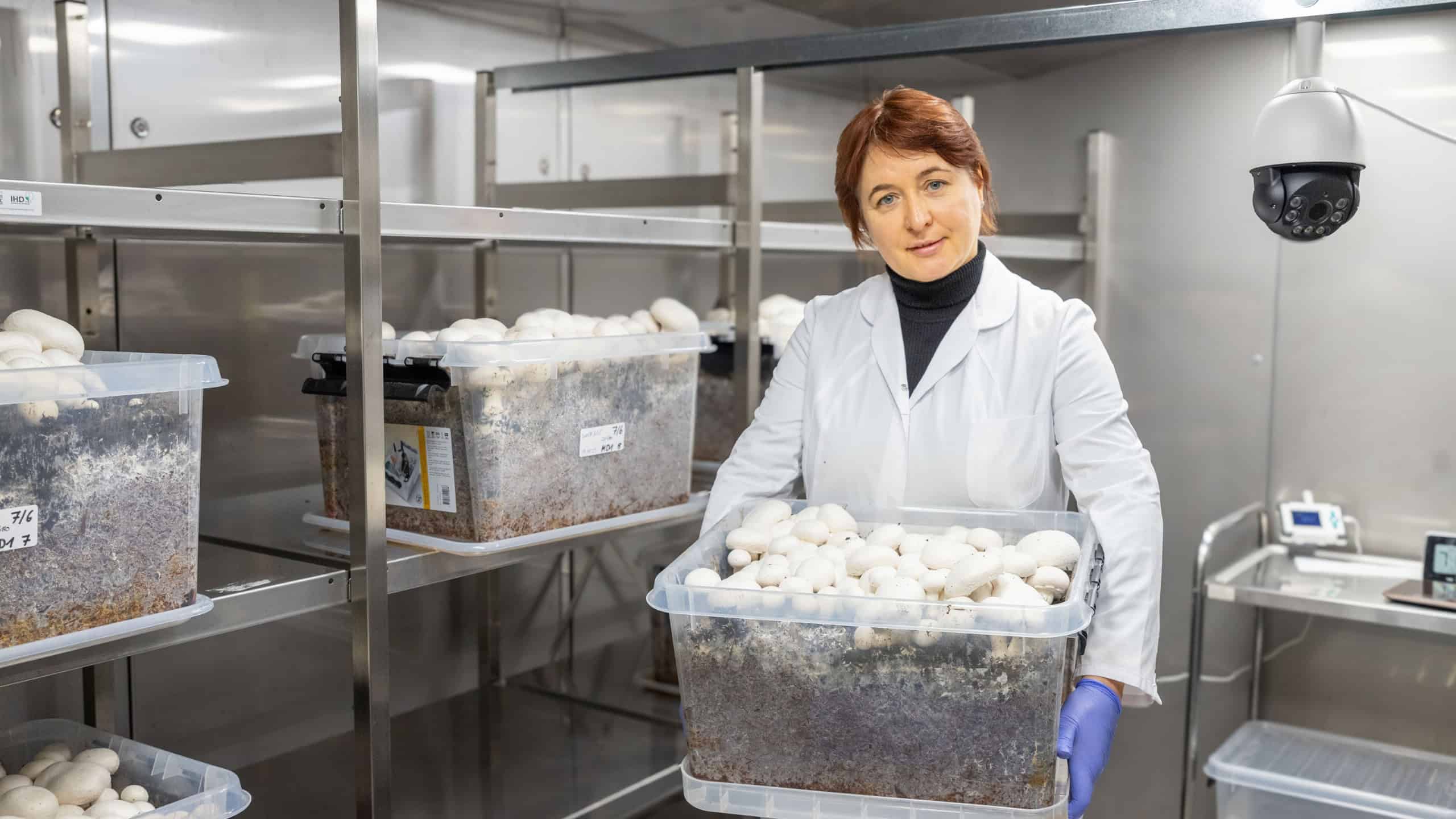
At the Dresden Institute of Wood Technology (IHD), Natalie Rangno is investigating how button mushrooms can be cultivated on peat-free growing medium. © IHD Dresden
Germans love button mushrooms. Each person here consumes about 1.9 kilograms of button mushrooms per year. In 2025, they accounted for nearly 98 percent of Germany’s edible mushroom harvest. No other edible mushroom is cultivated as frequently in Germany.
For button mushrooms to grow, the mushroom substrate in which they grow is not sufficient on its own. In cultivation facilities, there is a layer of covering soil several centimeters thick on top of it. This soil retains water, thereby creating the conditions in which button mushrooms thrive. Only under these conditions do they form their fruiting bodies. Until now, however, this soil has contained a lot of peat. That is set to change.
Peat forms over millennia in bogs and stores large amounts of carbon. When bogs are drained and peat is extracted and used, some of this carbon is released into the atmosphere as carbon dioxide. There, the greenhouse gas traps additional heat, causing the Earth to warm. For this reason, professional horticulture in Germany aims to use significantly less peat by 2030. But this requires materials that work just as well.
Natalie Rangno from the Dresden Institute for Wood Technology (IHD) is researching a solution. Together with the Dresden-based Fraunhofer Institute for Ceramic Technologies and Systems (IKTS) and LAV Erdenwerke in Markranstädt, she is working on a mulch that requires no peat at all.
120 mixtures for a new covering medium
That’s not so easy, though. Peat stores a lot of water while also ensuring good air exchange. “A substitute must also have these properties as much as possible,” explains the scientist. In the MykoDeck research project, Rangno and her partners began by examining 45 raw materials and waste products. From these, they produced 120 mixtures. In the end, they developed twelve formulations for peat-reduced or completely peat-free growing media. Three of these were tested by farms.
Basically, it worked. A mixture containing 50 percent less peat was used on brown button mushrooms at five farms. Reitzenhainer Pilzkorb GmbH, or ReiPiKo for short, tested two completely peat-free variants. After three harvest cycles, the yields were similarly high as with conventional peat-containing growing media. “We’ve now demonstrated on multiple occasions that the peat-free mixtures work on a small scale,” says Natalie Rangno. However, the trials also highlighted where there are still issues. Water management, in particular, is challenging. The peat-free soil dries out faster.
From the lab to large-scale mushroom farming
But can what works on a small scale be applied to large-scale mushroom farms? That’s exactly what the follow-up project, MykoDeckPro, is investigating. For LAV Erdenwerke, this is a major step. The company produces soils and substrates but had no experience with mushroom cultivation prior to MykoDeck. “We’re breaking new ground with this covering soil,” says Falko Windisch, who is responsible for research and development as well as product and quality management at the company. The experimental mixtures are intended to be developed into covering soils that can be produced in large quantities. To Windisch’s knowledge, the project partners are the only ones to completely avoid using peat.
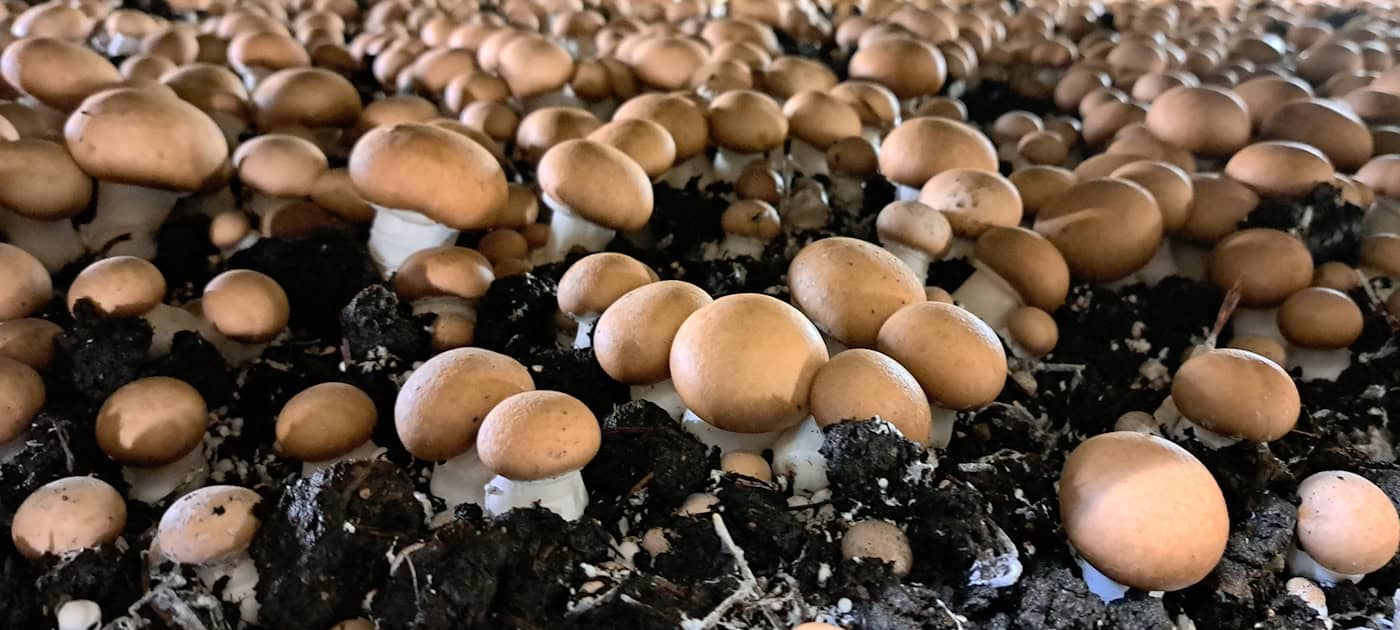
Model farms affiliated with the German Association of Button Mushroom and Cultivated Mushroom Growers are testing the new covering soil under real production conditions. A key question is how much water the peat-free soil requires. Rangno and her team are developing clear recommendations on the amounts of water needed to achieve the necessary moisture levels. But it’s not just the covering soil that might change. The transition also means new procedures for mushroom growers. “Producers first have to learn how to work with the new covering medium,” says Windisch.
Three partners for the field test
In the project, the partners share the tasks. Among other things, Rangno and the IHD are optimizing the formulations and conducting biological and chemical analyses of the cover soils. LAV Erdenwerke is working on the production processes and on achieving consistent quality in larger quantities. The Fraunhofer IKTS is examining raw materials and production conditions, among other things, and providing scientific support for the development.
The latest trials have given Natalie Rangno cause for optimism. The results look good, she says. But in the end, it won’t be enough if button mushrooms simply grow on the peat-free growing medium. It must also be producible in large quantities and perform reliably. It’s important that it fits into the mushroom growers’ workflows. Only then will it become clear whether the mixture from the lab also works on a large scale.