

What flavoring agents have to do with solar cells
Materials from the food industry could replace problematic chemicals in the manufacture of solar cells. Researchers in Dresden have used computer models to identify suitable candidates and have produced the first cells using them.
Read Aloud
0:00
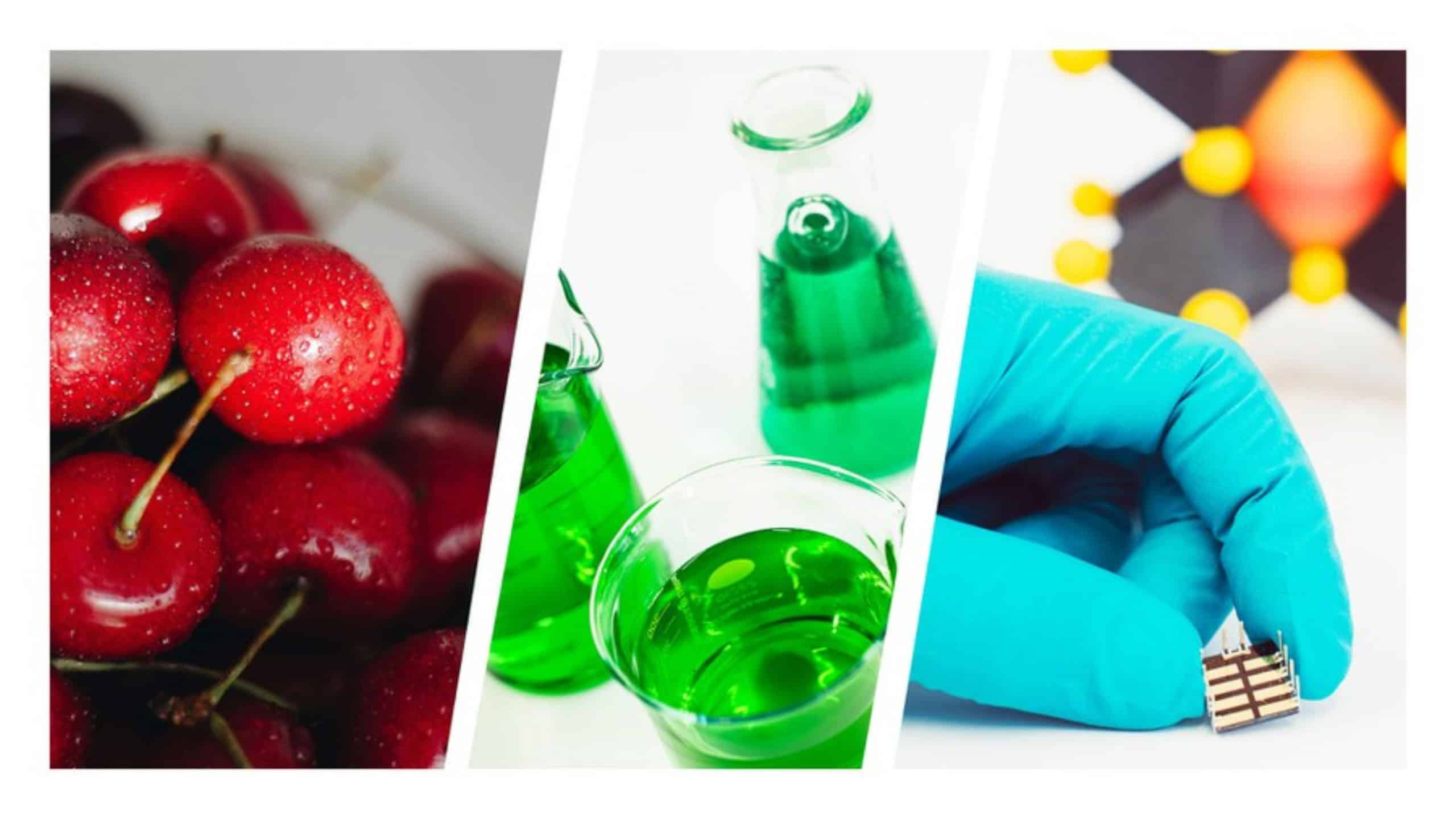
From the food industry to solar cells: Researchers in Dresden are investigating solvents that could serve as less harmful alternatives for the production of perovskite solar cells. © Collage featuring material by Anna Bratiytchuk (left) and Ekaterina Ananina
Flavoring agents provide taste and aroma in foods. Some of the substances used for this purpose could take on an entirely different role in the future: as solvents in the manufacture of solar cells. Researchers at the Technical University of Dresden (TUD) and the Leibniz Institute for Solid State and Materials Research Dresden (IFW) are thus searching for less harmful alternatives to the chemicals used to date.
The focus is on so-called perovskite solar cells. They are considered promising for photovoltaics because they can achieve high efficiency. During their production, the raw materials are processed in solvents. Many of the substances used to date can harm human health and the environment. However, finding substitutes is difficult, as the solvent influences how the materials can be processed and how well the finished solar cell functions.
However, all of this considers only one part of the manufacturing process. How environmentally friendly a solar cell is overall also depends on the other materials used, the production process, its lifespan, and recycling.
Computers instead of trial and error
Until now, the search for suitable solvents has required numerous laboratory experiments. The Dresden researchers want to reach their goal more quickly. Together with a team from the Universidad Nacional del Sur in Argentina, they are using various physical and chemical computer models. These models calculate which solvents might be suitable. Only then do laboratory tests begin.
And indeed, the researchers identified new candidates using this approach. Among them are substances that are also used as food additives. They then used these to manufacture solar cells. The performance of these cells was comparable to that of cells made using conventional, problematic solvents.
So far, the process has been tested in the lab. It remains to be seen whether the new solvents are also suitable for the large-scale production of solar cells. The method could facilitate the search for further alternatives. Not every substance would need to be tested in the lab first. This could reduce the number of experiments required.
Recycling also in focus
The work is part of the REC² Cluster of Excellence at TUD. There, researchers are investigating how electronics can be made more sustainable – from manufacturing through to recycling.
The search for suitable solvents is not yet complete. Next, the researchers want to find out whether less harmful solvents also offer advantages in the recycling of perovskite solar cells. Their method could also be applied to other electronic components that require solvents for their manufacture.
Original publication:
J. R. Bautista-Quijano, H. Heffner, V. V. Shilovskikh, B. Rivkin, I. López Corral, Y. Vaynzof, A predictive approach for fabricating efficient perovskite solar cells using green solvents, Energy & Environmental Science (2026).