Delivery robot ROSEE travels from Freiberg to Dresden
Researchers at the TU Bergakademie Freiberg sent ROSEE to Dresden. On dirt roads, village streets, and in city traffic, it was supposed to demonstrate how well it could navigate on its own. It didn't quite manage without any help.
Read Aloud
0:00
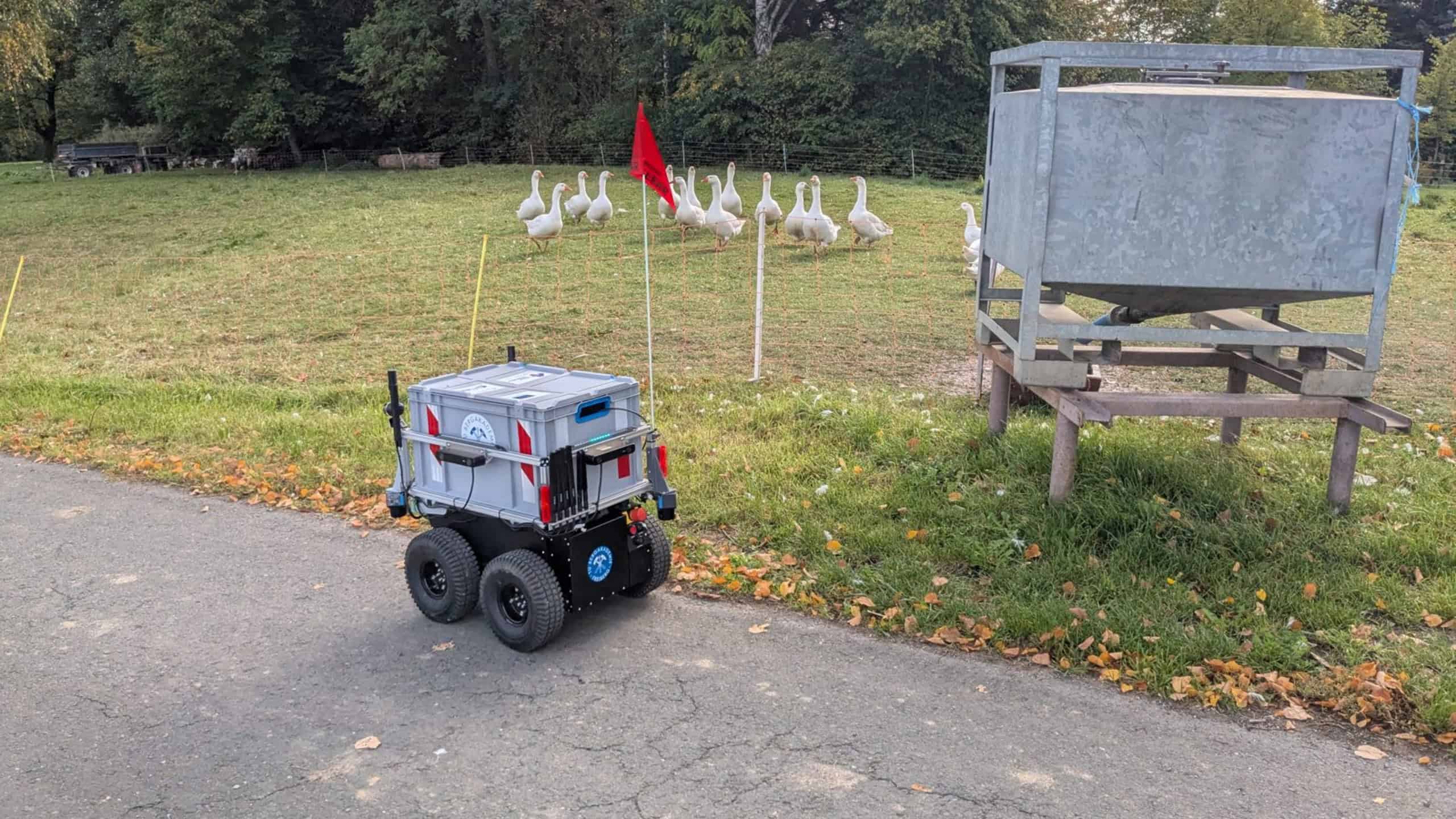
Robot Meets Geese: On its trip to Dresden, the delivery robot ROSEE was set to demonstrate how well it can navigate unfamiliar terrain. © Sebastian Zug/TUBAF
The nearest supermarket is a few villages away, and the bus runs infrequently. Without a car, getting there is a challenge. For many people in rural areas, this is everyday life. Could robots deliver groceries here someday? Researchers at the TU Bergakademie Freiberg want to find out what capabilities such vehicles would need to make this possible. To test this, they sent their delivery robot, ROSEE, from Freiberg to Dresden.
One day in early October, ROSEE set off at 7:15 a.m. from the RoboLab in Freiberg. Its destination: the 4transferLab in Dresden. Accompanied by a research team, she set off at about five kilometers per hour – roughly walking speed. She covered about 25 kilometers on her own wheels. She completed the rest of the route using, among other things, the streetcar. ROSEE arrived in Dresden at 6:50 p.m.
Dirt road, meadow, village street
Until now, ROSEE had mainly been on campus and in Freiberg. On the trip to Dresden, she had to navigate unfamiliar terrain. For the researchers, this raised important questions. Is a hilly dirt road passable? Where does the path end and an obstacle begin? And how does the robot navigate through narrow passages or across streets without sidewalks?”
ROSEE perceives its surroundings using its technology and adapts its driving style accordingly. She navigated parts of the route autonomously. Where that didn’t work, the research team took over control. In Dresden’s evening rush hour, driving on her own wheels finally came to an end. ROSEE took the streetcar.
“In the lab, we can simulate many situations. But it’s only under real-world conditions that we can see how reliably a robot understands its environment and makes decisions,” says Prof. Sebastian Zug of the TU Bergakademie Freiberg. The situations in which ROSEE needed assistance are particularly valuable for further research.
Delivery robots need more than just good sensors
In some parts of other countries, delivery robots are already a common sight on the streets. In April 2026, the company Starship Technologies reported more than ten million deliveries worldwide. Its small vehicles are primarily on the move in cities and on university campuses. Conditions are different in rural areas.
Roads can be uneven, sidewalks are often absent, and the distances between potential customers are greater. ROSEE’s trip was intended to show how a robot copes with such situations. The test was not yet a regular delivery.
There are also legal issues. So far, there are no clear rules in Germany governing the commercial use of autonomous delivery robots. According to Starship, only temporary trials with special permits are currently possible.
The TUBAF Innovation Center is also working on solutions for practical application in collaboration with Dresden’s 4transferLab. They bring together researchers, local governments, and authorities. The insights gained from the trip will now help improve ROSEEs’ navigation. The next trial is already planned for 2027. By then, the robot should be able to complete the entire route without human control, if possible.
See highlights from ROSEE’s journey here.