
Electricity from Waste Heat: Dresden Researchers Turn to Carbon Dioxide
In factories, large amounts of heat are lost without being utilized. A new research group at the Helmholtz Center Dresden-Rossendorf aims to change that. Using high-pressure carbon dioxide, the group hopes to generate electricity from waste heat or make the heat reusable for industrial purposes.
Read Aloud
0:00
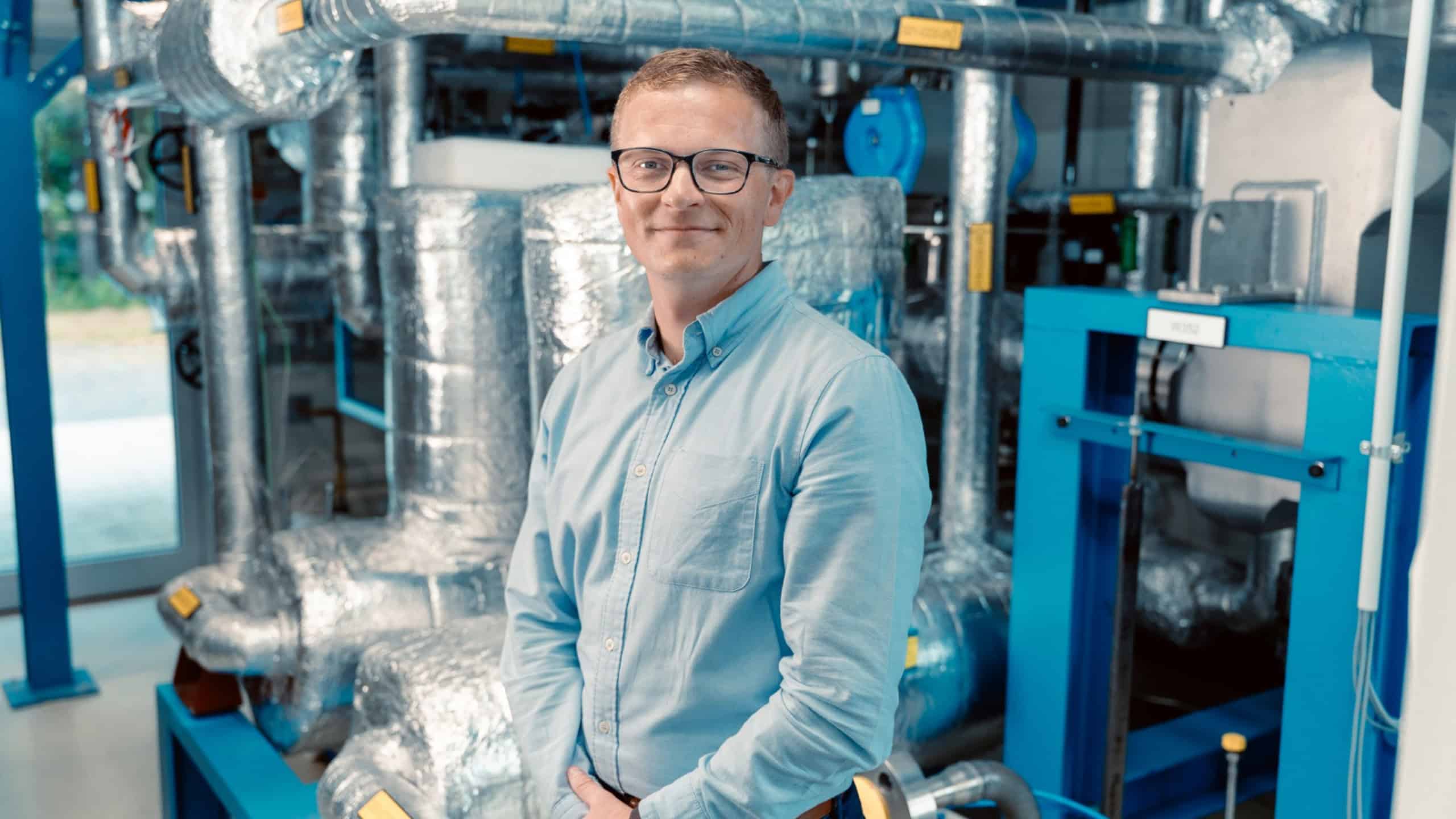
Dr. Riley Barta is conducting research at the Helmholtz Center Dresden-Rossendorf on how carbon dioxide can be used to make better use of industrial waste heat. Here, he stands in front of the CARBOSOLA test rig, where the technology is being studied. © HZDR/K. Zheynova
Anyone who cooks pasta knows this: The pot has long since been set on the table, but the stovetop is still hot. This heat is lost without being put to use. In industry, this happens on a massive scale. Steel mills, paper mills, and refineries release large amounts of heat into their surroundings. In the EU alone, estimates suggest that around 300 terawatt-hours of industrial waste heat could be harnessed annually. That’s more than half of Germany’s total electricity consumption. However, only a portion of this heat can actually be tapped.
A new research group at the Helmholtz-Zentrum Dresden-Rossendorf (HZDR) aims to investigate how such heat can be better utilized. To do so, it is focusing on a substance everyone is familiar with: carbon dioxide.
When carbon dioxide changes its properties
We normally think of carbon dioxide as a gas. When it is heated to high temperatures and subjected to high pressure, its properties change. It is then neither an ordinary gas nor an ordinary liquid. Researchers call this state “supercritical.” In this state, carbon dioxide is suitable as a working fluid for converting heat into electricity. It absorbs a factory’s waste heat and flows through a turbine. This drives a generator that produces electricity.
Such systems could generate more electricity from the same amount of heat than conventional systems using steam. Under favorable conditions, efficiency can be increased by up to ten percent. In addition, the technology can be built in a more compact design.
But it also works the other way around. With the help of electricity, carbon dioxide can raise heat to a higher temperature. This would allow a factory to reuse waste heat that is too cool for its production processes. This would be particularly interesting when a lot of wind or solar power is available.
Stress test in Rossendorf
A team led by Dr. Riley Barta will investigate how well this works under varying conditions. The scientist has previously conducted research at TU Dresden and was most recently a professor at Purdue University in the U.S. His new research group will begin work at the HZDR in October 2026. It will have 1.75 million euros at its disposal for the next five years.
“We want to find out how these cycles can operate efficiently and reliably even when the available waste heat or electricity demand fluctuates. That is precisely what matters for their practical application,” explains Barta. After all, things don’t always run the same way in a factory. Sometimes production is higher, sometimes lower. The amount of available waste heat changes accordingly. The systems must cope with this without constantly breaking down or consuming unnecessary energy.
To do this, the team uses a test facility at the HZDR. There, the researchers can generate temperatures of up to 500 degrees Celsius and a pressure of 300 bar—which is about 300 times normal atmospheric pressure. They are also investigating what happens when other substances mix with the carbon dioxide and thereby alter the plant’s performance.
Storing electricity for later use
The group is also working on another application. When wind turbines and solar panels generate more electricity than is currently needed, this excess could be used to force carbon dioxide deep into suitable rock layers under high pressure.
If needed, the carbon dioxide could be extracted again. There, it would be heated using previously stored heat and drive a turbine that generates electricity. Whether this can be implemented reliably and economically is still the subject of research. Other projects have already demonstrated that supercritical carbon dioxide is, in principle, suitable for electricity generation. In Texas, a large pilot plant has fed electricity into the grid. In China, a steel mill has been using the technology since late 2025 to generate electricity from waste heat.
The Dresden researchers now want to find out how such plants can function effectively even when conditions are constantly changing. Their findings are intended to help further develop the technology for use in factories.