

Solar cells: How to capture more sunlight
Solar cells are still far from fully utilizing the sun's energy to convert it into electricity. Researchers in Dresden have calculated how a wafer-thin material could change that.
Read Aloud
0:00
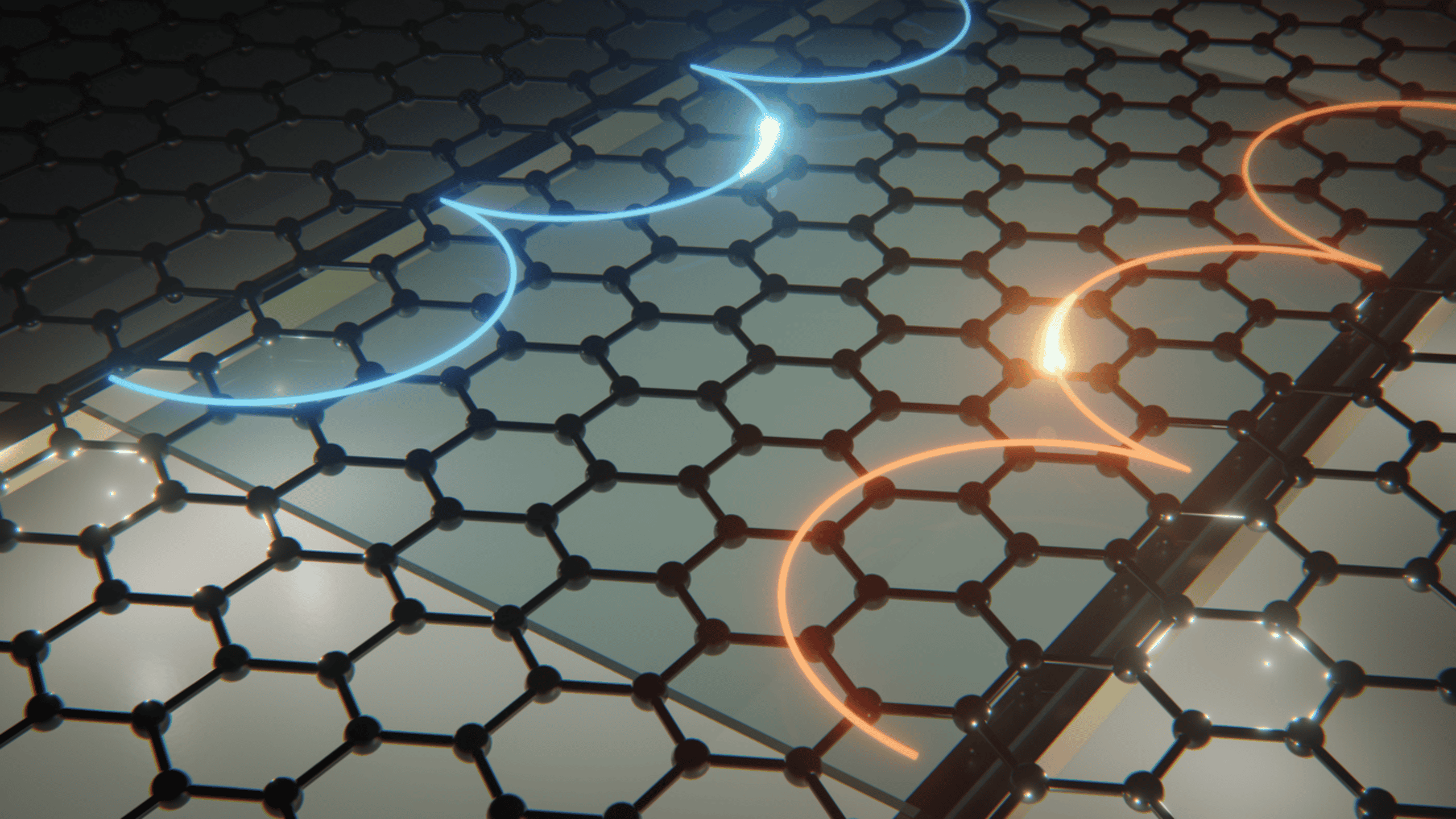
Invisible Guardrails: A magnetic field and electrical voltages are intended to separate the electrical charges in graphene from one another. This could allow more sunlight to be converted into electricity in the future. © Graphic: B. Schröder/HZDR
They are generating electricity from the sun on more and more rooftops. But solar cells cannot convert all sunlight into electricity. Some of the energy goes unused. This also applies to infrared radiation, which we perceive as heat. Researchers at the Helmholtz-Zentrum Dresden-Rossendorf (HZDR) are now exploring an idea for how to harness some of this radiation as well. To do so, they are turning to graphene, an ultra-thin material.
Graphene consists of carbon and is an exceptionally good conductor of electricity. It can also absorb light that has too little energy for silicon solar cells. But so far, there’s been a problem: the absorbed light energy cannot be readily used as electricity. To do so, the electrical charges generated by the light would have to be separated from one another.
Invisible guardrails for electricity
This is precisely what the Dresden researchers have devised. They aim to steer the electric charges in different directions using a magnetic field and strategically applied voltages. Much like guardrails that guide vehicles on a road.
To do this, very thin metal strips are to be attached above or below the graphene. When a voltage is applied, invisible barriers are created. Together with the magnetic field, these barriers ensure that the different electric charges move away from one another and reach different contacts. This would allow the energy from the absorbed light to be harnessed as electricity.
The researchers could then adjust the voltages to influence the path the charges take. The system could thus be adapted to light of varying energy.
It’s still just a theoretical calculation
So far, the researchers have only calculated how their idea might work. A corresponding experimental setup does not yet exist. However, the necessary components are already available. Even a standard permanent magnet could suffice. To capture more light, multiple layers of graphene could be stacked on top of one another and combined with mirrors. This would allow the light to pass through the thin layers multiple times.
In the long term, the technology could be of interest for solar cells that convert previously unused infrared radiation into electricity. Other possible applications include light sensors and electronic components. Now, the HZDR plans to test the idea experimentally.
Facts to share:
Solar cells cannot convert all of the sunlight into electricity. Researchers from Dresden have an idea for how we might harness this energy in the future. To do so, they’re relying on graphene, an extremely thin material. Experiments will have to show whether this works.
Original publication:
J. Josiek, F. Queisser, S. Winnerl, R. Schützhold: Magnetophotoelectric effect in graphene via tailored potential landscapes, in Physical Review Applied, 2026