

Flexible ceramic armour for lighter protective vests
Ceramic can stop bullets, but it is rigid. Four Fraunhofer institutes are developing flexible armour made from small, interlocking ceramic elements.
Read Aloud
0:00

During dangerous operations, police officers wear protective vests that may also contain hard ceramic plates. Researchers in Dresden are now developing a more flexible alternative made up of many small ceramic modules. © pixabay
A protective vest can save lives. Police officers wear them, as do soldiers in the German armed forces. But they also need to be able to move freely. Many protective vests designed to stop rifle fire contain hard ceramic plates. These can stop even rifle bullets, but their rigidity restricts movement.
Four Fraunhofer institutes, including the Fraunhofer Institute for Ceramic Technologies and Systems IKTS in Dresden, want to change that. In the ArMorph project, they are developing armour made from many small ceramic elements that could adapt to the shape of the body. The technology could also be used to protect vehicles.
Building blocks that interlock
Ceramic is hard and relatively lightweight. When a bullet strikes it, the ceramic can damage or even break up the projectile. Often, the ceramic itself fractures in the process. A layer behind it helps catch fragments and absorb some of the remaining impact energy.
But a large ceramic plate cannot bend. Anyone who has ever tiled a curved wall will recognise the problem. Large tiles do not fit neatly around curves. Small mosaic tiles do. The new armour is designed to work in much the same way. The researchers are developing small ceramic elements that interlock like three-dimensional puzzle pieces. They support one another while allowing the armour to follow curved surfaces.
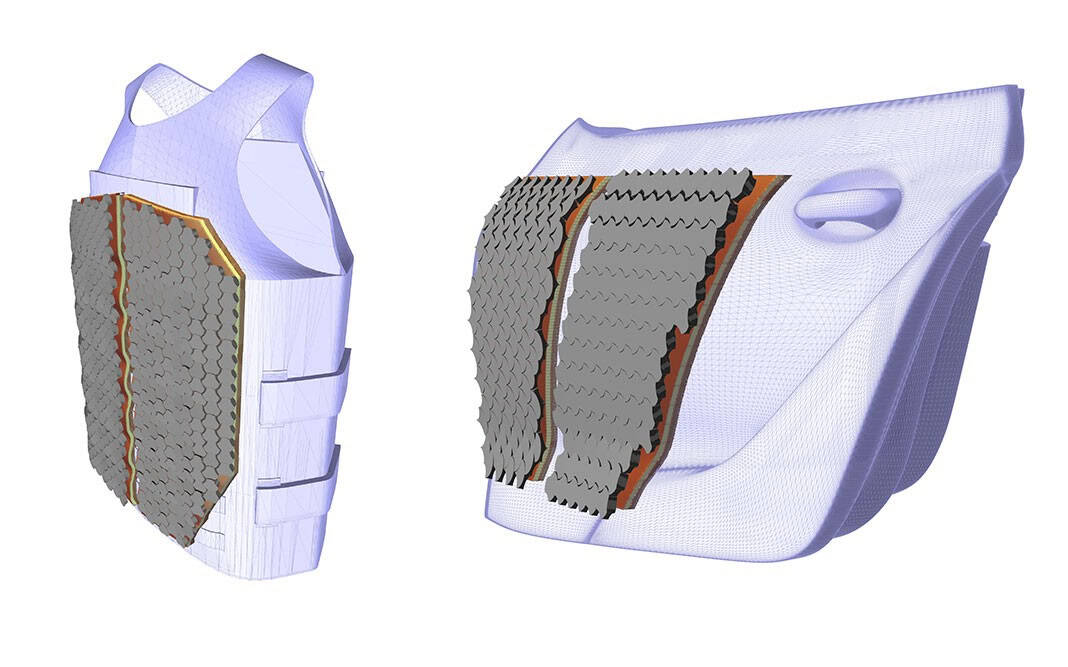
The IKTS team is developing the ceramic elements and using computer models to work out their optimal shape. They are mounted on a flexible backing made from polymer fibres, which Fraunhofer ICT near Karlsruhe is developing.
Fraunhofer IGP in Rostock is working on elastic adhesives and methods for manufacturing larger components. Fraunhofer EMI in Freiburg is responsible for simulations and ballistic testing. Because the armour consists of individual elements, it should also be easier to repair and recycle.
Inspiration from nature
The basic idea is not new. Fish have scales, while armadillos have armour made up of hard plates. Yet both can still move. Researchers have been studying these natural forms of protection for years, looking for ways to apply similar principles to man-made armour.
Just how difficult that can be became clear around 20 years ago in the US. A protective vest called Dragon Skin, made from overlapping ceramic discs, was designed to protect soldiers. But it failed tests conducted by the US Army in 2006.
According to the Army, the adhesive bonds could not withstand extreme temperature changes. The ceramic discs shifted, leaving dangerous gaps in the protection. The manufacturer disputed the Army's findings at the time.
For ArMorph, the question is therefore how reliably the individual elements will stay connected to one another and to the backing material. Tests will have to show whether the new system can withstand the demands placed on it.
The researchers plan to develop two prototypes, among others, by February 2029. One is a flexible insert for protective vests designed to meet Germany's SK4 ballistic protection standard. It is intended to withstand certain types of armour-piercing rifle ammunition while weighing less than 35 kilograms per square metre.
The second prototype is a shaped armour component for specially protected vehicles, designed to meet the VR7 ballistic protection standard. It is intended to be significantly lighter than comparable steel armour.
The Fraunhofer Society is funding the project with around €3.5 million. The participating institutes also hope to reduce Europe's dependence on other countries when it comes to developing advanced protective materials.
Facts to share:
Some protective vests contain hard ceramic plates that can even stop rifle bullets. But these plates are rigid. Researchers in Dresden are now developing armour made from small ceramic pieces that fit together like a puzzle. The aim is to provide protection without restricting movement as much.