
Smart sensors detect faults in industrial presses
Errors during the stamping of sheet metal parts can be costly. Researchers at Fraunhofer IWU in Chemnitz have partnered with a company to develop sensors that detect irregularities during production.
Read Aloud
0:00
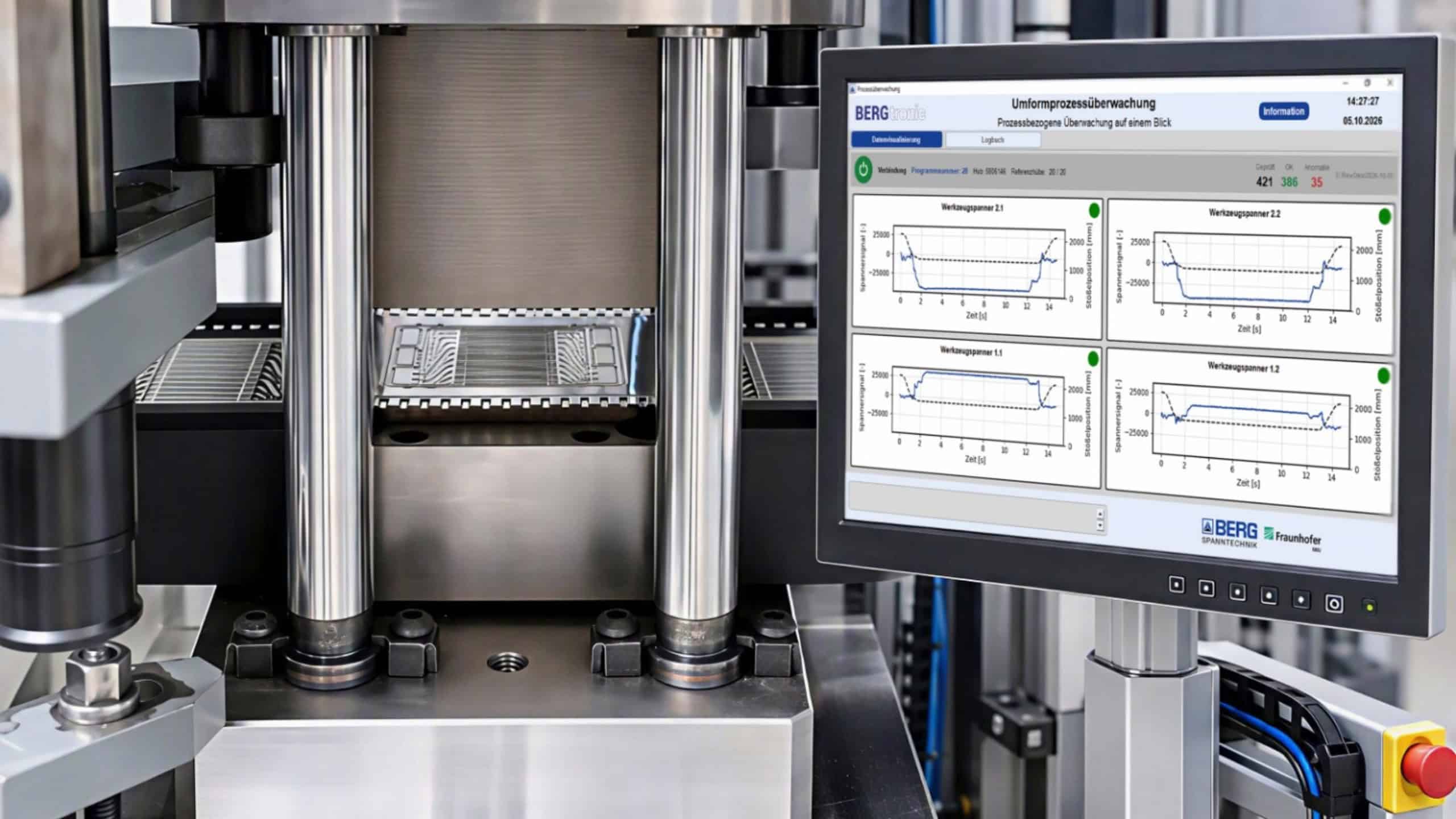
The software developed at Fraunhofer IWU analyzes sensor data from industrial presses. This makes it possible to detect irregularities during production and more easily identify defective components. © Fraunhofer IWU
Whether it’s a car door, a washing machine, or a refrigerator: Many everyday products contain sheet metal components. Large presses shape them with tremendous force. If something goes wrong during this process, defective parts are produced or production comes to a halt. Researchers at the Fraunhofer Institute for Machine Tools and Forming Technology (IWU), in collaboration with Berg & Co. GmbH Spanntechnik, have developed a solution designed to detect such problems during production. The sensor-based technology is now ready for the market and can also be retrofitted into older machines.
The focus is on so-called tool clamps. They hold the tool securely in the press and are thus positioned very close to the action. The experts have integrated a small sensor module into these clamps. It measures minute deformations on the press ram – that is, the part of the machine that presses the die onto the sheet metal. The measured values reveal whether the pressing process is proceeding as intended or whether irregularities are occurring.
The system is called BERGtronic. The sensors can also be retrofitted to existing tool clamps with minimal effort. A new press is not necessary for this.
A Memory for Errors
The monitoring software comes from Fraunhofer IWU. It evaluates the sensor data during production and automatically defines the range within which the measured values are normally allowed to fall. If they deviate from this range, the program detects an irregularity. Employees can respond to this, if necessary, even after a single pressing operation.
The software also keeps track of anomalies. It stores detected deviations in a log and compares new errors with previous events. This can help identify the cause of a problem more quickly. The system can even detect errors in the tool itself. No specialized knowledge of data analysis is required to operate the system.
In Use at an Automotive Supplier
“The sensor-based clamping technology can be integrated into presses regardless of the control concept. It takes very little effort to determine whether a machine is suitable for retrofitting and whether the solution fits the planned monitoring task,” says project manager Mohaned Alaluss from Fraunhofer IWU.
The system is already in practical use. At the automotive supplier Magna Body & Chassis Germany GmbH, the system has been operating under production conditions since March 2026. There, it is used in a process known as press hardening. In this process, hot steel is shaped and then rapidly cooled. This produces particularly strong components, such as those needed in automotive manufacturing.
The new monitoring system is designed to help detect defective parts early on and prevent unplanned machine downtime. The available data does not indicate to what extent this will actually reduce scrap or downtime.