
Minus 269°C for the quantum computers of the future
Quantum computers require extremely low temperatures. In Chemnitz, researchers can now test materials and electronic components at extremely low temperatures in a new laboratory.
Read Aloud
0:00
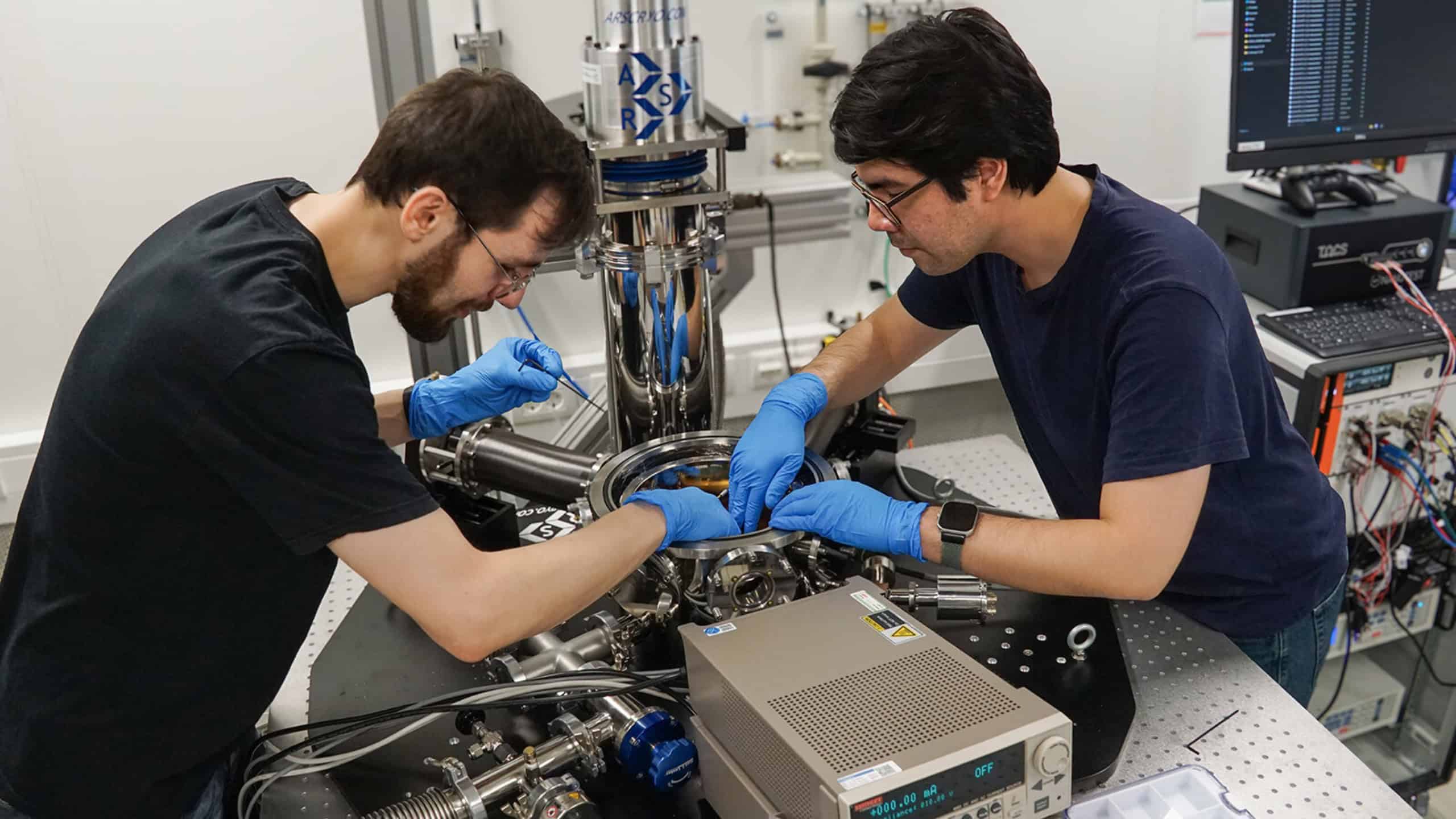
David Walther (left) and Carlos Rincon from Chemnitz University of Technology are installing a new test rig in a helium cryostat. This will allow them to study how thin layers of material behave at temperatures ranging from minus 269 to plus 25 degrees Celsius. © Dr. Uwe Zschenderlein
In freezing weather, cell phone batteries drain faster. Many devices don’t handle the cold well. In Chemnitz, researchers are now deliberately exposing components to freezing temperatures. In their new cold laboratory, CRYME, they are testing materials and electronic components at temperatures as low as minus 269 degrees Celsius. The reason for this is quantum computers, a new type of computer.
The Fraunhofer Institute for Electronic Nanosystems ENAS in Chemnitz and Chemnitz University of Technology established the lab in collaboration with partners from the Research Factory for Microelectronics Germany.
Computing just above absolute zero
Some quantum computers use tiny particles that must remain as undisturbed as possible. To do this, electrically charged atoms are held in place by electric fields and cooled to less than minus 263 degrees Celsius. It hardly gets any colder than that. Absolute zero is around minus 273 degrees.
Industry and science aim to build such computers on a smaller scale. However, this requires that materials and electronic components function reliably even in extreme cold. “That’s why it’s essential to test components and materials under realistic conditions,” says Prof. Dr. Daniel Kriesten. He heads the European Test and Reliability Center (ETRC), of which the new laboratory is a part.
The ETRC tests how reliably semiconductor devices operate. The new laboratory is part of this effort. There, researchers investigate, for example, how extreme cold affects materials and whether electronic components function as intended under these conditions.
Microscope for extreme cold
Fraunhofer ENAS has purchased new equipment with funding from the Federal Ministry of Research. This includes two cryostats, which are specialized cooling devices. A testing system measures how materials behave in cold conditions. A specialized scanning electron microscope enables material analysis at extremely low temperatures. Some of the devices are powered by liquid helium from the new facility at the neighboring Institute of Physics.
The laboratory is located at the MAIN Research Center at Chemnitz University of Technology. “As a key technology of the 21st century, quantum computing also stands for technological leadership, high-caliber jobs, and cutting-edge research,” says Prof. Dr. Bernhard Wunderle of Chemnitz University of Technology. Companies are also taking notice. “Several companies have expressed interest in collaborating. Concrete cooperation projects have already been launched, and further initiatives are in the planning stages,” says lab director Dr. Remi Pantou of Fraunhofer ENAS.