
How tiny diamonds are made from plastic
A high-power laser strikes plastic, creating tiny diamonds. Researchers from Dresden and Rostock are now able to collect them and plan to increase production.
Read Aloud
0:00
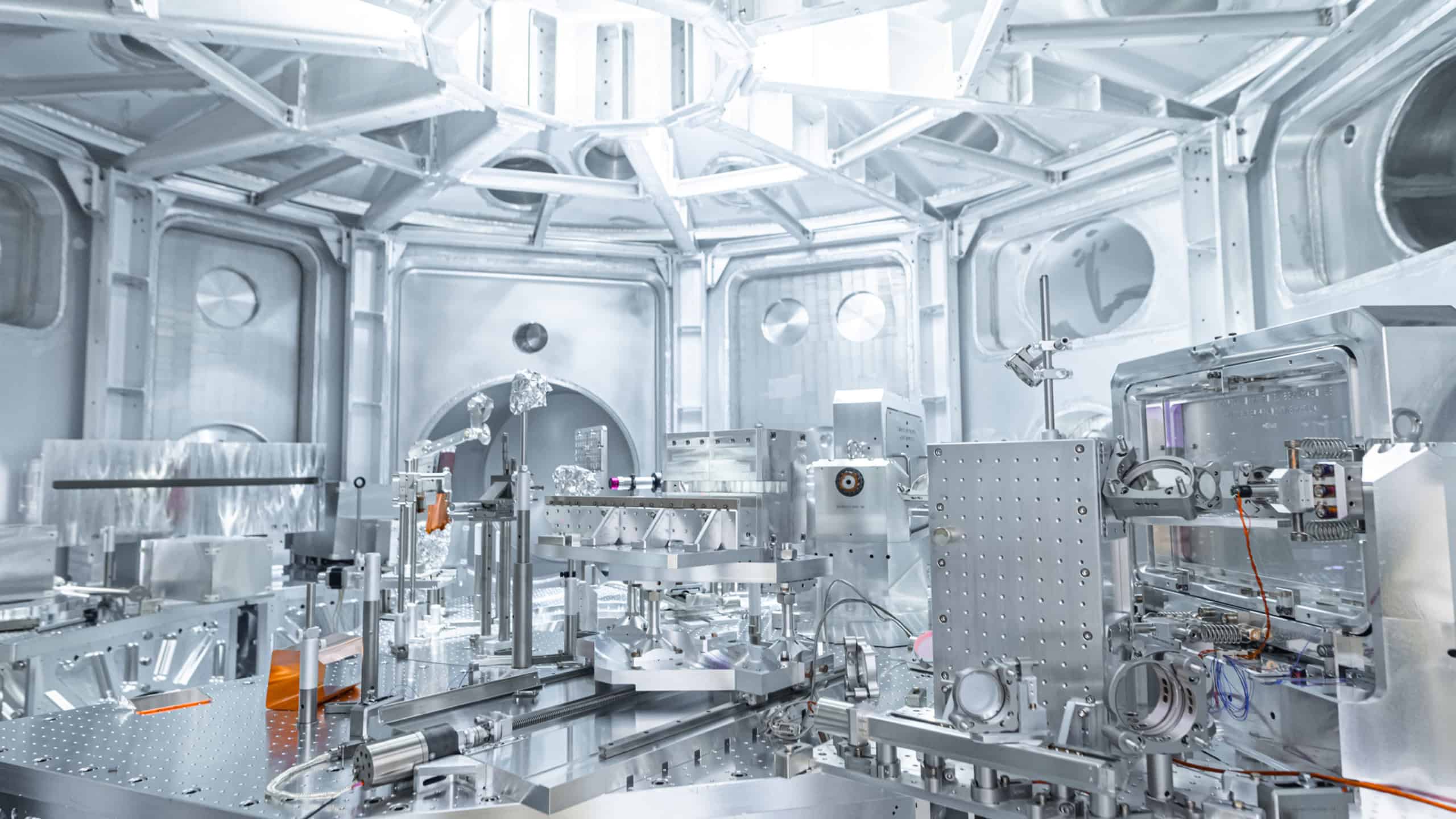
At the ELI Beamlines facility south of Prague, researchers from Saxony used a high-power laser to create nanodiamonds from plastic. © ELI Beamlines
Everyone knows diamonds as sparkling jewelry. However, the diamonds produced by researchers in Dresden and Rostock are invisible to the naked eye. They are only a few nanometers in size. Such nanodiamonds could be used, for example, in medicine, as tiny sensors, or as catalysts. The team from the Helmholtz-Zentrum Dresden-Rossendorf (HZDR) and the University of Rostock has now succeeded in specifically producing particularly small and nearly uniform nanodiamonds and then capturing them.
Originally, the experiments were not intended to develop a new production method at all. The researchers wanted to find out what happens inside distant planets like Neptune or Uranus. To do this, they fired high-power lasers at plastic and compressed it. This briefly created temperatures of several thousand degrees Celsius and a pressure millions of times higher than normal atmospheric pressure. Under these conditions, the carbon in the plastic can bond to form diamond.
From planetary physics to practical applications
“We had expected nanodiamonds to form under these conditions. What surprised us, however, was how quickly they form,” says Dominik Kraus, founding director of the HEDI Institute at HZDR and professor at the University of Rostock. This raised the question of whether nanodiamonds could be produced in a controlled manner using this method.
One problem remained unresolved at first. Although the researchers were able to detect the diamonds under the extreme conditions, they did not know whether the tiny particles would persist under normal pressure and temperature. They have now been able to demonstrate exactly that.
The experiments took place at the Extreme Light Infrastructure (ELI) south of Prague. There, a high-power laser fires three times per minute at a plastic film just 100 micrometers thick. Nanodiamonds form in the resulting shock wave and are ejected from the film.
Ten trillion diamonds per laser pulse
The nanodiamonds reach speeds of more than ten kilometers per second. That’s equivalent to the speed of a meteorite impact. Upon impact, the tiny diamonds could be destroyed instantly. That’s why they land in a soft, water-soluble gel.
About ten trillion nanodiamonds arrive there with each laser pulse. That only sounds like a lot until you consider their size. On average, a diamond measures just three billionths of a meter and consists of about 3,000 carbon atoms. The researchers needed about 100 laser pulses to collect a few hundred micrograms of material. This amount was sufficient to examine the diamonds using an electron microscope at the University of Rostock.
The next step is to produce more material. High-power lasers capable of firing many pulses in a short time are expected to increase the yield. Initially, the researchers aim to reach the milligram range. Nanodiamonds are already used today in grinding and polishing agents, for example. These particularly small and specifically modified diamonds could enable further applications: as quantum sensors, medical contrast agents, or catalysts.
Original publication:
B. Heuser, P. Böhringer, K. Oldenburg, F.P. Condamine, G. Fauvel, M.-L. Herbert, J. Kuhkle, T. Laštovička, P. Luckmann, J. Lütgert, P.T. May, D. Ranjan, S. Schumacher, R. L. Singh, M. Stevenson, S. Weber, D. Kraus, "Recovery of ultrasmall nanodiamonds from plastics shock-compressed to pressures around 100 GPa," in Diamond and Related Materials (2026)