

Electricity from tapping: A flexible sensor film from Chemnitz
It’s paper-thin and serves two purposes. Researchers at Chemnitz University of Technology have developed a film that measures pressure and generates electrical energy from motion. Here’s what it’s good for.
Read Aloud
0:00
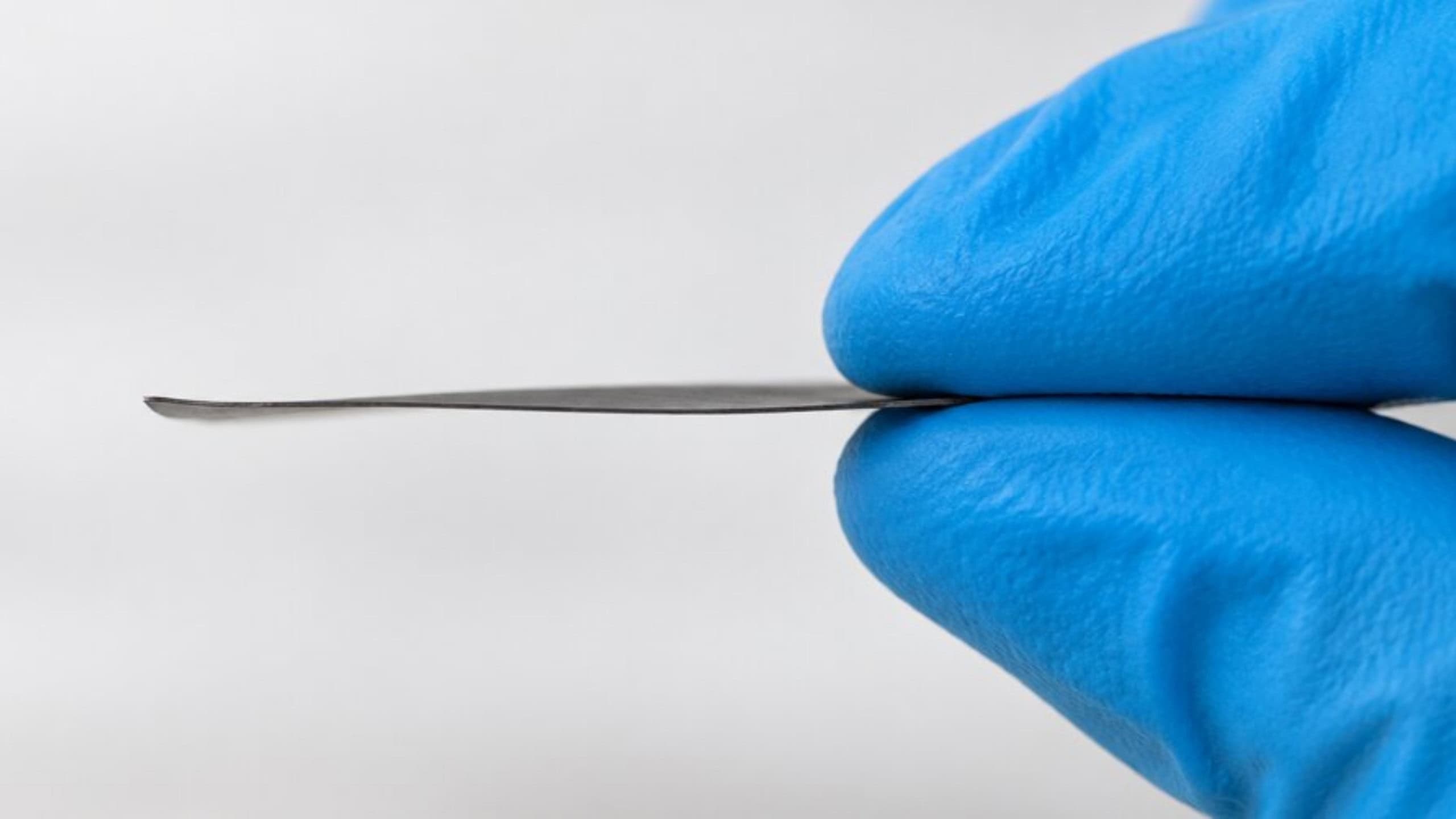
Caption: Measures pressure and generates energy: This wafer-thin nanocomposite film was developed at Chemnitz University of Technology. © Chemnitz University of Technology
The smartwatch counts steps, and the sensor patch on the arm measures health metrics. But such devices need power, and eventually the battery runs out. Researchers at Chemnitz University of Technology have developed a flexible film that measures pressure and generates electrical energy at the same time. It is only about 40 micrometers thick – thinner than a human hair.
The film can do two things: measure pressure and generate electrical energy from movement. When pressed evenly, its electrical resistance changes. This allows the strength of the pressure to be measured. If, on the other hand, it is subjected to repeated stress – such as tapping or vibration – electrical voltage is generated. Experts refer to the first effect as piezoresistivity and the second as piezoelectricity. Until now, materials for these two functions were usually developed separately.
Three ingredients, one formula
The team at the Chair of Measurement and Sensor Technology led by Prof. Olfa Kanoun combined three ingredients. A flexible plastic forms the base. Tiny, lead-free ceramic particles ensure that it generates electrical voltage more effectively when under stress. Carbon nanotubes form a conductive network within it. When the film is pressed, the contacts between the particles change, thereby altering the resistance. “A homogeneous distribution of the ceramic particles and the carbon nanotubes was essential,” explains Ahmed Attaoui, lead author of the study.
Depending on the formulation, it is possible to influence what the film does particularly well. With a higher proportion of nanotubes, it generated up to 25 volts and achieved a maximum power output of 345 microwatts. That was about a hundred times more than with the same material without nanotubes. Even after 100,000 cycles, the voltage dropped only slightly. In contrast, a mixture with more ceramic and fewer nanotubes was particularly sensitive to pressure.
“The key finding is the controllability of the system,” says Kanoun. Depending on whether a component is primarily intended to generate energy or measure pressure, developers can choose the composition accordingly.
Tapping generates energy
A simple experiment demonstrated how these two properties differ. When the researchers pressed the film evenly with their finger, its electrical resistance dropped significantly. This generated hardly any voltage. Rapid tapping, on the other hand, produced strong voltage pulses. The researchers stored the energy generated in this way in capacitors. After a few seconds, these were able to power several LEDs.
However, further development is needed before these can be turned into sensors for everyday use. So far, the researchers have primarily investigated the material’s capabilities. Possible applications include sensor patches for health monitoring, electronic skin for robots, or self-powered pressure sensors. Next, the team plans to test whether the film can perform a third function: whether it can be set in motion in a controlled manner using an electrical voltage.
Original publication:
Ahmed Attaoui, Ayda Bouhamed, Mario Scholze, Martin F.-X. Wagner, Christoph Tegenkamp, Chokri Bouraoui, Olfa Kanoun: “High-performance self-polarized PVDF-BaTiO₃-CNT nanocomposites: A multifunctional material for flexible next-generation energy harvesting and sensing.” Nano Energy, 2026, 148, 111688.