
Cutting steel at high speed
Researchers at Chemnitz University of Technology are cutting sheet steel at high speeds. This results in more durable edges. In the future, it may even be possible to eliminate the need for time-consuming rework.
Read Aloud
0:00
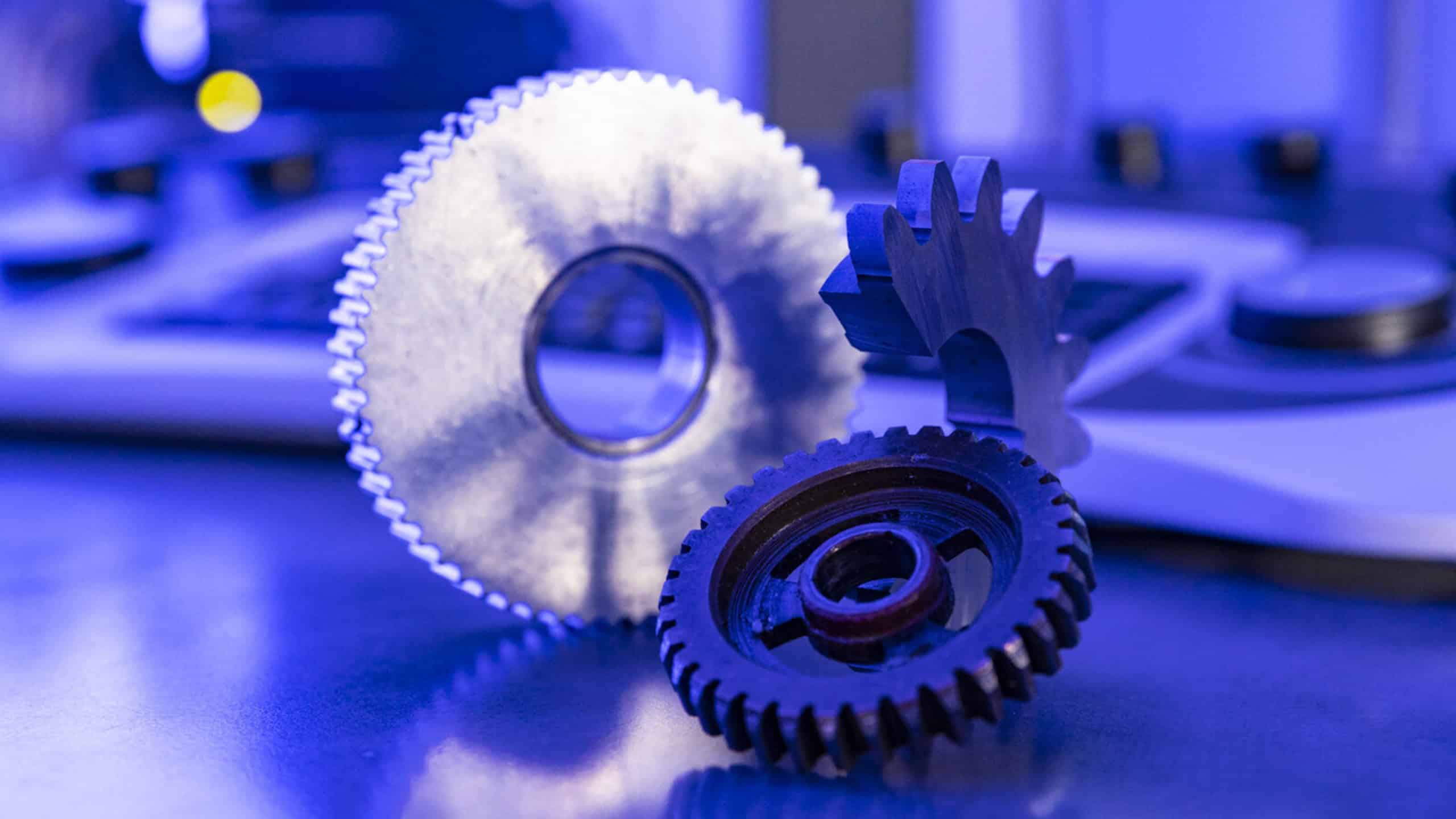
In the future, gears and chain links could be cut from sheet metal at high speeds without the need for subsequent finishing of the cut edges. © Jacob Müller
When a forklift lifts heavy loads, its chains have to withstand a great deal of stress. Researchers in Chemnitz now hope that a single chain link will show whether a new method for machining sheet steel is suitable for practical use. The idea behind it: The metal is cut at extremely high speeds. This could result in particularly durable cut edges and ultimately save labor and energy.
The German Research Foundation (DFG) is providing the FUNDAM³ENT research group with approximately 3.9 million euros in funding for another four years. About 1.64 million euros of this amount will go to Chemnitz University of Technology, which is leading the project. Also involved are the Fraunhofer Institute for Machine Tools and Forming Technology (IWU) in Chemnitz, as well as partners from Freiburg, Dortmund, and Munich.
Tiny zones with a big impact
Over the first four years, the team investigated what happens when sheet steel is cut at very high speeds. The cut edges become more precise as a result. They wear down less, are more resistant to rust, and can withstand stress for longer. In the best-case scenario, the edges will no longer require extensive post-processing. This could save energy.
During high-speed cutting, the metal at the cut edge changes. This creates tiny regions that experts call adiabatic shear bands. The researchers are investigating when these form and how they affect the cut edge. Several factors play a role here: the type of steel, the cutting speed, and the distance between the two parts of the cutting tool.
The next step toward practical application
Now the researchers want to find out how different types of steel and the temperature of the sheet metal affect high-speed cutting. They are also testing the process on more complex components while minimizing stress on the tools.
This is where the forklift comes into play. The team plans to manufacture a chain link like those used to lift heavy loads, for example in forklifts. This will allow the researchers to test whether their approach is also suitable for practical applications.