
"We should do a much better job of explaining how science actually works."
How can we build trust in science? Are facts enough, or is more needed? An interview with communications researcher Sven Engesser from the Technical University of Dresden.
Read Aloud
0:00
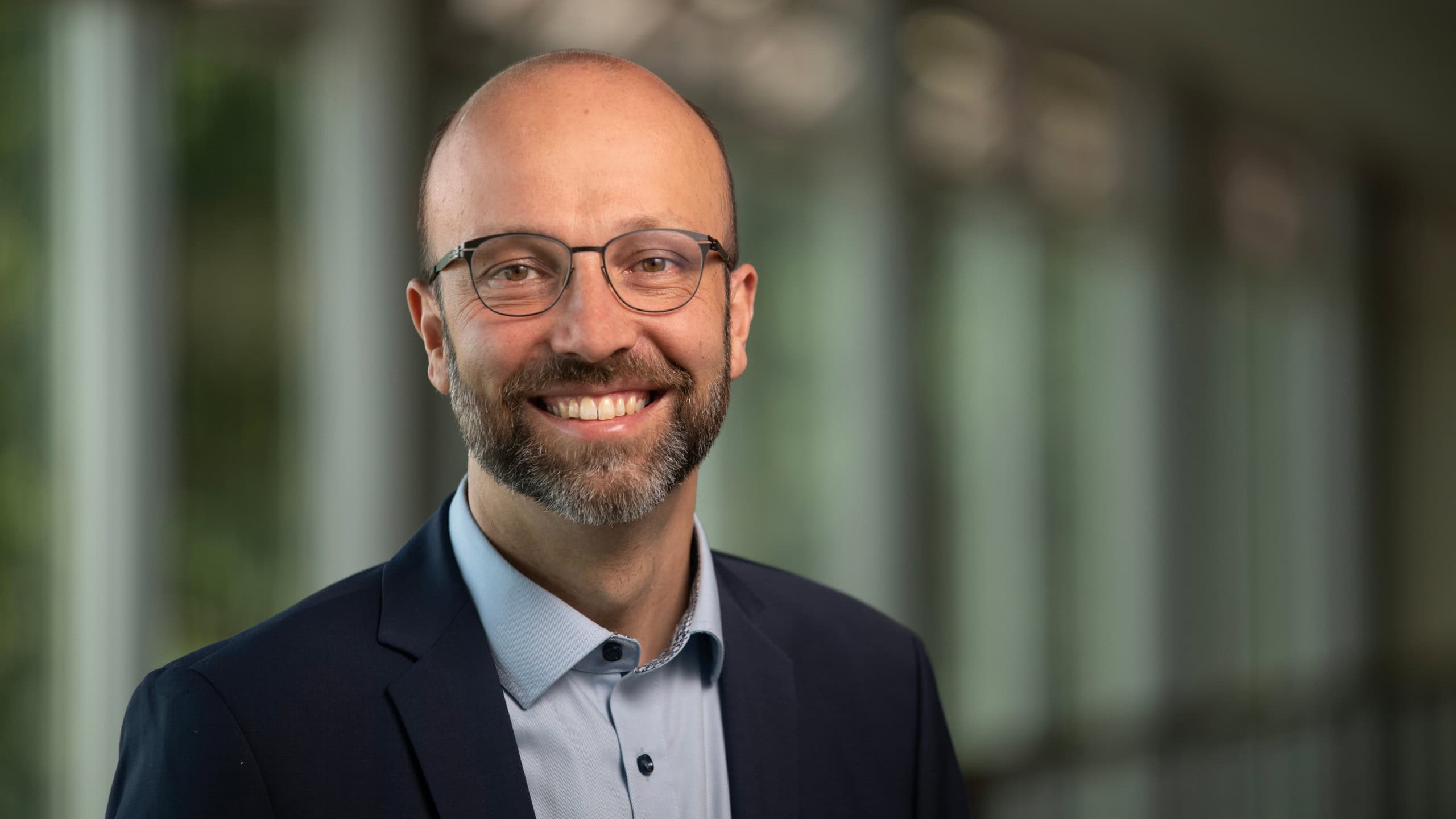
Prof. Sven Engesser conducts research at TU Dresden on how science is perceived and discussed by the public. © Sven Ellger/TUD
Science has rarely been as prominent as it is today. But visibility does not necessarily mean that scientific findings are understood or accepted. Sven Engesser, professor of science and technology communication at TU Dresden, studies what happens when science meets the public.
Professor Engesser, does science reach people differently today than it did ten years ago?
The public debate has become more polarized. There are people who value the importance of science even more today than they did in the past. Research has gained importance, particularly as a result of the pandemic. At the same time, there is a group – fortunately a minority – that has turned away from science during the pandemic and developed a high degree of skepticism toward science, even to the point of hostility. Reaching the first group is a piece of cake. With the second group, it will be hard work.
Actually, the opportunities for this should be better today than ever before. Researchers no longer need traditional media to reach a large audience on their own. Is that really an advantage?
About ten years ago, there was a veritable Twitter craze. Many researchers felt: Finally, we can talk about our work directly ourselves. Since then, a sense of disillusionment has set in. This is because the same platforms are also used by people who misrepresent or distort scientific findings – whether intentionally or unintentionally. Because anyone can now become a source of information, the risk of disinformation and misinformation has risen dramatically.
What can the scientific community do about this?
It is not powerless. From research on disinformation, for example, we know quite a bit about what’s called “inoculation.” It works a bit like a vaccination against misinformation. People are warned in advance about the false claims they might encounter and why these claims are incorrect. Afterward, they are more resistant to misinformation. If we know where the problem areas lie, we can certainly make a difference through good and open communication.
But can we win back people who already distrust science?
We have to distinguish between different groups. There is a group that is very alienated and ideologically entrenched. We can no longer reach these people with just a few messages. But there are others who have drifted away from science, for example, due to a specific event like the pandemic. It is certainly possible to bring them back into the fold.
One reason for mistrust could also be that science works differently than many people expect. One study reaches a conclusion, and the next one refutes it. Does the reasoning behind this need to be explained better?
Definitely. It makes a big difference what kind of understanding people have of science. Some people know that scientists are fallible, that findings can change, and that science is constantly evolving. In contrast, there’s a more dogmatic view: there is one truth, and science either already knows it or hasn’t discovered it yet. When science then communicates uncertainty, it can even give the impression that it’s hiding the truth.
What helps with such a view?
We should do a much better job of explaining how science actually works – how findings are obtained, how much error is involved, and just how long a process it can be. And we shouldn’t just present results all the time; we should also show, for example, how a study is conducted.
But doesn’t it undermine trust in science when researchers openly say, “We don’t know for sure yet”?
That is indeed a dilemma. When scientists communicate uncertainty, people might say, “I find that honest and open.” “He admits he doesn’t know something.” Others might think: “If he doesn’t know for sure, he’s obviously not competent.”
So what should researchers do?
I believe it’s better to communicate uncertainties. Both the scientific community and journalism sometimes think we can’t expect people to handle this – we have to provide them with simple truths. That can be patronizing. Studies show that people are often quite capable of dealing with uncertainty.
What role does funding play when it comes to research? It, too, is often used as an argument to question scientific findings.
It depends very much on the type of research in question. At universities – and especially in the social sciences – much of the funding comes from public sources. In my field of research, therefore, the conflict of interest is usually minimal. The situation is different, for example, with industry-sponsored or contract research. People are now also scrutinizing military research very closely. Who is actually paying for what? I don’t think that’s a bad thing in principle.
Shouldn’t science then simply disclose in full who is funding it and under what conditions?
That’s not always possible. For example, there may be confidentiality clauses, or trade secrets may be involved. Transparency therefore doesn’t automatically mean that everything can always be published. You have to weigh the pros and cons on a case-by-case basis.
In science communication, there’s a lot of talk about how to reach people. Do people even want to learn more about science?
Yes. Interest in science has actually increased, especially among the younger generation. At the same time, science has become increasingly important in our everyday lives. Today, many decisions can hardly be made without a certain basic understanding of science.
For example?
If, for example, I come across an air conditioner online that doesn’t have an exhaust hose, a basic understanding of physics helps me realize that something can’t be right. Otherwise, I might spend hundreds of euros on a product that can’t possibly work. The same applies to health and nutrition. Millions of young people wonder which products are actually good for their skin or what kind of sunscreen they need. Science is incredibly relevant to these kinds of everyday decisions.
Does that mean science needs to think more carefully about what people actually want to know?
Absolutely. In science, we sometimes lack an eye for what’s truly relevant to society and what concerns people. We have our specialized logic in mind and think a study is important because the academic discourse demands it. But people’s questions are often not that far removed from that.
But research has to be aware of those questions first. Does that require more dialogue between science and society?
Yes. This is already happening through participatory and citizen science projects, as well as other dialogic formats. But we can’t expect people to be able to immediately articulate, on command, what their needs are and what kind of research they want. That, too, is a process.
So, to reach people, science must gain a deeper understanding of what moves them. Is this just about their interests and needs?
No, we mustn’t forget one important component: emotions. Especially in Europe, science is strongly rooted in the tradition of the Enlightenment and the idea of rational human beings. That has served us well for a long time. But we need to take the role of emotions more seriously.
Why?
Many of our models show that people often react emotionally first and only then engage their reason. And nowadays, even topics that we would hardly have expected in the past are becoming emotionally charged and polarizing. Energy is one of them, as are mobility and space travel. Science communication must therefore understand that it is not just about facts. It communicates with people.