
Immigration for work – why a job alone isn't enough
People from abroad could help alleviate the shortage of skilled workers in rural areas. But what motivates them to stay permanently? A research team has investigated this question.
Read Aloud
0:00

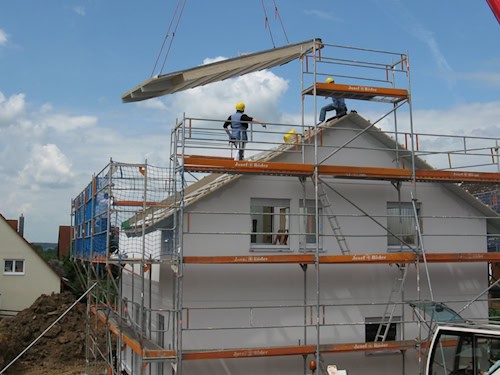
Many construction sites are looking for workers. Researchers have studied what factors contribute to people from other countries not only coming for a job but also staying for the long term. © Etienne Girardet/Unsplash
Far from major cities, many areas are facing a shortage of skilled workers. At the same time, the population in many regions is shrinking and aging. Skilled workers and labor from abroad could help in this situation. But how can a region ensure that people not only come but also stay?
A research team from HTWK Leipzig, Martin Luther University Halle-Wittenberg, and the Leibniz Institute for Regional Geography investigated this question. The researchers used the Burgenlandkreis district in Saxony-Anhalt as a case study. There, the population is projected to shrink by about one-fifth by 2040.
The researchers analyzed regional data and conducted interviews and workshops with immigrants, government agencies, businesses, and civil society organizations. Their findings were published in the journal “Wirtschaftsdienst.”
Many work below their potential
In 2025, 11 percent of employees subject to social insurance contributions in the Burgenlandkreis held a foreign passport. However, many work on fixed-term contracts, as temporary agency workers, or in jobs below their qualifications. As a result, their skills remain partially untapped.
One reason lies in history. Hardly anyone came to the GDR with the intention of staying permanently. That is why, to this day, many regions lack large networks of immigrants. This can create a vicious cycle: where few immigrants live, there are fewer contacts to help newcomers settle in. The absence of such networks, in turn, attracts fewer people to the region. Large cities therefore often have an easier time. Experts refer to this as “path dependence”: past developments shape today’s possibilities.
Another study from Saxony-Anhalt shows just how difficult it can be to stay. About one-third of the immigrants surveyed there are considering moving away. Reasons cited include a lack of a welcoming culture, experiences of discrimination and racism, and a lack of a social support network.
What keeps people in rural areas
That said, immigrants do not view life in the Burgenlandkreis district as entirely negative. In the surveys, they cited social closeness, affordable housing, short distances, and available childcare as advantages, among other things. Things become more challenging when it comes to career development opportunities, infrastructure, and cultural and social offerings.
The Burgenlandkreis is already trying to address some of these issues. In 2018, it established a migration agency where the immigration office, job center, youth welfare office, and social services all operate under one roof. In an integration network, around 70 stakeholders from government, business, and civil society exchange ideas. A Migration Council incorporates the experiences of immigrants into administrative work.
In the CareerPaths pilot project, immigrants get to know companies in the region. Some companies also offer language courses tailored to their respective industries and flexible work schedules.
Immigration alone is not enough
Nevertheless, researchers identify gaps. They recommend simpler procedures for the recognition of foreign professional qualifications, greater multilingualism in government agencies, and more effective protection against discrimination.
Immigration alone does not solve the skilled labor shortage, the researchers conclude. It is also crucial that people find work locally, integrate into the community, and see a future for themselves. To achieve this, government agencies, businesses, and civil society must work together.
Original publication:
Mrázová, L.; Fischer, H.; Winter, J.; Leibert, T.; Marmai, N.; Gescher, J.; Wink, R. (2026): Labor Market Integration: Path Dependencies and Recommendations for New Immigration Regions. Wirtschaftsdienst 106(9), 675–681.