

There is much more history buried beneath the castle ramparts
Pilatsch on the Lower Havel is known as a Slavic fortified settlement. An excavation has now revealed that people were using the site much earlier. Researchers from Leipzig, Tübingen, and the UFZ are investigating its history.
Read Aloud
0:00
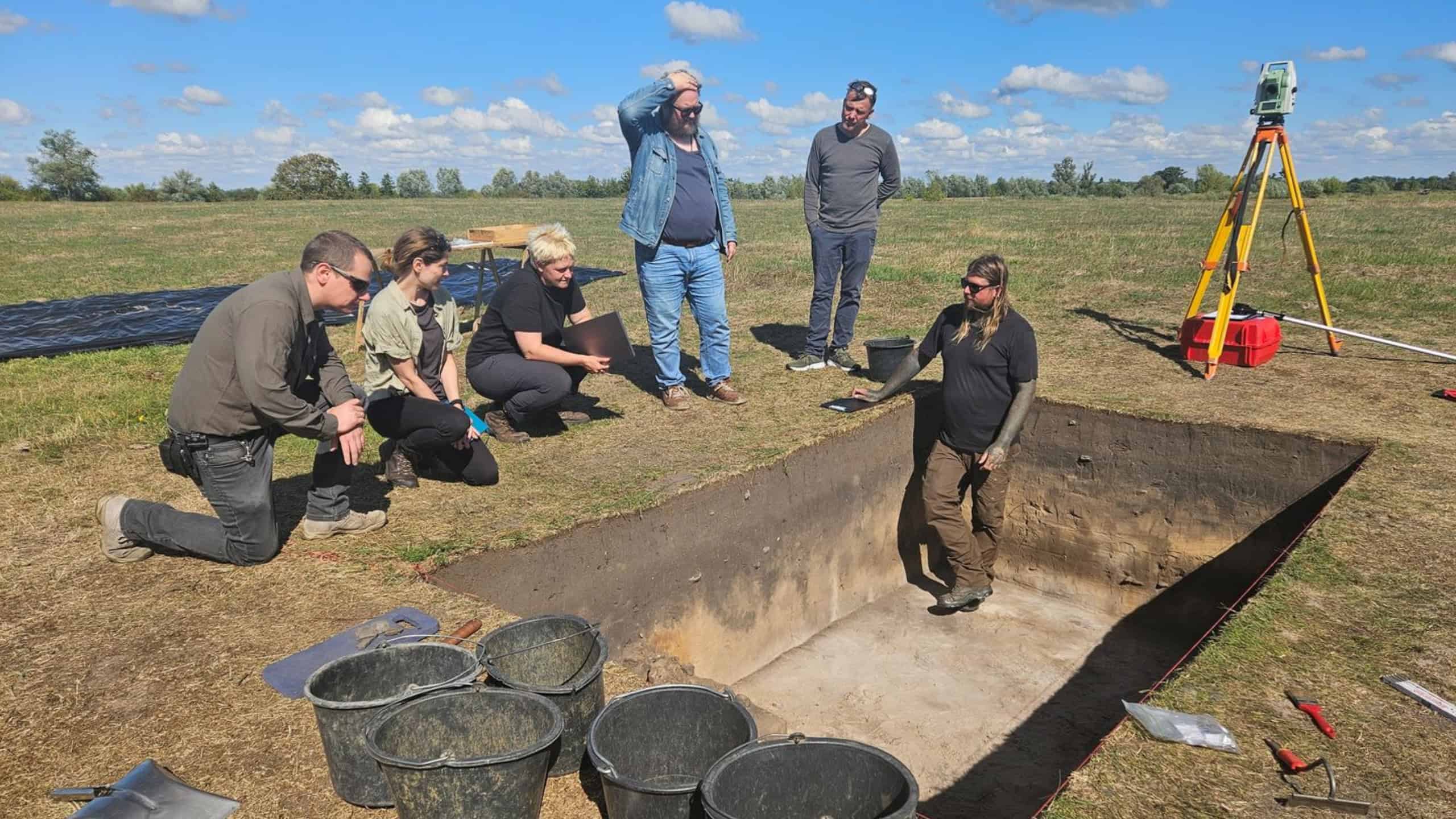
Researchers discuss new findings at the Pilatsch excavation site. Among them are excavation director Anne Köhler (3rd from left), excavation director Til Martens (right), and Havelaue Mayor Bill Neubüser (2nd from right). © C. Zielhofer
Rivers provide water, fish, and fertile soil. That is why people have settled along their banks for millennia. But rivers change, and people change the rivers. Researchers from Leipzig, Tübingen, and the Helmholtz Center for Environmental Research are investigating just how closely these two phenomena are linked along the Lower Havel in Brandenburg.
Near Gülpe lies the Pilatsch, a Slavic hillfort. It is a fortification made of mounded earth. It is located in a floodplain – that is, the flat land along the river that the Havel has shaped over a long period of time.
Measure first, then dig
Since 2025, the researchers have been exploring the site primarily using methods that cause minimal disturbance to the soil. They pass an electric current through the ground, measure the magnetic field, and use radar to peer deep into the earth. This provided them with clues about the structure of the rampart and ditches and where settlement areas might have been located. An excavation followed for the first time in late summer 2026.
“Thanks to the investigations conducted so far, we now have a rough idea of what structures might be hidden beneath the current ground surface,” explains Dr. Anne Köhler from the Institute of Geography at the University of Leipzig. “With the excavation, we can now verify these interpretations directly in the ground for the first time and date and interpret them using archaeological evidence and artifacts.”
The team opened up only a small area and dug by hand. They aim to determine how the rampart and ditches were constructed, from which period they date, and when people used the site.
Traces from the Neolithic Period
Today, the Pilatsch is primarily known as a Slavic fortification. However, the finds show that people used the site much earlier. The team also uncovered traces from the Neolithic period and the pre-Roman Iron Age.
The excavated soil is sifted and washed with water. This allows even small finds to be discovered, including pottery shards, slag, and animal bones. These can provide clues about how people lived here and used the site. The soil itself also tells part of the story. Samples from various layers are intended to reveal which deposits formed naturally and where humans have influenced the landscape. In this way, the researchers aim to link the history of the site to the development of the Havel River and its floodplains.
Experts from the University of Leipzig, the University of Tübingen, and the Helmholtz Center for Environmental Research (UFZ) are involved. Students from Tübingen assisted with the excavation. The Brandenburg State Office for the Preservation of Historical Monuments and the State Archaeological Museum are supporting the investigations.
“It is precisely the combination of archaeology, geoarchaeology, and modern investigative methods that gives us the opportunity to examine the fortified settlement not in isolation,” says Prof. Dr. Christoph Zielhofer, a geographer at the University of Leipzig. The team aims to determine why people chose this particular location for the fortified settlement and how its use and the natural development of the river landscape influenced one another.
Now, artifacts, soil samples, and measurement data are being analyzed. They are intended to help reconstruct the settlement history of the Pilatsch more precisely – from the earliest traces of human activity to the Slavic hillfort.