East Germany on the "Tagesschau": What 1,000 news broadcasts reveal
Students at the University of Leipzig analyzed 1,000 episodes of the "Tagesschau" news program. Eastern German states appear surprisingly often relative to their population size. However, there are clear differences between East and West when it comes to the topics covered.
Read Aloud
0:00
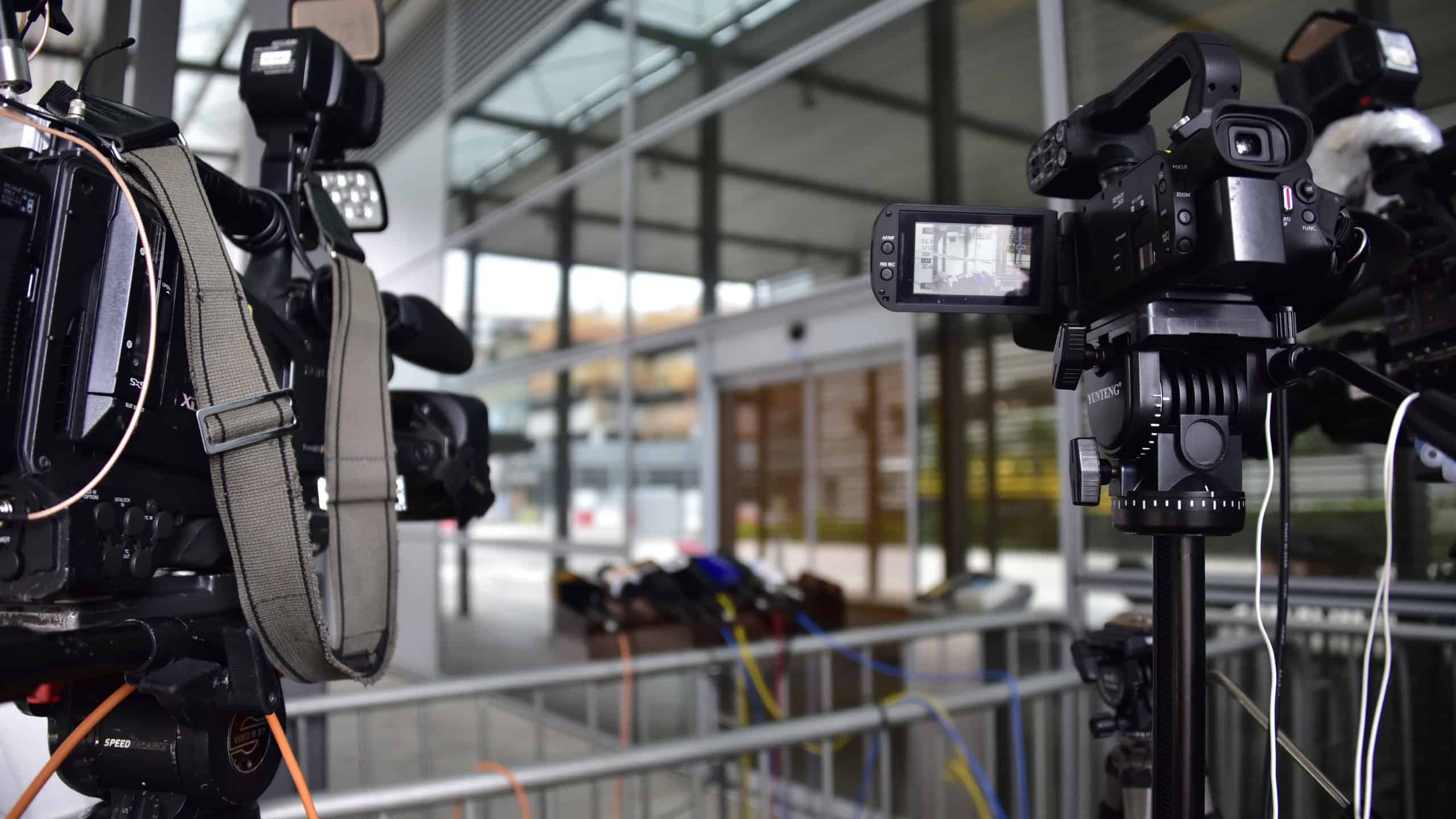
TV cameras at a press event. An analysis conducted in Leipzig of 1,000 episodes of the "Tagesschau" news program shows that, relative to their population, eastern German states are featured more frequently than western German states. © Andy Leung/pixabay
Every evening at 8 p.m., millions of people tune in to the Tagesschau. But how often do Saxony, Thuringia, or Brandenburg actually appear on the show, and which topics put Eastern Germany in the spotlight? Students at the University of Leipzig investigated this.
To do so, they analyzed 1,000 consecutive 8:00 p.m. editions of the Tagesschau from January 2023 to September 2025. They searched the broadcast transcripts for the names of the federal states as well as terms such as “East German” and “West German” and categorized the corresponding passages into different topic areas.
West German federal states do appear more frequently overall in the Tagesschau. However, when measured by population, the East German states are represented about two and a half times as much. Berlin was not included in the count due to its special status.
“The results are remarkable in two respects,” says Prof. Olaf Jacobs. “Measured by population size, East Germany is quantitatively much more prominent in the Tagesschau than West Germany.” At the same time, the selection of topics differs considerably. West Germany tends to be portrayed as an economic region, while East Germany tends to be portrayed as a political battleground.
Right-wing ideology more common in the East, the economy in the West
When it comes to an East German state, right-wing ideology is the focus in 24 percent of the segments analyzed. In the West, the figure is five percent. By contrast, the economy, infrastructure, and the labor market play a more frequent role in reports on West German states: 19 percent of the segments focus on these topics, compared to nine percent for East German states.
The news landscape during the period under study likely also played a role here. These included state elections in the East, election results for the AfD, and the classification of East German AfD state chapters by the Office for the Protection of the Constitution. The study cannot determine whether these events were reported on particularly frequently relative to other events.
When “the East” is explicitly referred to as “the East”
Even the term “the East” does not appear uniformly in the data. On individual topics, the five East German states differ more from one another than East and West do as a whole. Furthermore, the figures do not indicate whether coverage of the East and West was positive, negative, or neutral. The content and tone of the articles were not evaluated.
The students found another difference in the terms themselves. Terms such as “East German” or “East Germany” appeared in 83 of the passages examined, while corresponding terms for West Germany appeared in 30. In more than half of these cases, the West was also mentioned alongside the East. The East is thus more frequently explicitly identified as a separate category in the reporting.
The analysis was conducted as part of a seminar at the Institute for Communication and Media Studies at the University of Leipzig. Students in a master’s program collected and analyzed the data for this purpose. Partners in the project are the Federal Foundation for the Reappraisal of the Past and the Leipzig-based firm Hoferichter & Jacobs.
What matters in everyday life
At the same time, the online survey “DNA of the East” was conducted with approximately 2,560 participants. It is not representative. Participants were people who visited the project website and thus already had a particular interest in the topic. About 64 percent of them grew up in East Germany.
77 percent believe that the media do not portray East Germany accurately. 92 percent still see differences between East and West. In everyday life, however, this issue takes a back seat. 68 percent do not distinguish between East and West Germans in their daily lives. 87 percent believe that East Germans can be proud of what has been achieved since 1990. “Criticism of lingering differences and pride in what has been achieved since 1990 are by no means mutually exclusive,” says Dr. Anna Kaminsky, director of the Federal Foundation for the Reappraisal of the SED Dictatorship.
At the same time, the life stories of those surveyed show just how closely East and West are now intertwined. Twenty-three percent of those who grew up in the East now live in the West. Of those who grew up in the West, 36 percent have moved to the East. The results of the survey and the “Tagesschau” analysis are available on the project website “DNA of the East”.