Why bacteria aren't perfect swimmers
Sometimes pushing, sometimes pulling: For the first time, researchers have been able to change the orientation of an artificial microswimmer while it is moving. This provides new insights into why bacteria swim and how they swim.
Read Aloud
0:00
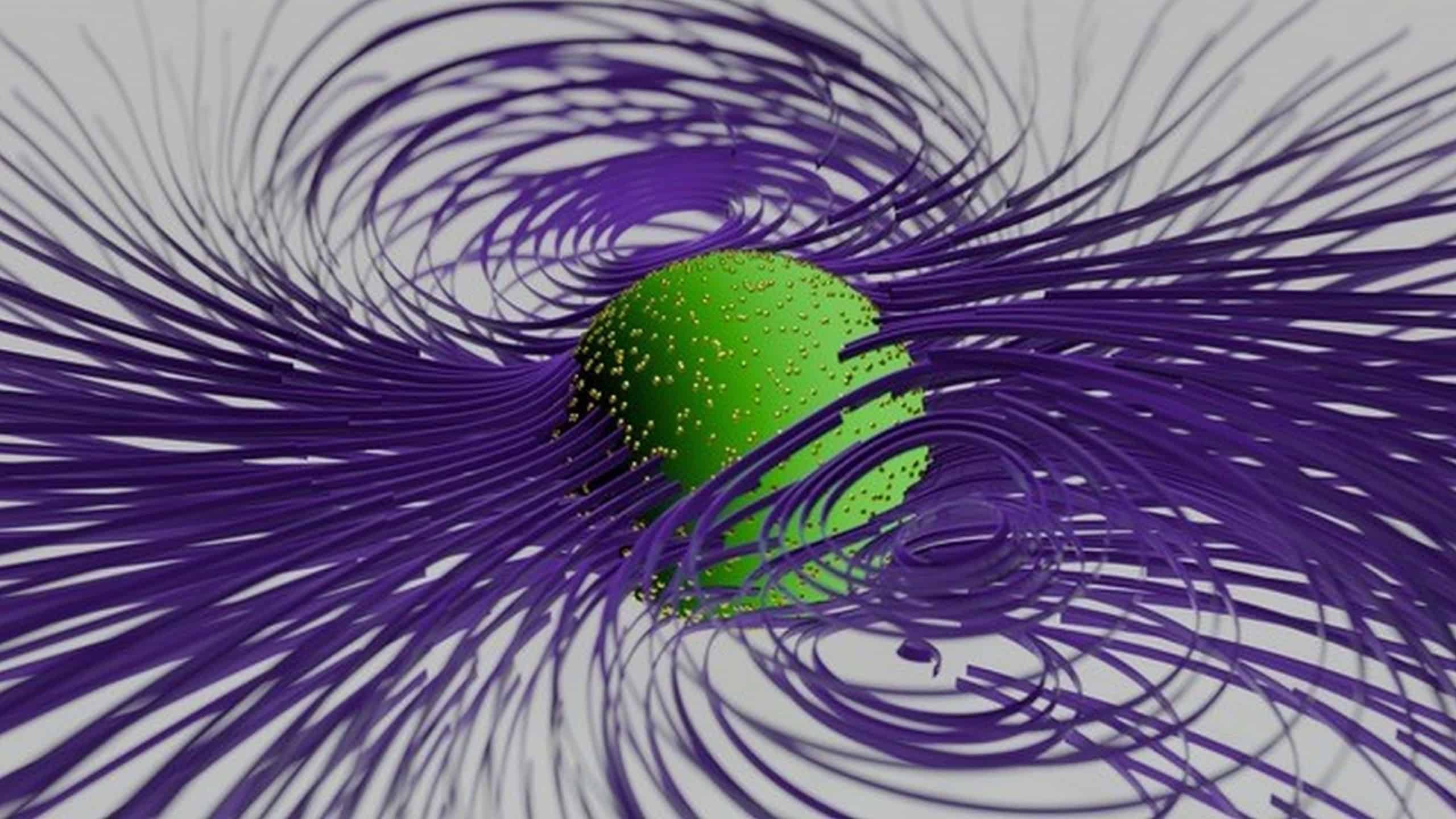
The artificial microswimmer is only about four micrometers in size and is studded with tiny gold particles. Using laser light, researchers can control how it moves through a liquid. © University of Leipzig/Molecular Nanophotonics Research Group
In a drop of water, tiny organisms move in very different ways. Bacteria such as E. coli propel themselves forward using thin propelling filaments, known as flagella, at their rear end. It’s similar to a boat with a stern propeller. Algae such as Chlamydomonas, on the other hand, use filaments at their front end to pull themselves through the water. This creates different types of currents in each case.
Physicists at the University of Leipzig and Charles University in Prague want to better understand these movements. To do so, they are using artificial microswimmers – tiny particles that allow researchers to simulate and study the behavior and interactions of microorganisms in the lab. Until now, the way these artificial swimmers moved through a liquid was determined as early as the manufacturing stage. The group led by Prof. Frank Cichos has now succeeded in making the same tiny sphere swim differently using light. This change occurs while the sphere is in motion.
How light changes the way it swims
The transparent spheres are coated with tiny gold particles. When laser light hits the gold, the surface heats up at that point. The researchers can heat different areas of the sphere to varying degrees. The resulting temperature pattern sets the sphere in motion and simultaneously determines how the fluid flows around it.
When the researchers change the light pattern, the flow changes as well. As a result, the same sphere can move through the water one moment much like a bacterium and, shortly thereafter, more like an alga. There is, however, a limitation. The laser can heat the sphere, but it cannot cool it. This influences which swimming style is most advantageous under these conditions. In the process, the researchers stumbled upon a result that initially sounded contradictory.
“The intuitively unexpected thing about this is that, at the same laser power, the slowest swimming style of all is actually the most efficient if you want to reach a certain speed,” says doctoral student Lisa Rohde, the study’s first author. This result applies to the specific conditions of the experiment. It shows that a swimmer’s technical and physical limitations help determine which swimming style is actually most advantageous.
What artificial swimmers reveal about bacteria
Such limitations also exist in nature. They could help explain why, over the course of evolution, bacteria have adopted swimming styles that are theoretically suboptimal but still work well. “Until now, the hydrodynamic characteristics of a microswimmer were fixed at the moment of its creation, much like an animal’s physique,” says Cichos. Now, the researchers can alter this property using light during the experiment.
This opens up new possibilities. It will allow them to better investigate in the future how many such particles behave collectively – for example, in the movement patterns of bacteria or in swarms. With previous artificial swimmers, such experiments were only possible to a limited extent because their swimming style was fixed.
Next, the team plans to combine this control with machine learning. The microswimmers will then learn which swimming style is best suited for a specific task. The researchers also want to investigate how the microswimmers move differently in viscous mucus compared to water.
Original publication:
Rohde, L., Anchutkin, G., Holubec, V. et al. Programmable hydrodynamics of active particles. Nat Commun 17, 9406 (2026).