
Hitchhiking through the cell membrane
Cells must transport proteins and lipid-like molecules to the right locations. Researchers from Dresden have investigated whether the same transport pathway is responsible for this.
Read Aloud
0:00
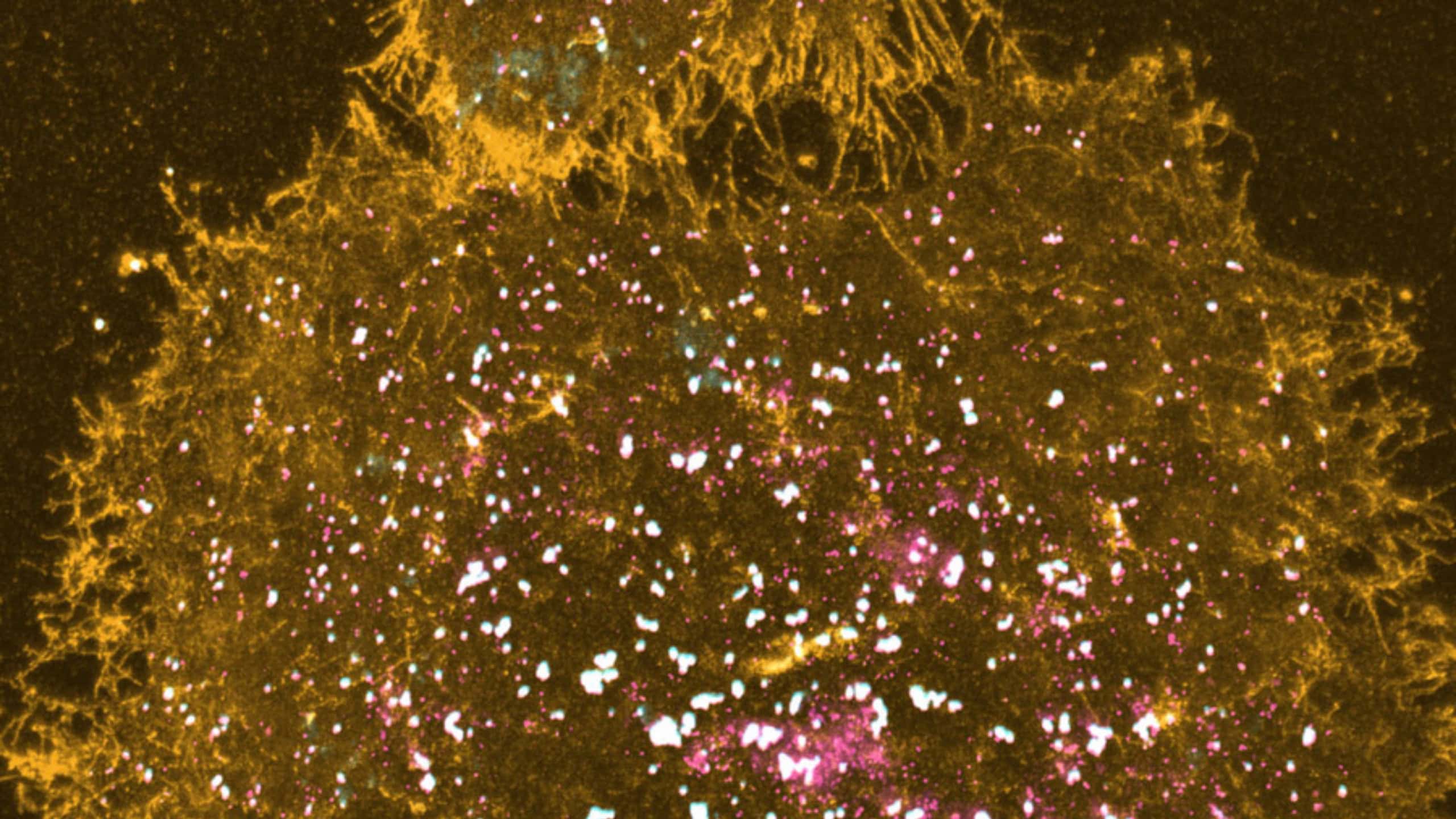
View of the membrane of a human melanoma cell. The lipids under investigation are shown in orange. © H. Mathilda Lennartz et al./MPI-CBG/Nat Cell Biol (2026)
Every cell in our body has a kind of delivery service. It transports substances from the outside into the cell. To do this, the cell membrane bulges inward and pinches off a tiny vesicle that carries the substances. A protein called clathrin helps with this process. Experts call this process clathrin-mediated endocytosis.
It was already known that this process selectively sorts proteins. These proteins perform many tasks within the cell. However, another question remained unanswered until now: Does the delivery service also sort lipids? These are fat-like molecules that make up a large part of the cell envelope, the membrane.
Three Dresden teams investigate lipids
To find this out, three Dresden research institutions collaborated: the Max Planck Institute for Molecular Cell Biology and Genetics (MPI-CBG), the Biotechnology Center at TU Dresden (BIOTEC), and the Center for Systems Biology Dresden (CSBD). The researchers made various lipids visible under the microscope and observed how they behaved in the cell membrane. A mathematical model helped them analyze the data.
They examined ten different types of lipids and compared how frequently they entered the cell via this pathway. “Some of the lipids were transported into the cell with a slight preference over others,” says first author Mathilda Lennartz, who conducted her research as a postdoctoral fellow at the MPI-CBG.
The “delivery service” is hardly responsible for lipids
She attributes this to the arrangement of the lipids. Some tend to accumulate on the inner side of the membrane, while others accumulate on the outer side. The shape of these invaginations also plays a role. As a result, lipids are taken up slightly more frequently from the inner side.
However, the differences are very small. This is emphasized by the study leaders André Nadler of the MPI-CBG and Alf Honigmann of BIOTEC. The researchers therefore assume that the cell uses this transport pathway primarily to sort proteins. Lipids are apparently sorted via other pathways – for example, through transport routes that do not involve the formation of such vesicles.
“This allows the cell to separate two processes that are already logistically very complicated: the sorting of proteins and the sorting of lipids,” say the study leaders Nadler and Honigmann. The new method now gives researchers a closer look at the lipids. It can reveal how they are distributed in the cell membrane and how they move there.
Original publication:
Lennartz, H.M., da Costa Nunes, S., Böhlig, K. et al. Quantification of lipid sorting during clathrin-mediated endocytosis. Nat Cell Biol (2026).