Unraveled: How the fruit fly’s nervous system works
For the first time, researchers have fully mapped the central nervous system of fruit flies. Dr. Katharina Eichler, a biologist from Leipzig, was part of the team. Here’s how this relates to us.
Read Aloud
0:00
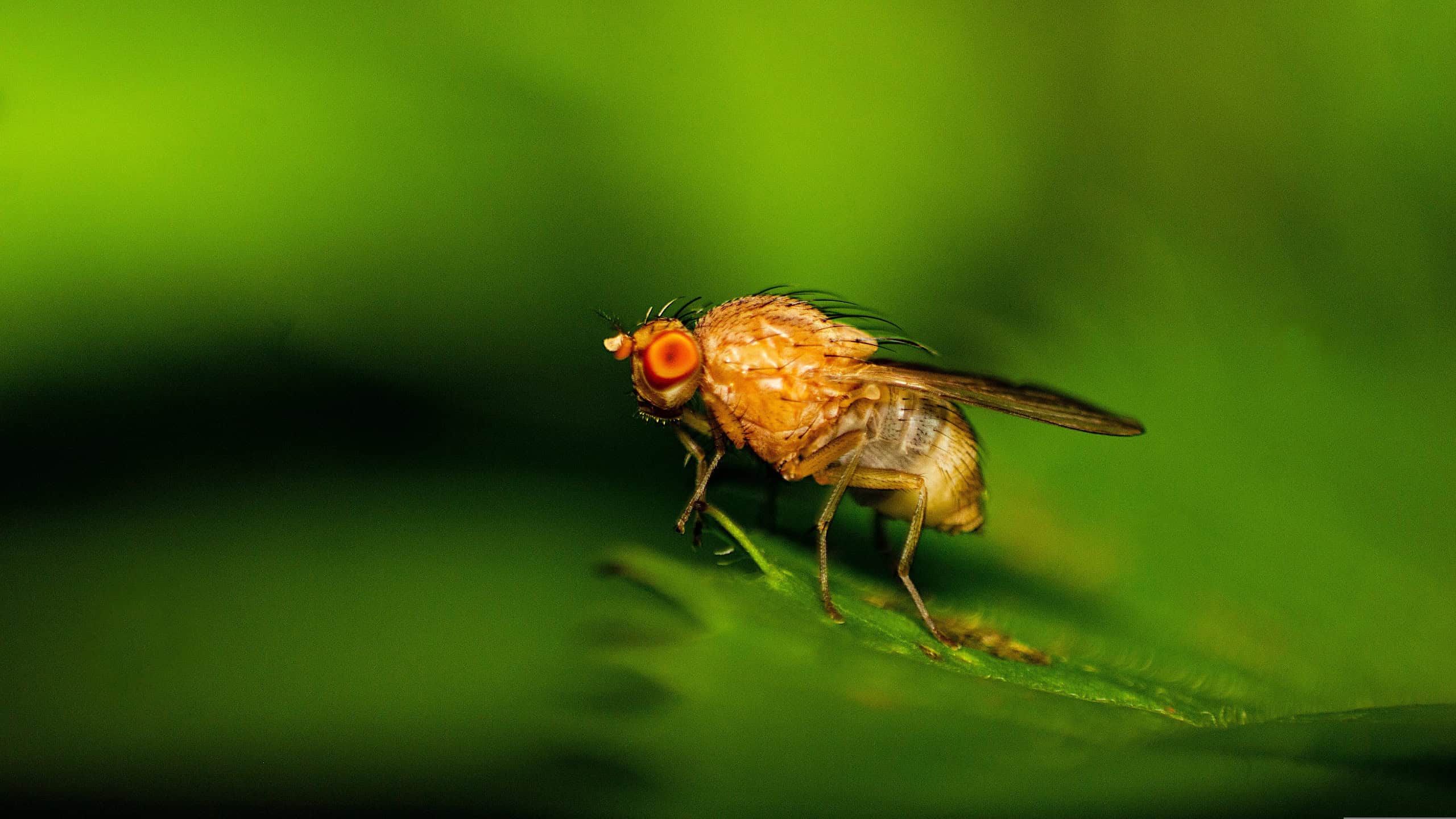
Fruit flies are small, but their nervous system is complex. Researchers have now mapped the entire central nervous system of a male and a female fruit fly for the first time. © Denitsa Kireva/pixabay
How does a signal travel from the brain to the muscles that ultimately carry out a movement? Even in the tiny fruit fly, this pathway had not yet been fully traced. Two international research teams have now mapped the animals’ entire central nervous system for the first time – from the brain through the neck to the nerve cells that control the muscles. Dr. Katharina Eichler from the University of Leipzig was part of the team.
A gap is closed
Previous connectome maps of the fly brain had a gap. The brain and the abdominal medulla – the counterpart to the spinal cord in vertebrates – had already been mapped. But only in different animals, respectively. As a result, it was only possible to trace how a sensory impression in the brain ultimately leads to a movement through indirect means. The new wiring diagrams, known as connectomes, show for the first time all the nerve cells and their connections within a single animal.
The female connectome “BANC” was developed under the leadership of Harvard Medical School. It comprises approximately 160,000 neurons. More than 150 experts spent three years verifying the automatically generated reconstruction.
The analysis shows: Not every movement is controlled directly by the brain. Much of it is regulated locally by the nervous system. When the fly walks, flees, grooms itself, or eats, sensory cells, nerve cells, and muscles work together. The brain tends to set the direction rather than control every single step.
Male and female compared
The male connectome, “maleCNS,” was created through an international collaboration involving, among others, the Janelia Research Campus, the University of Cambridge, and Google Research. With 166,700 neurons, it is the largest complete brain wiring map to date. Now that data from both a male and a female fly are available, researchers can, for the first time, compare the nervous systems down to the level of individual connections between neurons.
In males and females, the neurons responsible for perception and movement are largely the same. The researchers found differences primarily in the areas of the brain where decisions are made and behavior is controlled. Although only a few neurons are sex-specific, they influence large parts of the brain.
In both projects, Katharina Eichler examined approximately 1,300 nerve cells that transmit commands from the brain to the body. She reconstructed and named these cells. This now allows researchers to compare the same neurons in males and females and to identify them in older brain maps as well. “The descending neurons are something like the brain’s command lines. They determine whether a fly walks, flies, flees, or courts,” says the Leipzig-based researcher.
The human brain has about 86 billion nerve cells; the fly has only a fraction of that. Nevertheless, it exhibits complex behaviors such as learning and navigation. “Many basic principles of how nervous systems generate behavior are likely similar across species,” says Eichler. Both datasets are freely accessible. In Leipzig, Eichler is already using them for comparative studies between different fly species.
Original publications:
Bates, A.S., Phelps, J.S., Kim, M., et al. Distributed control circuits across a brain-and-cord connectome. Nature 656, 957–970 (2026).
Berg S. et al.: Sexual dimorphism in the complete Drosophila male central nervous system connectome. Cell (2026).