
Mandrills: Could miscarriage be an evolutionary strategy?
Female mandrills are more likely to lose their unborn young when they are still caring for a young offspring. A long-term study shows the role that the older young’s behavior plays in this.
Read Aloud
0:00
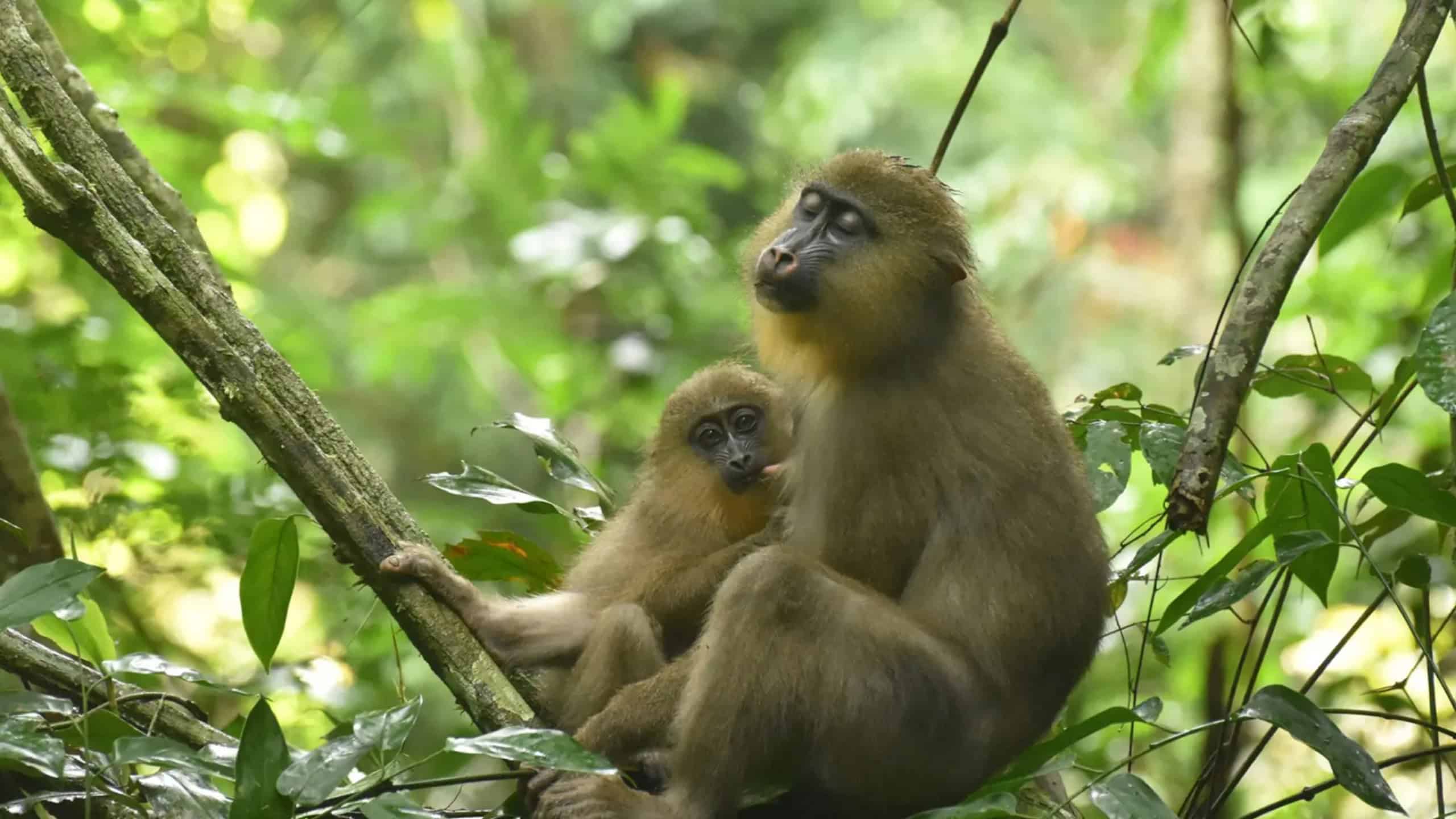
A female mandrill rests among the branches and leaves, nursing her young. © Berta Roura-Torres
Sometimes Mom and Dad can’t be too far away. The child cries, seeking physical closeness with its parents and wanting to be held. Anyone with children is familiar with moments like these. The offspring of female monkeys can be similarly clingy. In mandrills, the behavior of the young even influences whether the mother has a miscarriage.
This is the finding of a new study in which the Max Planck Institute for Evolutionary Anthropology in Leipzig also participated. Researchers from Montpellier and the University of Turku in Finland were also involved.
Protest from the young
Mandrills live in the rainforests of Central Africa. In Gabon, the research team observed 117 females over a period of eleven years, during which they recorded 356 pregnancies. The animals belong to a wild mandrill population that is unique in the world. They are so accustomed to humans that researchers can observe them up close on a regular basis.
What the researchers found: Females who became pregnant again while still caring for a young one were more likely to lose their unborn offspring. The risk was particularly high when the older infant protested frequently and persistently sought its mother’s attention. If she was pregnant again, she often did not respond.
“We combined more than a decade of observational data on reproduction with non-invasive data on pregnancies as well as detailed behavioral observations of mothers and their young,” says Nikolaos Smit of the University of Turku. He previously conducted research in Leipzig.
The animals did not need to be captured or physically examined for the observations. One way to tell if a female mandrill is expecting offspring is by a noticeable swelling in the perineal region.
Failure or strategy?
Miscarriages are relatively common among primates, including humans. According to estimates, 10 to 20 percent of pregnancies end this way. Among the mandrills studied, the rate was just under 15 percent: 52 out of 356 pregnancies.
“Fetal loss is typically viewed as a form of reproductive failure,” says Marie Charpentier, who leads the “Mandrillus Project.” The results suggest that, over the course of evolution, a miscarriage may have been an advantage under certain circumstances. The mother would then have more energy for the young she already has.
Another finding supports this. Females who had a miscarriage had offspring again more quickly than females whose young died after birth. They subsequently also produced more offspring that reached adulthood. It is known from other primate species that the younger of two offspring born in quick succession is at a particularly high risk of dying early.
Among geladas, a species of monkey in Ethiopia, the risk of miscarriage also appears to depend on what is happening within the group. When a new male takes over as leader, pregnant females are particularly likely to lose their unborn young. Researchers suspect that the females’ bodies are reacting to a perceived threat: the new leader might kill his predecessor’s offspring.
However, the mandrill study initially shows only statistical correlations. Whether the young animals’ protest behavior actually contributes to miscarriages and which physiological processes play a role in this still needs to be investigated. It also remains unclear whether conclusions about humans can be drawn from these results.
Facts to Share:
When a mandrill mother becomes pregnant again while she is still caring for a young infant, miscarriages occur more frequently. The risk is particularly high if the infant frequently seeks out its mother. Researchers do not yet know why this is the case.
Original publication:
Nikolaos Smit, Berta Roura-Torres, Axelle Delaunay, Alice Baniel, Elise Huchard, Marie J. E. Charpentier: Infant presence and mother-infant conflict predict fetal loss in wild mandrills, PLOS Biology, November 3, 2026.