

Dresden’s new giant takes on a mystery deep inside Earth
How can currents in the Earth's liquid core generate a magnetic field? A colossal machine at the HZDR – the only one of its kind in the world – is now set to provide the answer. In a few months, the real work will begin.
Read Aloud
0:00
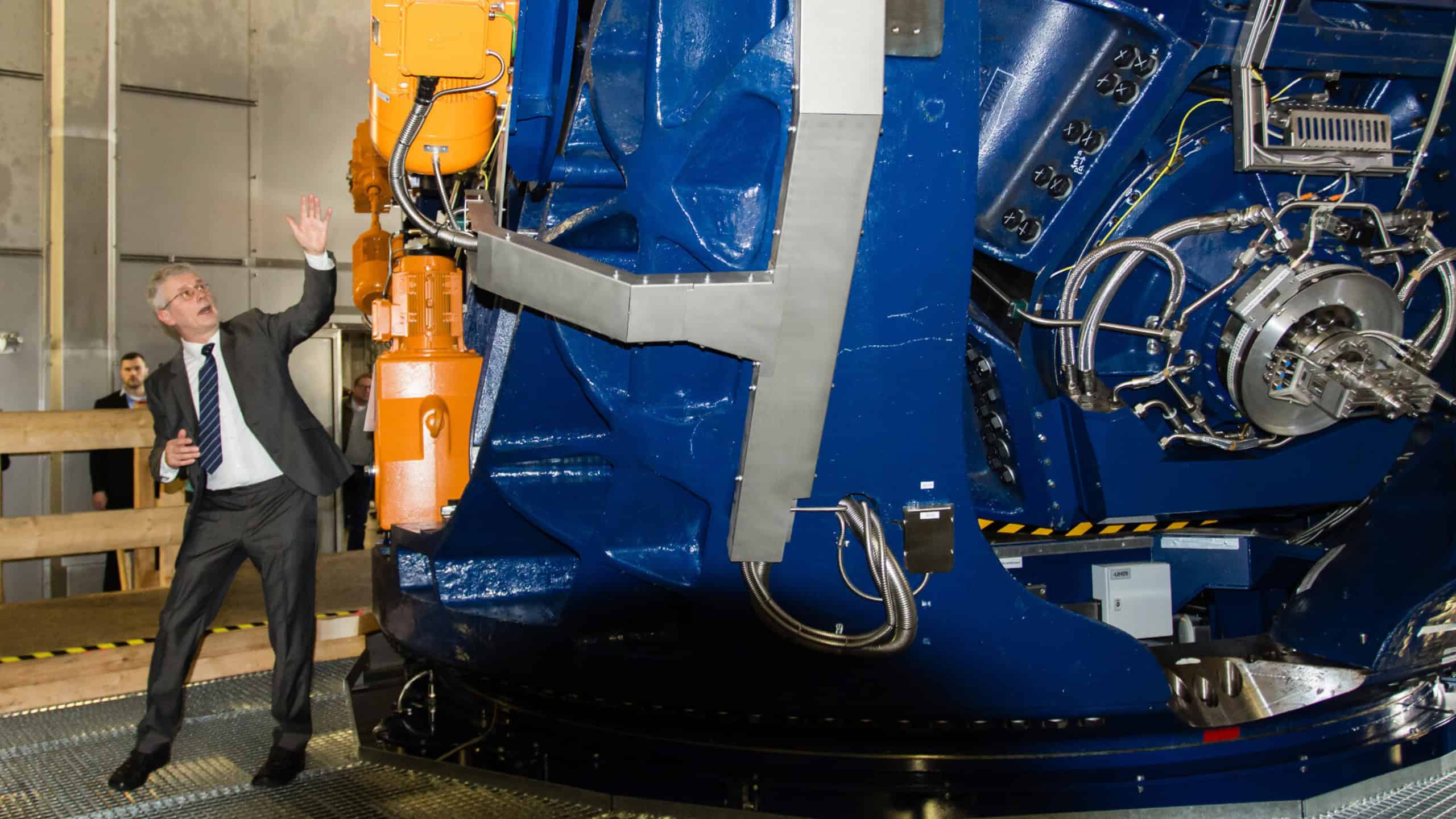
At the opening, physicist Frank Stefani demonstrates the HZDR's giant dynamo. Will a stable magnetic field soon form in the experiment? © Jana Mundus
As the door opens, the smell of motor oil hits the guests’ noses. A thin, oily film covers the floor and walls of the room they are now entering. “It’s best not to lean against anything,” Dr. Frank Stefani is quick to warn. For the scientist at the Helmholtz-Zentrum Dresden-Rossendorf (HZDR), today is a special day. He has been waiting for this moment for over a decade. Here, in a new building constructed specifically for this purpose on the HZDR campus, stands something that is the only one of its kind in the world. A giant dynamo designed to simulate the Earth’s liquid core. Its name: DRESDYN.
It is a colossus, measuring five by five meters. Inside sits a steel container two meters in diameter. During the experiments, it rotates around its own axis up to ten times per second. It is mounted on a platform that simultaneously rotates once per second. Incredible forces are at work here, and they’re expected to achieve something astonishing. At least, that’s the hope. Because it’s not yet clear whether this grand experiment will succeed.
To understand what makes this so complicated, one need only look inside the Earth. The solid inner core is surrounded by liquid iron. The metal is constantly in motion. The Earth’s rotation influences how it flows. The Earth’s axis is tilted. While our planet rotates around its own axis once a day, the axis slowly traces a circle. Anyone who has ever watched a wobbling toy spinning top is familiar with this effect. The gravitational pull of the Sun and the Moon causes our Earth to wobble. It takes the Earth’s axis 26,000 years to complete its circle.
First the semper opera house, then a giant dynamo
DRESDYN replicates precisely these two movements. After a renovation, eight metric tons of liquid sodium are expected to flow through the container in just over a year. At temperatures between 100 and 170 degrees Celsius. It conducts electricity like liquid iron. Frank Stefani and his team want to know whether the wobble sets the metal in motion in such a way that a magnetic field is generated and sustains itself. So far, the researchers have only calculated how this might happen. Tests using water have been underway for nearly two years. The results have the scientists feeling optimistic. Ultimately, the right parameters are needed for the experiment to succeed.
At this point we can't show you anything yet
In order to interact with or display content from third-party providers such as Facebook, YouTube and others, we still need your consent.
Even the construction of the new large-scale device was extraordinary. Although dynamo experiments had already been conducted in Riga and Karlsruhe, no facility of this scale exists anywhere else in the world. Everything had to be rethought and built from scratch – in some cases, even with unusual partners. Early on, the HZDR brought the Dresden-based company SBS Bühnentechnik GmbH on board. “It involved things that had to rotate and move, so they thought of us,” recalls former managing director Manfred Freimüller. “And we were crazy enough to say yes,” he adds with a laugh.
Normally, the company works for venues like the Semperoper, the Bolshoi Theater in Moscow, or opera houses in Buenos Aires or Beijing. Now, however, it was research. Time and again, the experts ran into limitations. During operation, a force 400 times greater than its weight acts on the outer walls of the steel container. Welded seams? Too unreliable. So they had huge parts cast, including the bearings, each weighing 3.5 metric tons. “There were constant challenges for which we had to find solutions,” adds project manager Gunter Weigelt. The foundation was one such challenge. After all, the facility weighs 150 metric tons. Seven reinforced concrete columns now extend 22 meters deep into the granite and support the machine.
Nerves on edge until the very end
In 2028, the HZDR researchers plan to begin experiments with sodium. “I’m 90 percent convinced that this will succeed,” says Stefani. Then a magnetic field would be generated and sustain itself. “I’d rather not think about the remaining ten percent.”
Understandable, since the construction cost a total of 27.8 million euros. The majority came from the federal government and the Free State of Saxony. The remaining funds came from the Helmholtz Association. Stefani is used to explaining why such a massive investment is necessary.
Other potential applications include, for example, studies on the behavior of liquid metals in technical systems or in liquid-metal batteries. The researcher is also concerned about global warming. Currently, studies are yielding conflicting results. It is completely unclear whether our planet will warm by 1.5 or up to five degrees Celsius in the future. Experiments with DRESDYN could make the sun’s influence on the climate more tangible.
Fingers crossed
As a special exception, Saxony’s Minister President Michael Kretschmer and Saxony’s Minister of Science Sebastian Gemkow were allowed to take their seats in the DRESDYN control room during the official opening and press the start button alongside Sebastian M. Schmidt, Scientific Director of the HZDR, to press the start button. From there, researchers normally monitor what is happening in the giant dynamo chamber via screens.
Once liquid sodium begins rotating in the container, this becomes even more important. The metal can ignite when exposed to air and reacts violently with water. That is why the dynamo is housed in a sealed, protected chamber. In the event of a fire, an argon fire suppression system displaces the oxygen and smothers the flames. 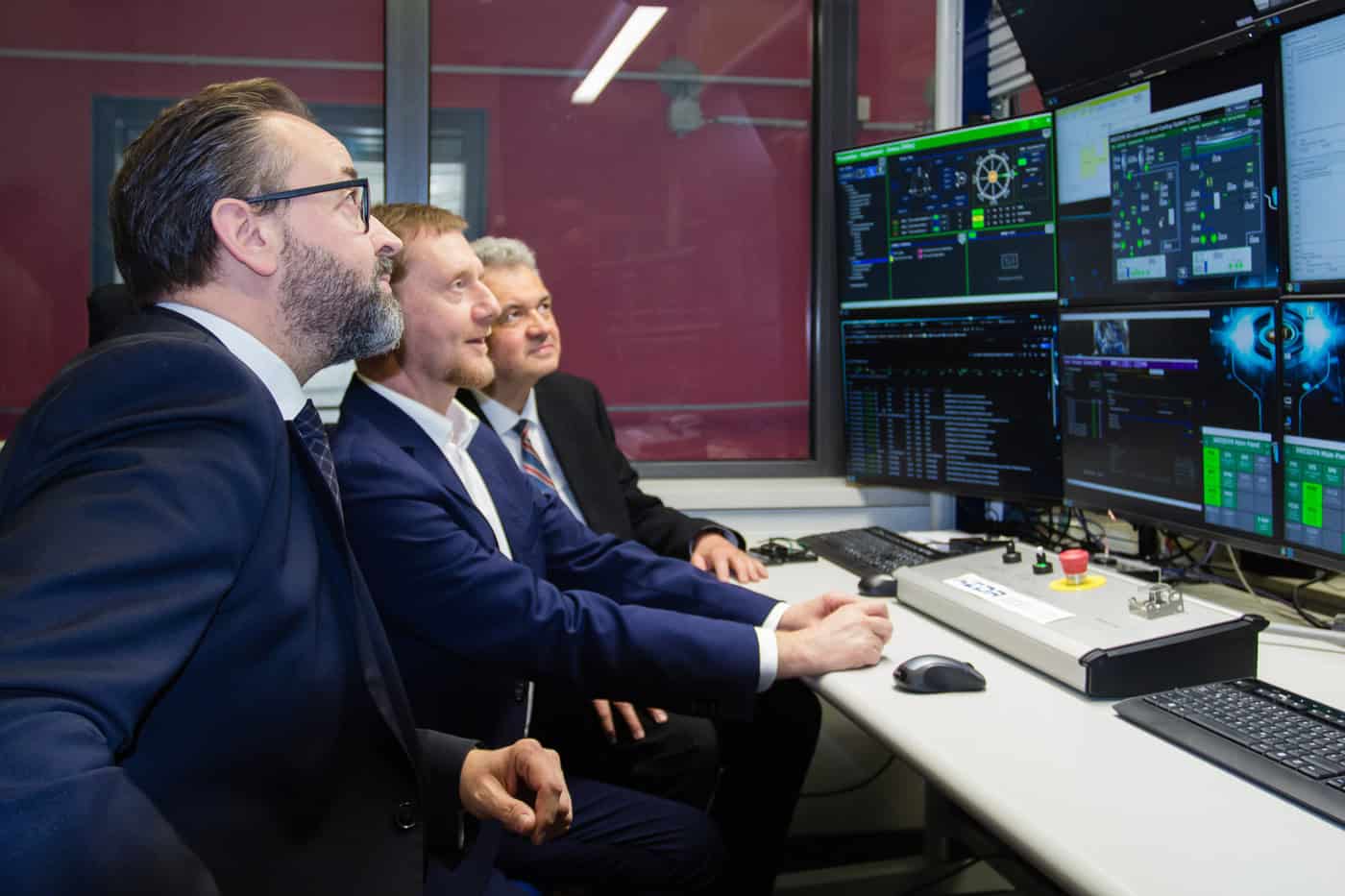
When experiments are planned, it takes up to five hours for the facility to fully ramp up. “There’s motor oil everywhere in the facility – that’s why it smells that way. It has to be ready for operation,” explains Nico Freyer, head of the Mechanical Development Department. Everything must be maintained regularly.
Despite the enormous speed, almost no vibration can be felt during the current experiments, says Nicole Wagner, head of the Central Department of Research Technology. “However, there are also facilities in the neighborhood with very sensitive measuring equipment.” It has become clear that these facilities are affected. Therefore, it was agreed that experiments would only take place when no sensitive measurements are being conducted next door.
In his speech on opening day, Kretschmer described how enthusiastic the HZDR researchers have been in recent years, repeatedly talking about DRESDYN and the possibilities it is expected to unlock. He emphasized how important this enthusiasm and such large-scale equipment are for Saxony to remain a leader in research.
As the visitors stand in the hall with the giant dynamo, Frank Stefani is in his element, patiently explaining and pointing out details. Many guests shake his hand as they say goodbye and wish him success. “We’re keeping our fingers crossed,” someone tells him. Stefani smiles. “We can really use every crossed finger here.” By 2028 at the latest, when things really get serious.