Home
/
Topics
/
Mistletoe Infestation in Pine Trees – Why Drought Puts Additional Stress on the Trees
The mistletoe problem: how a good-luck charm can harm pine trees
At Christmas, a sprig of mistletoe hung above the door is said to guarantee a kiss. High up in the canopy, mistletoe doesn't just sap water from pine trees. Researchers are now investigating just how much stress this causes the trees.
Read Aloud
0:00
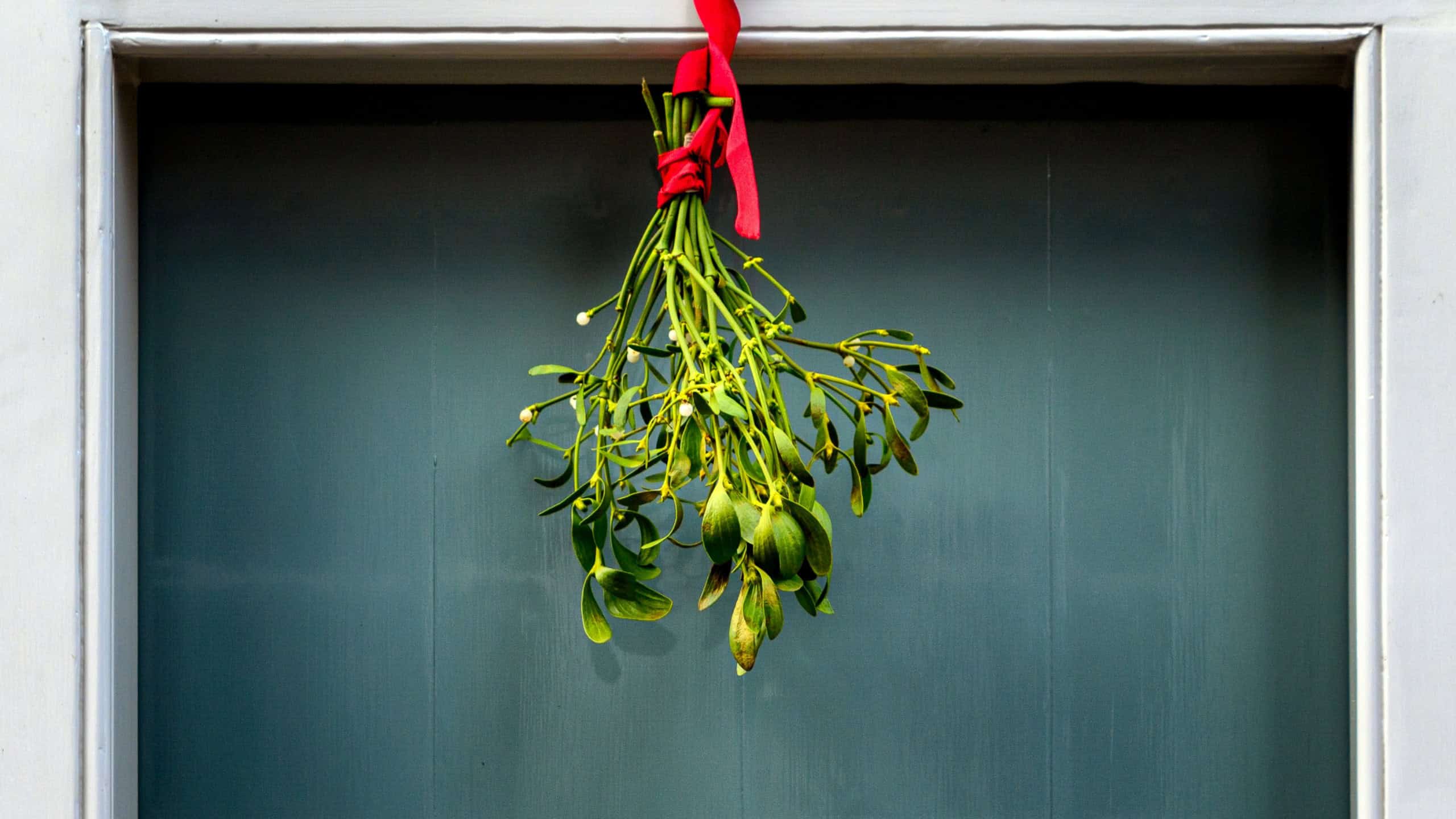
At Christmas, many people hang a sprig of mistletoe over their door. In the forest, pine mistletoe can harm its host tree, especially when conditions remain dry for a long time. © Paul Zoetemeijer/Unsplash
Around Christmas, the mistletoe makes us think of lovers – of people who meet beneath the hanging greenery and exchange kisses. Mistletoe is seen as a good-luck charm at the end of the year. But it’s no fun for the trees outside. Ernst van der Maaten and his colleagues at the Technical University of Dresden (TUD) want to investigate how mistletoe affects Scots pines – and not just in Saxony.
“Mistletoe is what’s known as a semi-parasite,” explains the professor at the Chair of Forest Growth and Dendrosciences at TUD. When it infests trees, it taps into their vascular system – which transports water and minerals – using its specialized sucking organs. These are necessary to ensure transport from the roots to the crowns.
Researchers can already see the consequences in satellite images, including in Saxony. High up in the pine crowns, the mistles are visible as green bushes. “The trees cannot defend themselves against them,” says van der Maaten. If they lack water, the pines slowly die off. Drought stress, such as during the dry years of 2018 through 2020, puts additional strain on them. During hot summers, the mistletoe now puts even more strain on them.
A resilient tree comes under pressure
The TUD researchers in the KliBiK project want to find out how well the pine trees cope with this double burden. To this end, a total of three university chairs are collaborating with the Thünen Institute of Forest Genetics and Sachsenforst. The Eva Mayr-Stihl Foundation is funding the project with 1.3 million euros through 2031.
Pines grow on just over one-fifth of Germany’s forest area. No other tree species occupies more land in this country. For a long time, it was considered robust. In the past, beech and spruce trees were the ones causing concern. “But now we’re seeing problems with pine as well,” explains van der Maaten. The droughts of recent years have weakened many pine forests in Central Europe. At the same time, pine mistletoe is spreading.
A study from the Swiss Rhone Valley has already shown the consequences of this. Between 1996 and 2004, on a two-hectare study plot, about six out of ten pine trees died, most of them following dry spells. Trees with heavier mistletoe infestation died more frequently than trees with light infestation or no mistletoe at all. However, little research has been done so far on how drought and mistletoe infestation affect pine trees of different origins.
Tree rings and satellite images
The team led by Ernst van der Maaten is focusing on two areas. At study sites stretching from southwestern Germany to northeastern Poland, they are comparing pine trees originating from different regions. The researchers measure how well the trees grow and record how many survive. “This allows us to determine to what extent the trees’ origin plays a role in their ability to cope with drought,” he explains.
In other pine forests, they are comparing trees with and without mistletoe. The width of an annual ring indicates how much the trunk grew in a given year. In addition, the team is examining the wood structure and chemical composition of the rings at different heights along the trunk. From this, they hope to determine how drought and infestation affect the trees’ water balance and their ability to produce sugar using light.
Using drone and satellite imagery, the Chair of Environmental Remote Sensing is investigating how mistletoe infestation and signs of drought stress are distributed across large forest areas. The results are incorporated into a computer model developed by the Chair of Silviculture. Using this model, the researchers plan to simulate, under various climate conditions, which pine species are suitable for a given site and which forest management interventions could be beneficial.
The research is primarily focused on Saxony. Other study sites are located in Brandenburg, Mecklenburg-Western Pomerania, and Saxony-Anhalt. Forest management agencies are to be involved at an early stage. There are also plans for an online tool that will later allow forest owners to check what risks exist at their site and what measures might be appropriate.
“We want to provide practical insights for forestry practice,” says the forestry scientist. The answer to the question of whether pine trees can still survive in our latitudes is likely one of the most important.