16 floods in two years – Europe’s forgotten flood series
The Magdalene Flood of 1342 was long considered an exceptional, isolated disaster. A new study now shows that, within just two years, 16 major floods struck large parts of Europe – including Saxony.
Read Aloud
0:00
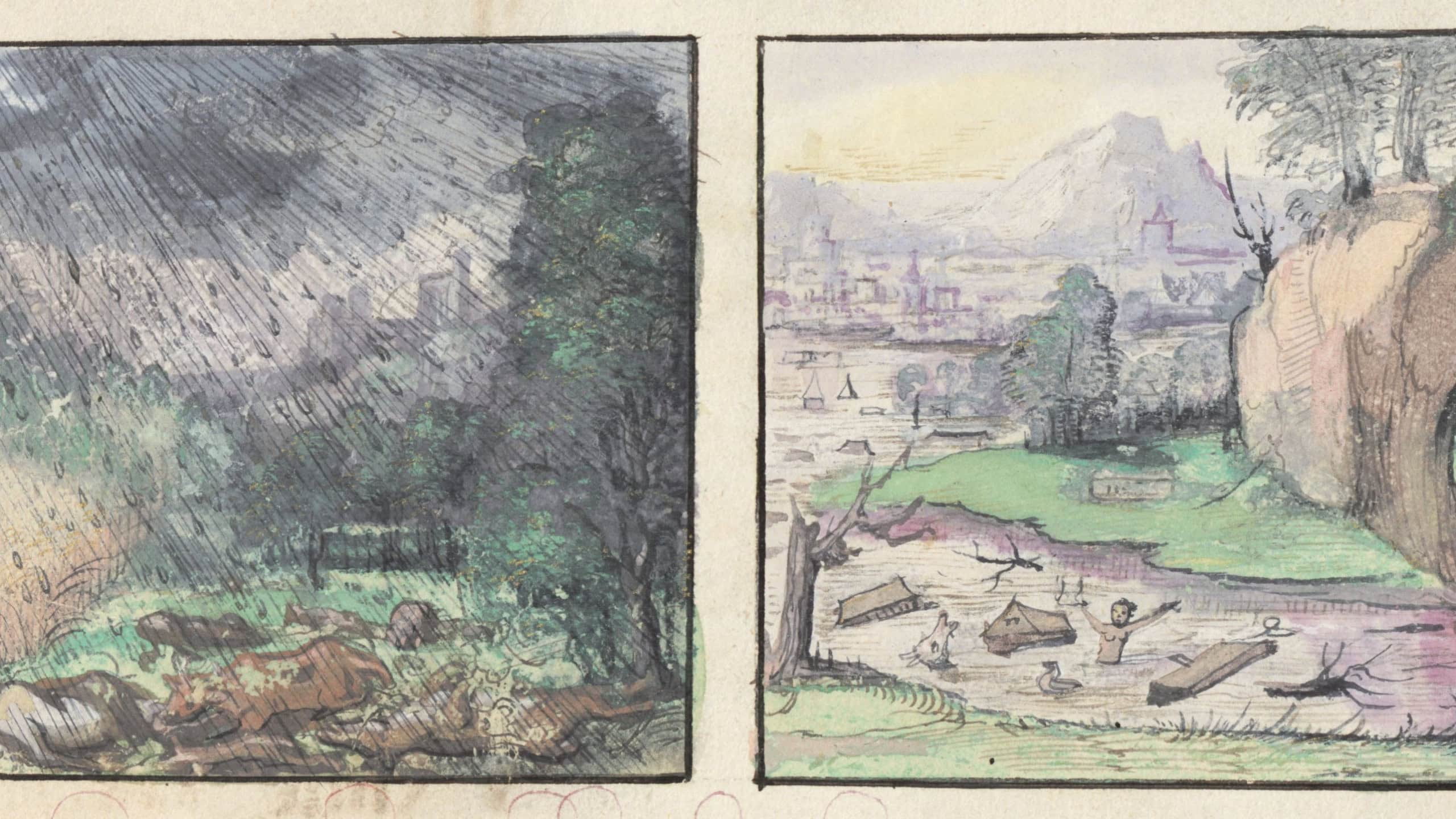
A historical illustration in Jakob Fugger’s "Ehrenspiegel" depicts extreme rainfall and flooding in the 13th century. © BSB Munich, Cgm 895, fol. 133v. | Public Domain Mark 1.0 Universal
Saxony is no stranger to flooding. The floods of 2002 and 2013 are still fresh in many people’s minds. About 700 years ago, Europe experienced an even more unusual series of floods. Within just two years, 16 major floods occurred. This is shown by a new study published in the scientific journal *Nature*, with contributions from Leipzig-based environmental historian Martin Bauch of the Leibniz Institute for the History and Culture of Eastern Europe (GWZO).
Until now, the Magdalene Flood of July 1342 was considered the most severe flood in Central Europe over the past millennium. The study shows that it was not an isolated event. Between the winter of 1341 – 42 and the end of 1343, 16 major floods struck large parts of Europe. Four of these reached magnitudes that, statistically speaking, are expected to occur only about once every 500 to 1,000 years. These included the Magdalene, Candlemas, St. James, and St. Bartholomew floods. 1342 was the year with the most floods in the past 700 years.
16 floods in two years
The researchers analyzed over 1,000 historical sources, such as chronicles and account books. Bauch primarily contributed sources from Central Germany, Bohemia, and Eastern Central Europe to the study.
Lead author Andrea Kiss from TU Wien conducted research in 2025 as a visiting scholar at the GWZO in Leipzig. “We can reconstruct, month by month, which regions of Europe were affected and when. This clearly shows that the floods stretch like a string of pearls through the years 1341 to 1343 – not all equally devastating, not all in the same place, but all clearly connected,” she says.
In Prague, the Vltava River swept away the Judith Bridge, the predecessor to the Charles Bridge. On the Elbe River, bridges in Dresden and Meissen collapsed. The chronicler Johann von Winterthur reported approximately 6,000 deaths along the Danube. According to the researchers, the floods claimed many thousands of lives across Europe.
Volcanoes and sea ice may have played a role
The researchers cite several factors as possible causes for this unusual cluster of events. Around 1340, a series of major volcanic eruptions occurred, including at least five in the tropics as well as an eruption of the Icelandic volcano Hekla. At the same time, Arctic sea ice retreated over several years. Both factors could have altered air currents over Europe and contributed to extreme, prolonged precipitation.
Bauch contextualizes the series of events. “The Magdalene Flood remains present in the collective memory to this day because it was documented with flood marks and commemorative plaques, but also through annual prayer processions. The fact that it was just one event in a whole chain of disasters has been forgotten over the centuries.” These years were part of the crisis of the 14th century, which culminated a few years later in the Black Death, explains Bauch.
Vienna-based hydrologist Günter Blöschl also sees significance in this for today’s flood protection. “Floods are not statistically independent of one another: they do not simply occur at random like lottery wins, but can be statistically and causally linked,” he says. However, series of multiple extreme floods occurring within a few months are rarely taken into account in today’s risk management.
According to the researchers’ assessment, climate change could make such clusters more likely in the future. They therefore advocate taking into account not only individual extreme events but also entire series of events when planning flood protection measures.
Original publication:
Kiss, A., Viglione, A., Barrientos, M., Enzi, S., Bauch, M. et al. (2026): Cascading continental-scale floods across Europe in 1342–1343. Nature.