
Plastic could make data storage more energy-efficient
Magnets that can be switched on and off using a small amount of electricity could make data storage more energy-efficient. Researchers at Chemnitz University of Technology have shown that this requires no liquid electrolyte and less energy.
Read Aloud
0:00
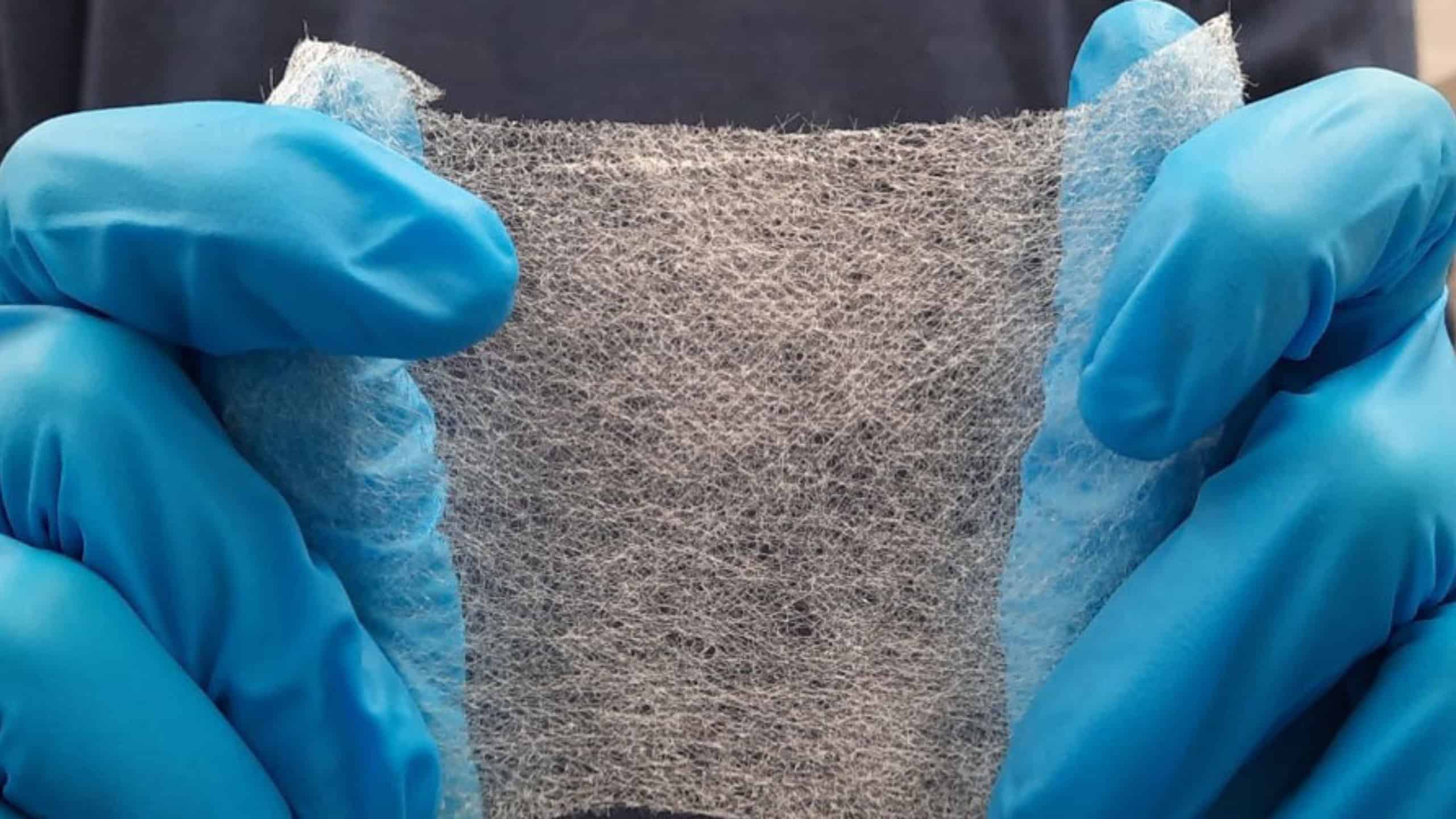
These porous plastic films can store small amounts of liquid. Researchers at Chemnitz University of Technology have used them as electrolytes to selectively alter the magnetic properties of materials. © Danny Quint
Many of our electronic devices contain magnetic materials. They are important, for example, when we want to store photos, videos, or documents. Hard drives use tiny areas for this purpose, whose magnetization can be selectively altered. In this way, information can be written to these areas and later overwritten.
But this switching process consumes energy. Researchers at Chemnitz University of Technology are therefore investigating a method that allows magnetic properties to be altered using small electric currents. They have now succeeded in improving a key component of this technology, which could lead to more energy-efficient data storage in the future.
Plastics instead of liquid electrolytes
The researchers are using a clever trick to achieve this. It works similarly to a battery. Using electricity, they trigger a chemical reaction that alters the magnetic material. This allows its magnetic properties to be precisely controlled. The process is called magneto-ionics.
For this to work, electrically charged particles must move. A so-called electrolyte ensures this happens. Until now, liquids have mostly been used for this purpose. However, they can leak and must therefore be securely packaged. In addition, unwanted chemical reactions can occur. For example, water can split into hydrogen and oxygen. This consumes additional energy.
The team led by Prof. Karin Leistner, holder of the Chair of Electrochemical Sensors and Energy Storage, therefore sought an alternative to liquid electrolytes. Together with researchers from the Chair of Polymer Chemistry, led by Prof. Michael Sommer, they tested various plastic-based electrolytes. These included a thin film that stores a small amount of liquid, a gel, and a special membrane.
A building block, but not yet a finished data storage device
All three variants worked. The researchers were able to use them to alter the magnetic properties of very thin metal layers. In doing so, the magnetic state could be reset more effectively than with conventional liquid electrolytes. Furthermore, the process required less energy. This is because fewer unwanted chemical reactions occurred with the new materials, resulting in less energy loss.
The experiments show that the magnetic properties of the materials can be altered even with a low electrical voltage. However, further research is needed before they can be used in electronic devices. The Chemnitz-based development is, so far, a laboratory result – not a finished data storage device.
The new materials could offer another advantage: they might be easier to integrate into electronic components. Unlike conventional liquid electrolytes, they would not require a rigid casing to prevent leakage. This could pave the way for flexible components in the future.
Original publication:
M. Gößler, R. Weber, M. Sommer, and K. Leistner, “Magneto-Ionic Devices With Polymer-Based Electrolytes.” Advanced Functional Materials (2026): e78857.