What heated fats have to do with evolution
When food is fried or baked, heat alters the fats in it. Little research has been done on what effects these changes have on the body or whether living organisms adapt to them. A research team in Dresden is using fruit flies to find answers.
Read Aloud
0:00
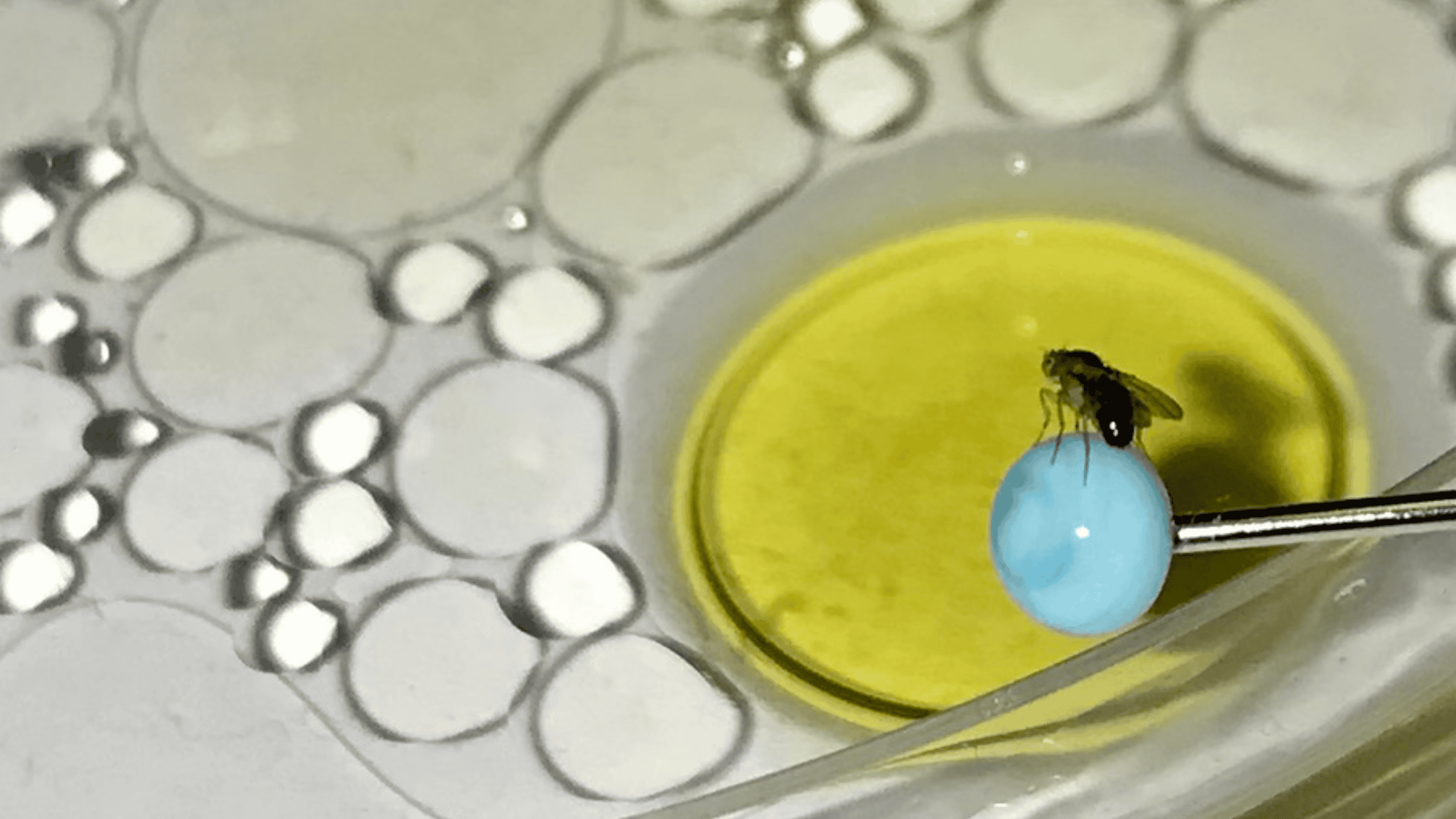
A fruit fly hovering over a drop of oil. Researchers want to use these insects to study the effects of heated dietary fats and whether flies adapt to them over generations. © AG Marko Brankatschk
The pan sizzles, the oil is heating up, and the fried potatoes are about to go in. But what does heat do to the fat? And what do heated fats do to us? Researchers in Dresden want to find out. A tiny creature – the fruit fly – is set to help them.
The German Research Foundation (DFG) is funding a new research group at the Technical University of Dresden (TUD) with approximately 3.1 million euros over four years. Biology professor Klaus Reinhardt leads the group. The Swiss National Science Foundation is also funding the project.
Cooking, frying, and baking have been part of everyday life for millennia. Heat makes food easier to digest and alters its chemical composition. The effects of heated sugar and heated protein have been well studied. In contrast, little is known about the effects of fats – so-called lipids – after they’ve been heated. The researchers are not only interested in what effects such altered fats have on the body; they also want to know whether living organisms can adapt to them over many generations.
Fruit flies as test subjects
Seven research groups from TUD and Dresden University Hospital are collaborating with a Swiss research team on this project. The researchers come from the fields of biology, food chemistry, and molecular medicine. First, they want to find out what happens to plant-based and animal fats when they are heated. Then they will examine the consequences. How do the altered fats affect the animals? And do the flies adapt to them over many generations?
The fruit fly is well-suited for this purpose. It has a short lifespan and reproduces rapidly. This allows researchers to observe the effects of different dietary fats over many generations. The researchers are focusing primarily on reproduction and the question of how the flies adapt to different dietary conditions.
An open lab for everyone
“Although the results from the flies cannot be directly applied to humans, many fundamental biological processes and lipid transport systems are comparable between flies and humans,” explains Marko Brankatschk, acting professor of plant cell and molecular biology at TUD. In the long term, the team therefore aims to clarify what the findings might mean for human nutrition and evolutionary history.
The researchers also plan to bring this topic into schools. Through special educational programs, students will learn how nutrition relates to chemistry, biology, and evolution. Later, an “Open Lab” will be established. There, interested participants can bring their own food samples and work with the scientists to investigate how the fats in the samples affect fruit flies.