
How nerve cells avoid traffic jams
Nerve cells move essential materials along tiny tracks. Problems with this transport system have been linked to several neurological disorders. Researchers in Dresden are investigating the “traffic rules” that keep materials moving inside nerve cells.
Read Aloud
0:00
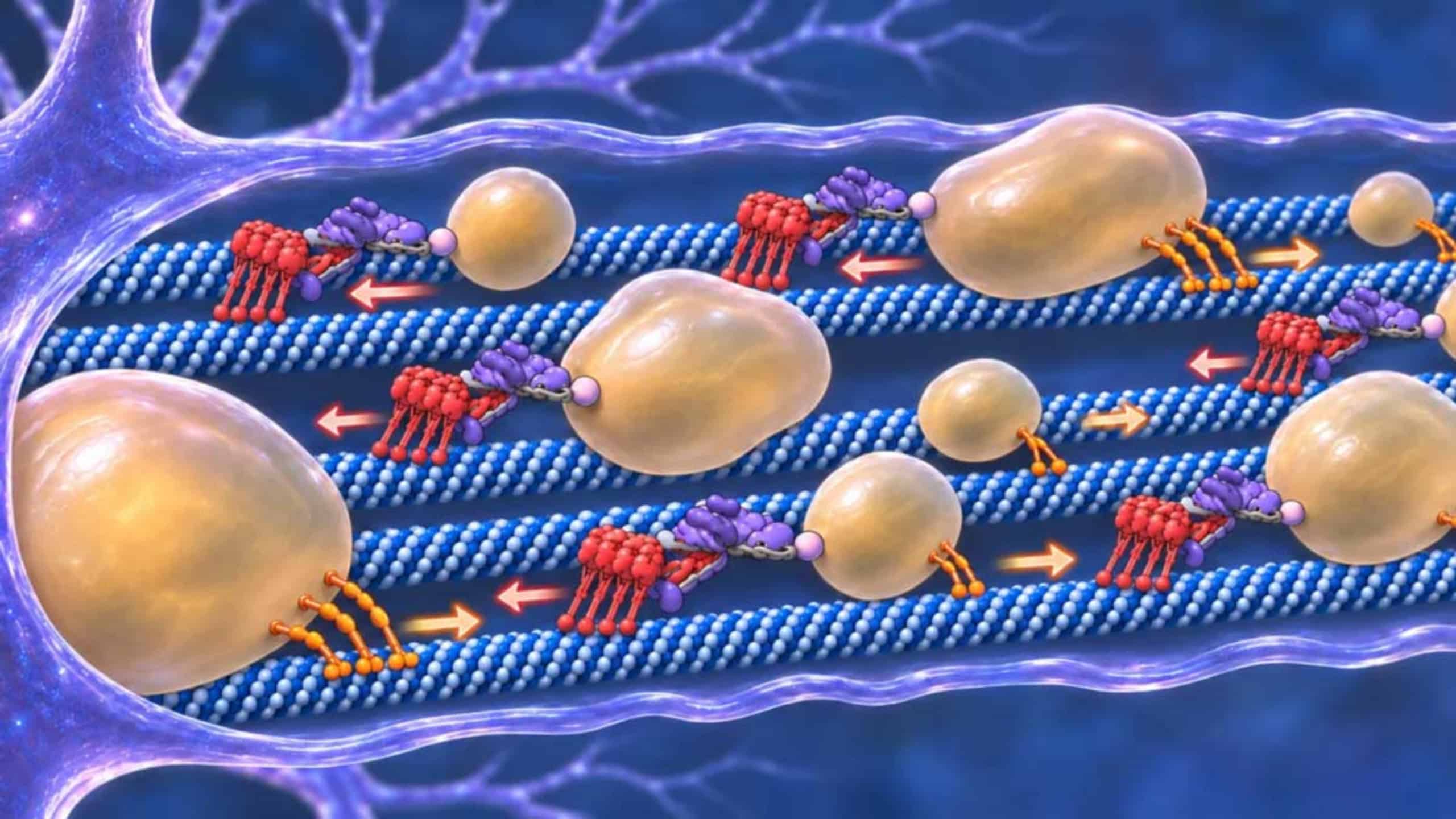
In the long extension of a nerve cell, there is two-way traffic. The orange motor proteins transport substances and cellular components to the tip. The red ones bring them back to the cell body. © Stefan Diez, created with ChatGPT 6 based on schematic drawings by Anne Straube
Even in warm, lined boots, cold feet are a fact of life in autumn and winter. We can feel the cold right down to our little toes because nerve endings in the skin respond to a drop in temperature. Nerve cells carry the signal to the spinal cord. From there, it travels to the brain, where we register the cold.
Inside the longest nerve cells, essential materials have to travel up to a metre. This steady supply keeps parts of the cell far from its centre working properly. Researchers at TU Dresden, the University of Göttingen and the University of Warwick want to find out how this transport system works. The European Research Council is funding their joint project, TransportRules, with around €10 million over six years.
Around €3.5 million will go to the Dresden research group led by Stefan Diez. He is a professor at B CUBE, the Center for Molecular Bioengineering at TU Dresden, and a Max Planck Fellow at the Max Planck Institute for Molecular Cell Biology and Genetics (MPI-CBG).
When the supply stalls
Nerve cells need to move signalling molecules and tiny structures that generate energy from one part of the cell to another. Proteins that act like tiny motors carry these materials along fine fibres that serve as tracks. Each track is only a fraction of a millimetre long, yet the transport system can deliver materials all the way to the tip of a nerve cell’s long extension.
The longest nerve cells are often among the first to suffer when transport breaks down. Researchers have linked such problems to inherited nerve disorders that can weaken muscles or reduce sensation in the feet. They have also observed transport problems in nerve cells affected by Alzheimer’s disease, Parkinson’s disease and ALS. The role these problems play varies from one disease to another.

“Surprisingly, we still know very little about how this traffic is organised within our cells,” says Diez, who also works at Dresden’s Physics of Life Cluster of Excellence. “Without this understanding, we can hardly explain what goes wrong in these diseases.”
Traffic jams in the lab
At the University of Warwick, Anne Straube and her team will observe how materials move through living human nerve cells. In Göttingen, Stefan Klumpp’s team will use computer simulations to study how the different parts of the transport system work together.
In Dresden, Diez and his colleagues will recreate the system in the lab. They will build extremely thin tracks and make artificial packages that they can modify for different experiments. “This allows us to specifically investigate how traffic jams and collisions occur,” says Diez. In a 2012 lab study, Diez and his colleagues showed that certain motor proteins can jam when too many crowd onto the same track.
By the end of the project, the three teams aim to develop a model that explains how transport works in healthy nerve cells. That could help them understand why the system falters in some diseases and guide future research into treatments.