Atherosclerosis: The speed of gene activity matters
In cases of atherosclerosis, plaque deposits can rupture and trigger a heart attack or stroke. Researchers in Leipzig have discovered what influences this: the rate at which cells transcribe information.
Read Aloud
0:00
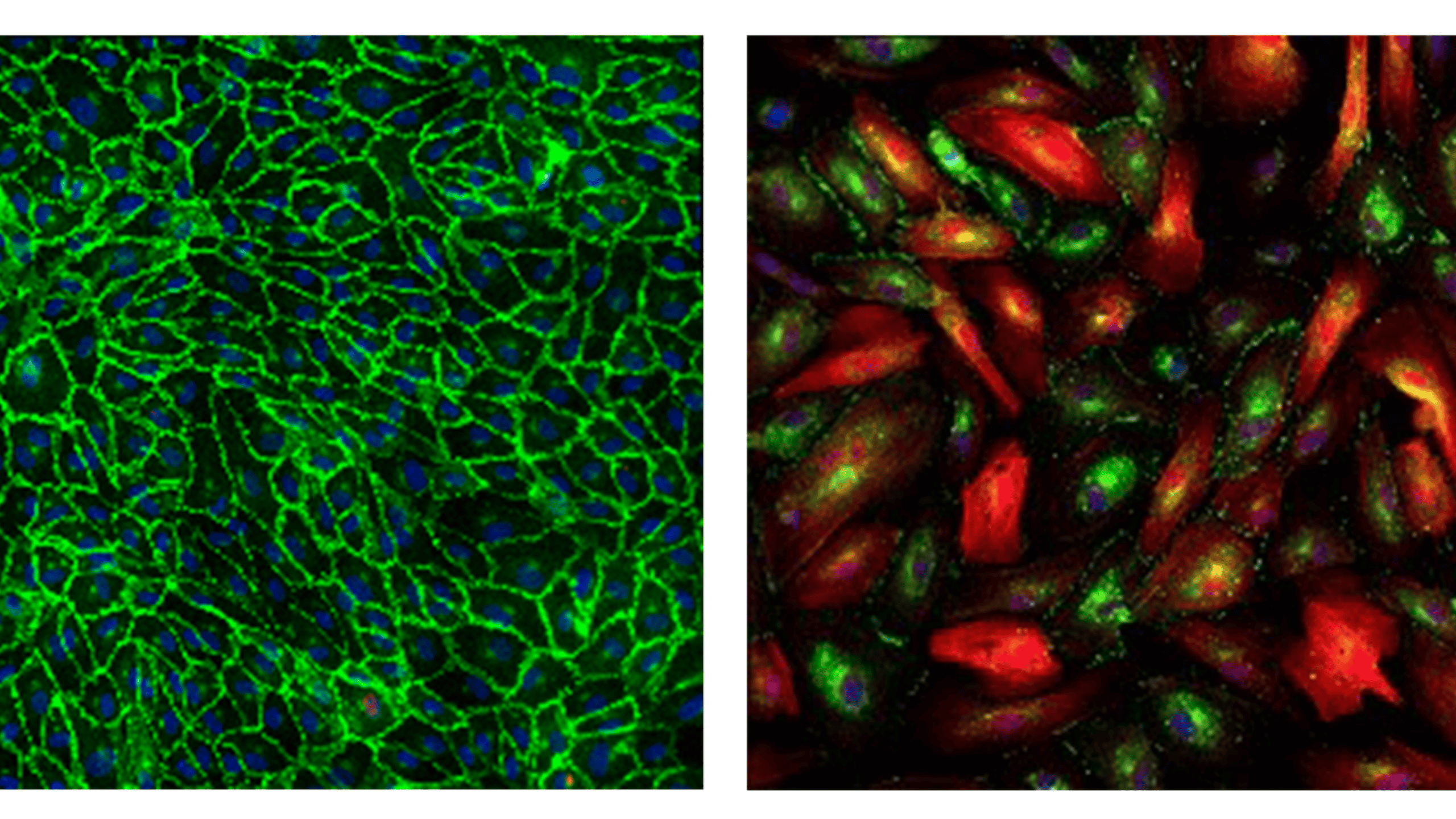
Healthy endothelial cells (green) line the inside of blood vessels. When they undergo pathological changes (red), they lose their cohesion. The vessel wall becomes more permeable, allowing fat and immune cells to penetrate and promote plaque formation. © Jes-Niels Boeckel
A heart attack or stroke often strikes suddenly. The underlying cause, however, develops over many years. Deposits build up in the walls of blood vessels. Experts call them plaques; the disease is called atherosclerosis, commonly known as hardening of the arteries. It becomes dangerous when such a deposit ruptures. A blood clot can then form and block a blood vessel.
A research team at Leipzig University Medical Center has now discovered a mechanism that could make such deposits more unstable. Apparently, it is not only a matter of which genes are active in the cells; how quickly this occurs is also crucial.
The focus is on cells that line the inside of blood vessels. They form a protective layer between the blood and the vessel wall. In atherosclerosis, these cells are exposed to inflammation and altered blood flow over a long period of time. As a result, they can undergo changes and become increasingly unable to fulfill their original function. The vessel wall becomes more permeable.
When genes are activated too quickly
In order for a cell to use the information contained in a gene, it must first transcribe it. This process produces RNA, a kind of working copy of the genetic information. This process does not always proceed at the same speed. For many genes, there is initially a pause shortly after transcription begins.
A group of proteins can end this pause. It is called the Super Elongation Complex, or SEC for short. The Leipzig researchers discovered that this mechanism becomes particularly active when the cells in the blood vessel wall undergo pathological changes. “We were able to show that in the pathological transformation of endothelial cells, it is not only crucial which genes are activated, but also how quickly this cellular transcription occurs,” says study leader Prof. Dr. Jes-Niels Boeckel of the University of Leipzig and Leipzig University Hospital.
The team therefore attempted to slow down the process. To do this, the researchers treated human vascular cells in the lab with experimental compounds. The pathological changes in the cells decreased. In a further experiment, they amplified the mechanism. As a result, the cells developed typical disease characteristics even without additional stimuli.
The researchers also investigated the effect in three-dimensional models of heart tissue. When the mechanism was slowed down, less collagen was deposited and the heart muscle cells functioned better.
Still a long way from a treatment
The team then tested the approach on mice with vascular calcification. Treated animals had fewer plaques and fewer pathologically altered cells in their blood vessels. This was observed both in preventive treatment and in cases of pre-existing atherosclerosis. However, the active ingredient has not yet been tested in humans with atherosclerosis.
In addition, the researchers examined 1,048 sections of human plaques from a Dutch biobank. There, too, they found a link between the mechanism under investigation and the characteristics of unstable plaques. Whether a treatment that inhibits this mechanism would actually help humans cannot be determined from these findings.
The active ingredients used in the study are experimental. However, one component of the mechanism under investigation – the protein CDK9 – is also being studied in cancer research as a potential target for drugs. It remains to be seen whether this could one day lead to the development of a treatment for atherosclerosis.
Original publication:
Kokot, K.E., Reichardt, S., Menedo, C. et al. Targeting super elongation complex-driven RNA polymerase II elongation reduces plaque vulnerability. Sig Transduct Target Ther 11, 385 (2026).