A little more rain, much more flooding
In 2024, Storm Boris caused severe flooding in Central Europe. Researchers from Leipzig and Dresden have calculated the extent to which climate change influenced the flooding.
Read Aloud
0:00
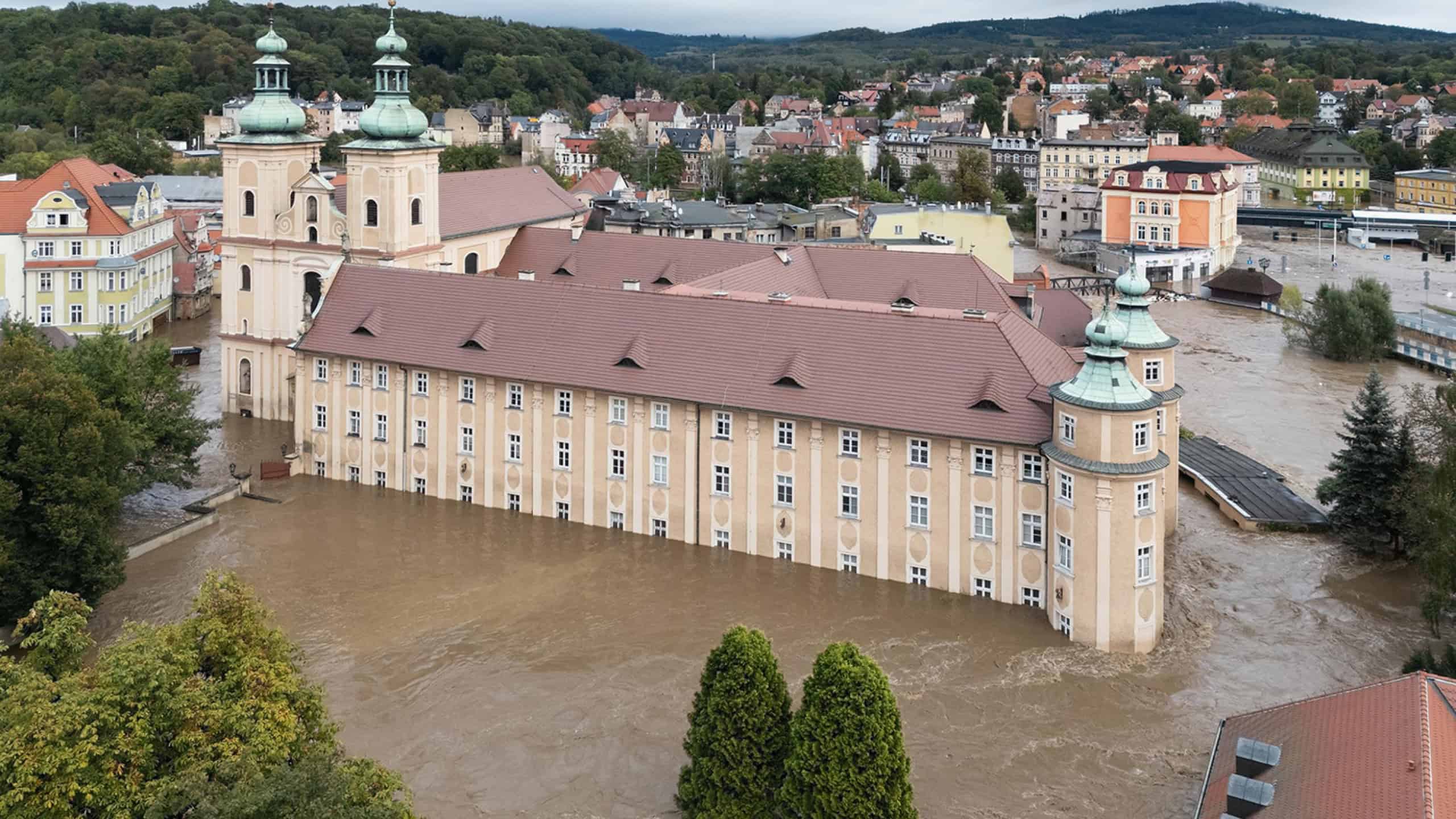
Flooding after Storm Boris: In September 2024, the Glatz Neisse flooded the grounds of the Franciscan monastery in Kłodzko, Poland. © Jacek Halicki, CC BY-SA 4.0
It rained for days in September 2024 in parts of Central and Eastern Europe. Rivers burst their banks, and entire towns were flooded. Storm Boris hit Poland, the Czech Republic, and Austria particularly hard. It was already known that climate change had intensified the rainfall. Researchers from Leipzig and Dresden have now investigated what this meant for the flooding. According to their findings, the impact of climate change on peak flood levels was significantly greater than on rainfall amounts.
A small increase in rainfall, a big one in the rivers
The study was conducted under the leadership of the Helmholtz Center for Environmental Research (UFZ) in Leipzig. The team led by lead author Peter Miersch calculated not only how much rain fell during Storm Boris, but also how much water consequently entered the rivers. To do this, the researchers used various computer programs and compared two scenarios: flooding under current climate conditions and the same event in a hypothetical world without human-induced climate change.
Without this influence, approximately six to nine percent less precipitation would have fallen during Storm Boris. The peak flood levels would have been 14 to 22 percent lower on average. This refers to the moment when the most water is flowing through the river.
The ground plays an important role. “It can initially absorb part of a heavy rainfall event,” explains Miersch. “But at some point it becomes saturated, and then every additional millimeter of water flows directly into the river.” To verify their results, the researchers used two climate models and two different computational methods for water runoff. One of them utilized artificial intelligence. Despite the different methods, they arrived at similar results.
Dikes have their limits
This makes a significant difference for flood protection. Dikes and protective walls can only hold back certain amounts of water. “If climate change leads to a ten percent increase in extreme precipitation, that doesn’t mean the flooding will also be only ten percent worse. It could also be twenty percent,” says Jakob Zscheischler. He conducts research at the UFZ and is a professor at TU Dresden.
According to Zscheischler, if the limits of flood protection are exceeded, very extensive damage can occur very quickly. That is why it is not enough to consider only how rainfall amounts are changing during the planning process.
The study does not answer whether storms like Boris will become more frequent in the future due to climate change. Changes to the landscape or water management practices were also not taken into account. The researchers specifically wanted to determine what difference climate change made in this one event.
This is an important insight for assessing future flood risks. It is not just the amount of rainfall that matters, but also what happens to the water afterward.
Original publication:
Peter Miersch et al., Evidence from the 2024 Storm Boris indicates that anthropogenic climate change amplifies floods more than extreme precipitation. Sci. Adv. 12, eaef7703 (2026).