Green roofs put to the test in heavy rain: Why design matters
How well can green roofs help protect our cities from heavy rainfall? Researchers from Leipzig and Dresden put them to the test in 222 experiments.
Read Aloud
0:00
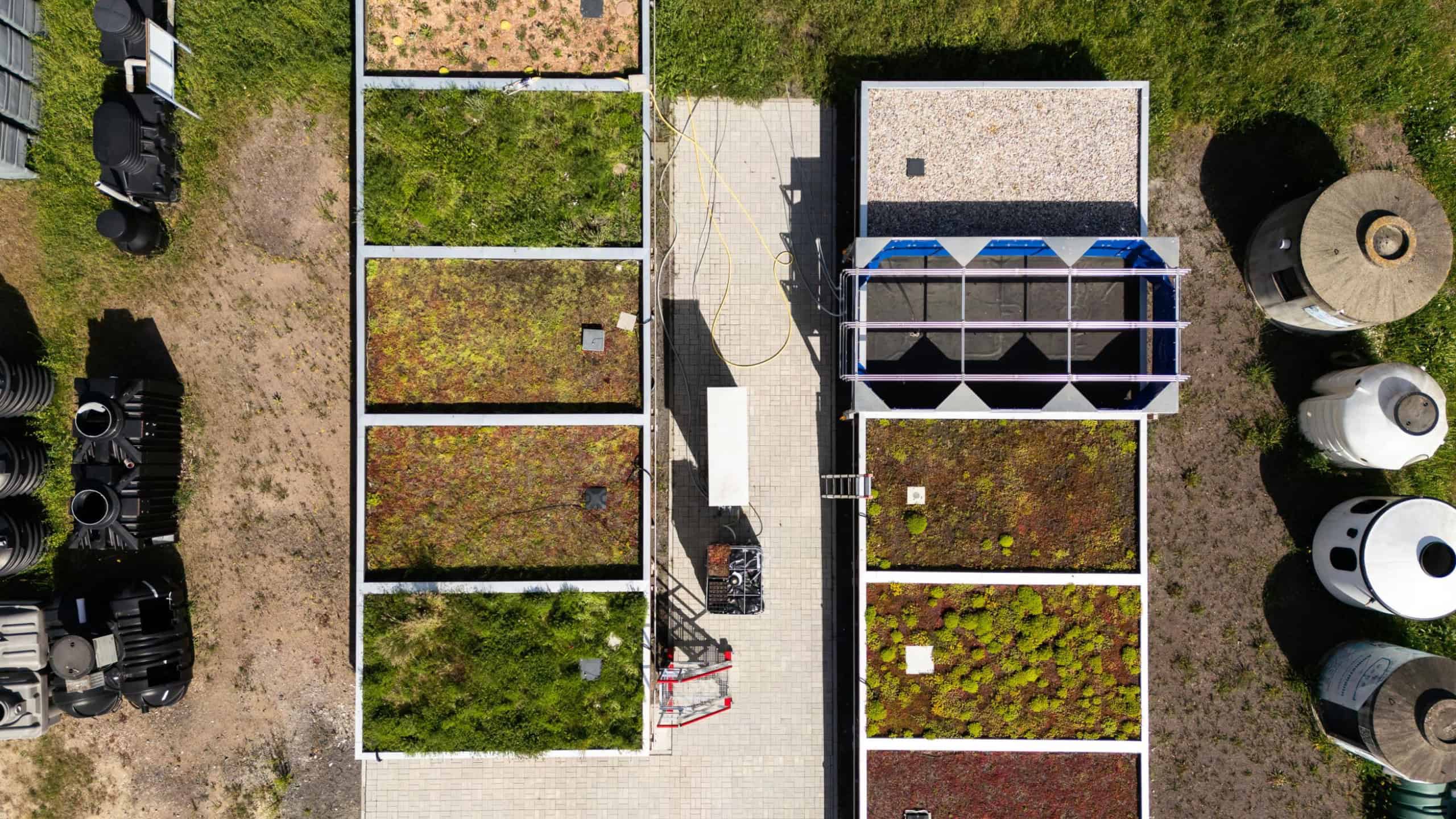
Ten roof structures, 222 heavy-rain tests: At this test facility in Leipzig-Leutzsch, researchers investigated how effectively green roofs retain rainwater and delay its runoff. © Leipzig Group
One moment, it's hot and dry. The next, rain is pouring down. Water gushes out of storm drains, streets turn into streams, and basements flood. During heavy rainfall, urban drainage systems can quickly become overwhelmed. Green roofs could help slow the flow of rainwater. But how effective are they? A research team from Leipzig and Dresden spent four years investigating.
The MaNuGrün project brought together Leipzig Waterworks, Leipzig University of Applied Sciences (HTWK Leipzig), the Helmholtz Centre for Environmental Research (UFZ), and Dresden's municipal wastewater utility, along with other partners. The four-year project began in December 2021 and was funded by the German Federal Environmental Foundation.
For the study, Leipzig Waterworks built a test facility with ten different roof configurations: eight commercially available green roof systems, a gravel roof, and a conventional roof.
Between June and September 2025, a specially designed rainfall simulator subjected the roofs to 222 artificial rainstorms of varying intensity. Some simulated rainfall events expected statistically about once a year, while others reproduced the intensity of a so-called 100-year storm. Sensors measured how much water drained from the roofs and how quickly it flowed away.
Slowing the runoff is key
All the green roofs tested significantly slowed the flow of rainwater. A green roof with a deeper growing medium and a flow restrictor proved particularly effective. The restrictor controls how much water can drain from the roof at a time.
Roofs with a growing medium at least ten centimetres deep were especially good at retaining rainwater. So it's not simply the plants that matter. What lies beneath them makes a big difference, too.
This matches findings from studies in England and the US. There, green roofs retained almost all the water from lighter rain showers. During heavy rainfall, however, they quickly reached their storage capacity. At that point, what matters most is how slowly the water drains away.
Smarter sewer planning
Cities use computer models to plan their sewer networks. But these models often fail to accurately account for how much rainwater drains from green roofs. As a result, they can overestimate the amount of water entering the sewer system. In some cases, the predicted runoff was up to eight times higher than the amount actually measured during the experiments.
Using the data collected, HTWK Leipzig developed a more accurate model. The UFZ also examined the water balance of each roof, looking at how much water was retained, evaporated or drained away.
"Rainwater should be retained, allowed to evaporate or soak into the ground," says HTWK Professor Hubertus Milke. "Green roofs are an effective way to achieve this."
The findings could help cities plan their drainage systems more accurately. To make the research useful in practice, the Education and Demonstration Centre for Decentralised Infrastructure (BDZ) has produced a guide for local authorities, planning firms and private individuals.