

Steer instead of just braking: When an accident Is inevitable
An emergency braking system in a car is designed to prevent accidents. But sometimes braking isn't enough. Chemnitz University of Technology is researching ways to minimize injuries to pedestrians.
Read Aloud
0:00
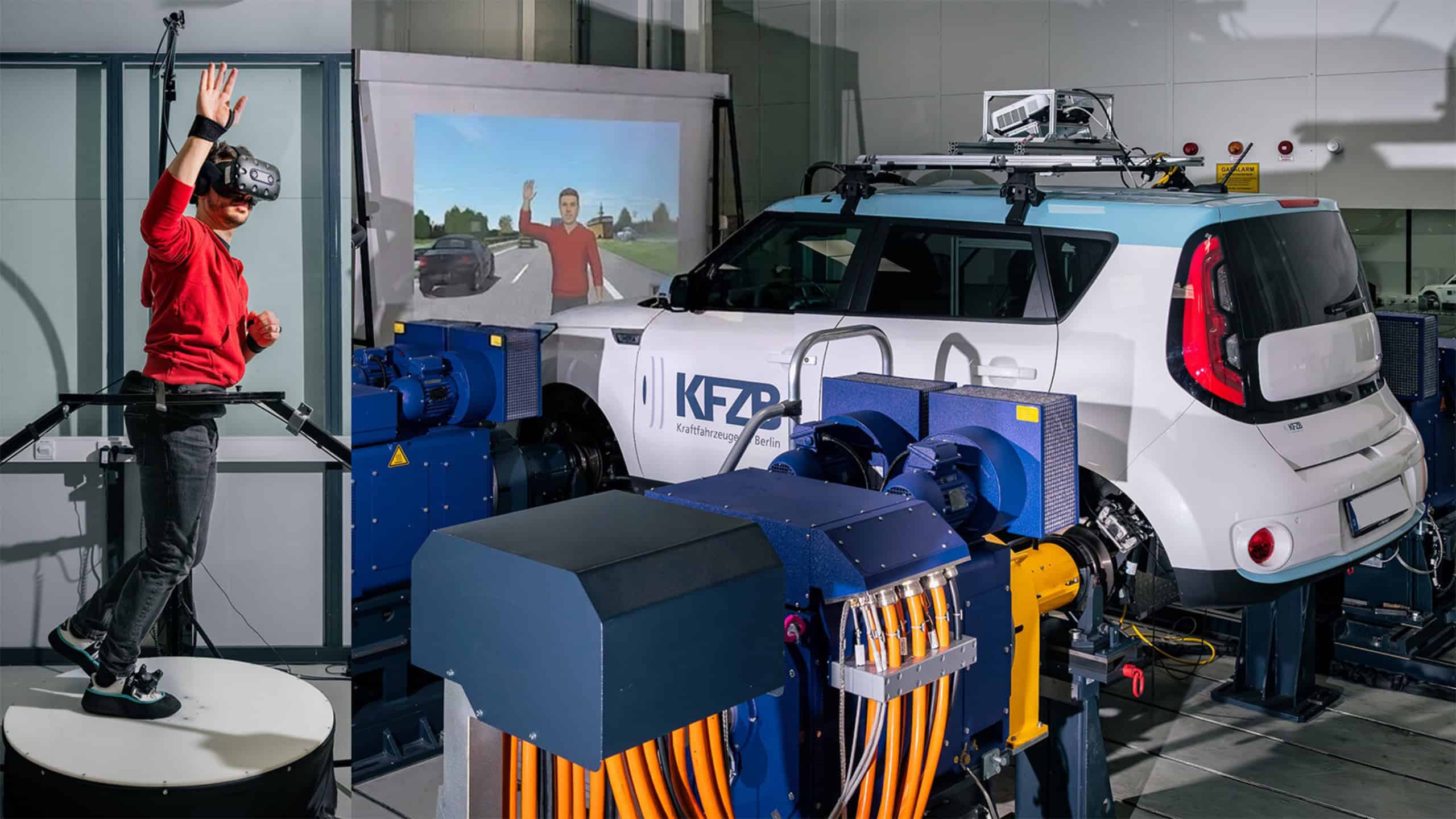
A test facility at the Technical University of Berlin combines reality and simulation, bringing vehicles and people together – without any injuries. Researchers from Chemnitz are also collaborating on this project. © Kevin Fuchs
A pedestrian suddenly steps onto the street between two parked cars. The driver of the car brakes immediately, but there isn’t enough time to stop. In moments like these, the severity of a person’s injuries can be determined. According to the Federal Statistical Office, nearly two-thirds of traffic fatalities within built-up areas in 2025 involved pedestrians or cyclists.
Many new cars are equipped with emergency braking assistance. This system can detect people on the road and brake automatically. Researchers at Chemnitz University of Technology are now collaborating with partners to develop a technology designed to do more than just brake. In the event of an unavoidable accident, it is also intended to steer the vehicle in a targeted manner. The goal is no longer to prevent the collision, but to minimize injuries as much as possible.
When braking alone isn’t enough
In the VIRTUS research project, researchers are developing an algorithm – that is, a defined computational process. It analyzes data from the vehicle’s sensors, predicts how a pedestrian or cyclist will move, and calculates how the car should brake and steer.
The fact that cars can brake or swerve on their own is nothing new – this technology already exists. For the scientists, another question is more important: What happens if a collision is nevertheless unavoidable? In that case, it also depends on where and at what angle the vehicle strikes a person. That is precisely what the new control system is designed to take into account.
Initial computer simulations in the predecessor project, ATTENTION, have already shown that the risk of injury can be reduced through targeted braking and steering. Over the next three years, the researchers plan to test whether this also works reliably under realistic conditions. The federal government is funding the project with approximately 1.6 million euros, of which Chemnitz University of Technology will receive 247,000 euros. Also participating are the Technical University of Berlin and the Fraunhofer Institute for Transient Dynamics, which is leading the project.
Real people in virtual traffic
For the tests, a real car on a test bench, a driver, and a virtual pedestrian are connected to one another. This allows dangerous traffic situations to be simulated without putting anyone at risk. “This is a crucial step toward operational safety technology,” says project manager Thomas Soot of the Fraunhofer Institute.
The team led by Chemnitz-based psychologist Professor Stefan Brandenburg is investigating how drivers and pedestrians react to such maneuvers. This also addresses the question of whether people trust the technology and how their behavior influences its effectiveness.
With VIRTUS, the researchers aim to do more than just test the new driving function. They are also developing test procedures and ethical guidelines that can be applied to other automated driving systems in the future. After all, the question of how to best protect people in the event of an unavoidable accident arises in other situations as well.