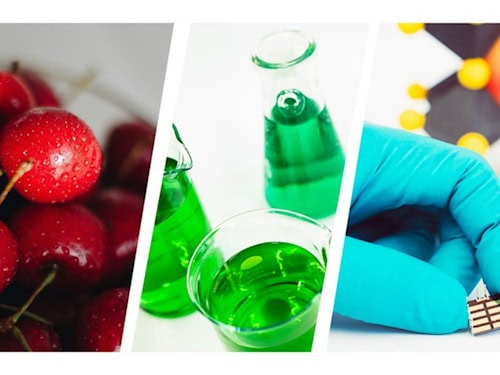
Banana flavoring replaces toxic chemical in solar cell production
A substance that smells like bananas could make the production of solar cells safer. Researchers in Dresden have used it to replace a toxic solvent.
Read Aloud
0:00
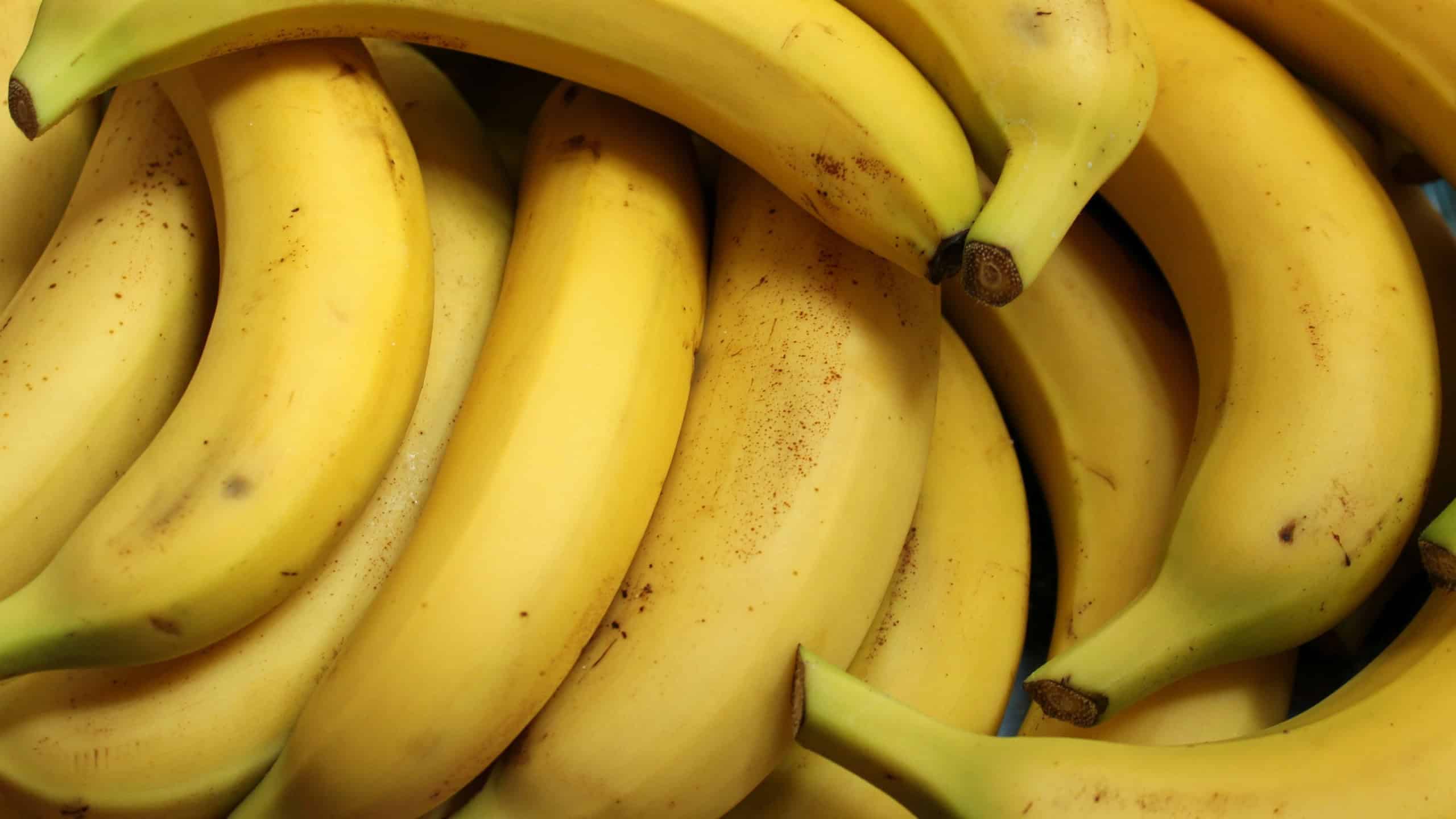
A substance that contributes to the characteristic scent of ripe bananas could make the production of solar cells safer. Researchers in Dresden are using it as an alternative to a toxic solvent. © Alicja/pixabay
The scent of a ripe banana wafts up to our noses. It reminds us of summer ice cream sundaes or freshly baked banana bread. One of the substances responsible for this is isoamyl acetate, which occurs naturally in bananas. The food industry uses it as a flavoring for fruit gummies, yogurt, or candies. Researchers in Dresden have now found a completely different use for it: they’re using it to make solar cells.
These are so-called perovskite solar cells. Among other things, they consist of a wafer-thin crystal layer that converts sunlight into electricity. Such solar cells are considered promising because they could be manufactured relatively easily and inexpensively. But there’s a problem. Until now, the production process has often required solvents that are harmful to health.
One of these is dimethylformamide, or DMF for short. Substances are dissolved in it to later form the thin layer of the solar cell. Among other things, DMF can harm unborn children in the womb. For this reason, stricter regulations governing the use of this chemical in the workplace have been in effect in the European Union since the end of 2023.
The computer searches for a replacement
Researchers have long been searching for less harmful alternatives. They usually test various liquids in the lab to do so. A team from the Technical University of Dresden (TUD) and the Leibniz Institute for Solid State and Materials Research Dresden (IFW), in collaboration with the Universidad Nacional del Sur in Argentina, has taken a different approach.
The scientists developed a method that allows suitable solvents to be predicted using a computer. To do this, they combined several computational models. These help assess how well certain substances dissolve in a liquid and whether they are suitable for the production of solar cells.
The starting point was 1,268 possible solvents. After several screening steps, five remained, which the team tested in the laboratory. Among them were substances primarily used in the food and perfume industries.
Until now, there has been no systematic approach to searching for less harmful solvents for the production of solar cells, explains Prof. Yana Vaynzof. “This prompted us to consider whether we should completely rethink our search for suitable solvents.” Vaynzof heads the Institute for Novel Electronic Technologies at IFW Dresden and holds a professorship at TU Dresden.
Banana-scented solar cells pass the test
The best solar cell, manufactured using isoamyl acetate, converted 23.2 percent of the incident sunlight into electricity. A comparison cell using the conventional solvent DMF achieved 22.4 percent. On average, the efficiencies were similarly high.
The researchers were thus able to demonstrate that DMF can be replaced without the solar cells suffering a significant loss in efficiency. However, production does not work without additional solvents. DMSO, which was also used, is considered significantly less harmful.
However, there is still a lot of work to be done before such solar cells can be produced in large quantities. The particularly high-performance cells were only a few square millimeters in size. Initial experiments with larger cells have already been conducted. However, they converted less sunlight into electricity. It remains to be seen whether the process will also work in factories.
There is also another environmental issue. The perovskite solar cells studied still contain lead. So using less harmful solvents alone does not yet make the technology environmentally friendly.
Next, the Dresden researchers want to investigate whether the new solvents can also be used in the recycling of solar cells. Their computational method could also aid in the manufacture of other electronic components, as those processes also involve materials that have traditionally required problematic solvents.
Original publication:
Jose Roberto Bautista-Quijano, Herman Heffner, Vladimir Shilovskikh, Boris Rivkin, Ignacio López-Corral, Yana Vaynzof; A predictive approach for fabricating efficient perovskite solar cells using green solvents. Energy Environ. Sci. 2026.