Hydrogen Expert: “We’re good enough to get started”
In the future, hydrogen is expected to play a role in the energy supply. But the gas is difficult to handle. Prof. Peter Wasserscheid is working on solutions.
Read Aloud
0:00
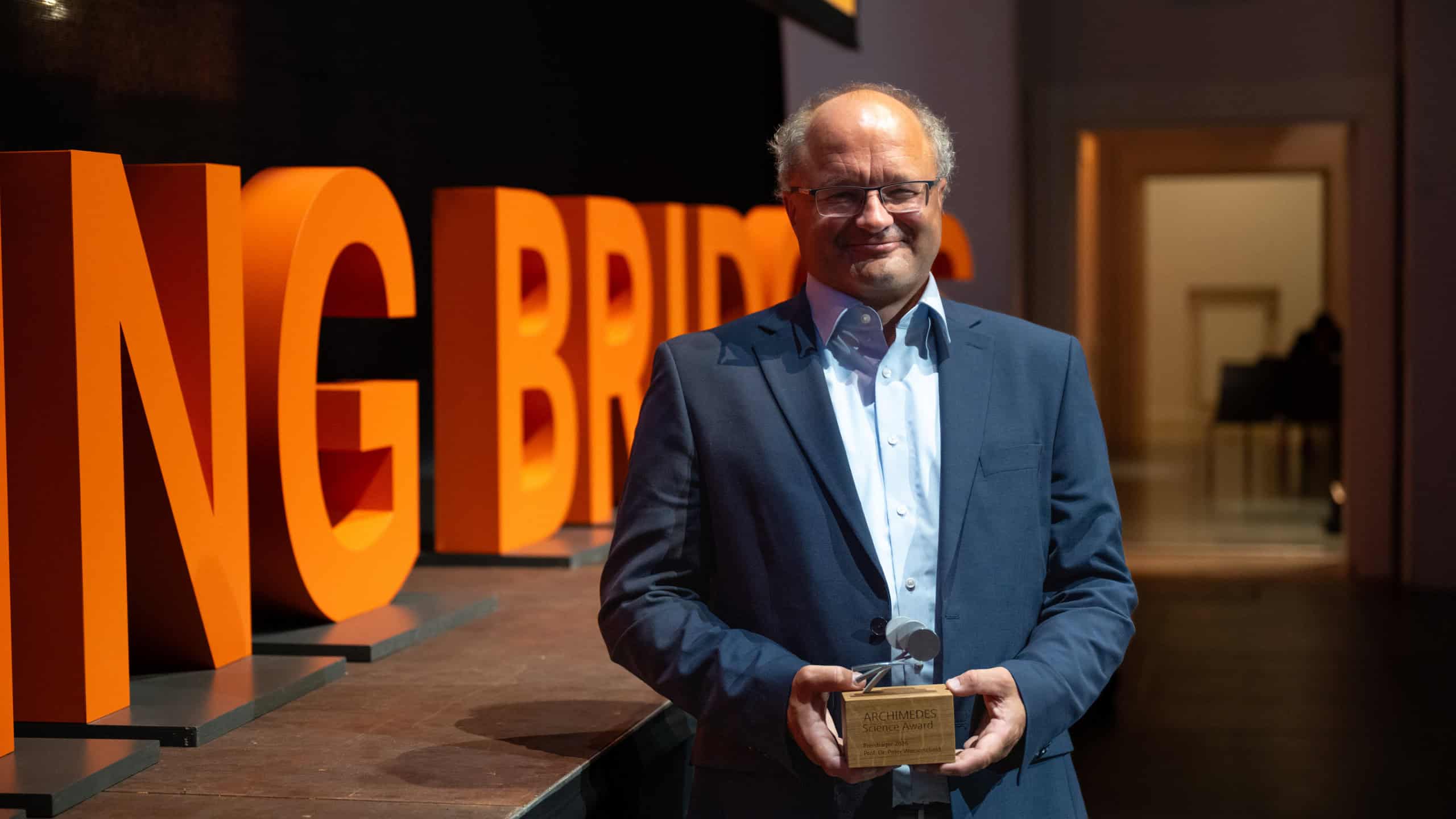
Peter Wasserscheid was honored with the 2026 Archimedes Science Award for his research on hydrogen technologies. © Robert Lohse
In the future, hydrogen is expected to provide energy in places where electricity alone is not enough. However, this requires that it can be safely stored, transported, and used affordably. Chemical engineer Prof. Peter Wasserscheid has been working on solutions to these challenges for many years. He has now been honored with the Archimedes Science Award 2026 in Dresden. The prize, worth 50,000 euros, is awarded by the Free State of Saxony and DRESDEN-concept under the auspices of TU Dresden. In this interview, the expert explains why we need hydrogen.
Professor Wasserscheid, you hold a chair at Friedrich-Alexander University Erlangen-Nuremberg and also work at the Jülich Research Center. Where will the award from Saxony find its place?
I think in Erlangen. Not because I’m there more often, but because I have a slightly larger office there.
When did hydrogen become a research topic for you where you felt: “I can make a difference here”?
I actually started out working on something completely different – liquid salts. These turned out to be very promising for various hydrogen technologies. Through this work, I sort of drifted into the topic of hydrogen. And it fascinated me. Then the reactor disaster in Fukushima occurred, and that made the search for a new type of energy supply more urgent. It was clear to me that a lot was going to change in energy technology. I found it exciting to be part of that change. Together with many colleagues, we eventually developed the ideas for liquid hydrogen storage.
We have electricity from the sun and wind, as well as from fossil fuels like coal or gas. Why do we need hydrogen on top of that?
You can’t solve every energy problem with electricity. The best example is humans themselves. We don’t plug ourselves in at night to recharge; instead, we have to eat. So we obtain our energy from food. Technologically speaking, there are also applications that are difficult to power with electricity alone. These include, for example, large, heavy vehicles or the transport and long-term storage of energy. And there are processes that require hydrogen as a chemical element, such as in the production of iron and steel.
However, hydrogen is a gas. How can it be stored in a way that allows us to transport it as easily as we do gasoline or diesel today?
That is precisely the challenge. Hydrogen is the lightest element in the periodic table and, relative to its mass, very energy-dense. As a gas at normal pressure, however, it has a low energy density. It only becomes liquid at minus 253 degrees Celsius. We are therefore pursuing the idea of chemically binding the hydrogen to a liquid. With the help of a catalyst, it reacts with a low-energy liquid. This produces a high-energy liquid that can be stored, transported, and distributed. The reaction is reversible. The hydrogen can be released again at a different location and at a different time.
What is the advantage of this?
The major advantage is that we can use existing infrastructure for this. There are tankers, storage facilities, and tanks for liquid fuels all over the world. If we want to quickly solve a global problem without having to build new infrastructure everywhere, we’ll need to be able to fill these tanks in the future with something that’s no longer fossil energy, but rather stored green energy. That would be hydrogen.
In Jülich, you’re also exploring the role hydrogen can play in the structural transformation of former lignite-mining regions. What appeals to you about this?
The goal is to replace lignite with more climate-friendly energy while simultaneously creating new jobs. We often face the challenge of driving change: When everything seems to be going well, there’s little reason to replace something that appears to be working with something better. Scientists have many new ideas, but people rightly ask why they should take the risk of trying something new. In a lignite-mining region, it’s clear that something has to change. Power plants are being shut down, and companies will have to source their energy differently in the future. This offers an opportunity to test new solutions and demonstrate that they work. If successful, they can later be implemented in other places around the world.
Critics of the energy transition fear that the changes will be expensive and that people will end up footing the bill. What do you say to them?
As a scientist, you have to take this criticism very seriously. The transformation can only take place if people want it. Ultimately, it’s our job to convince them and show that this kind of change will ultimately be better for their wallets, too. That’s why I’m a big advocate of not imposing everything through political mandates or subsidies. We scientists shouldn’t be satisfied until we have a solution that’s truly convincing – one that’s objectively better than what we have now, even without special conditions. That might take longer. But in the end, such a solution has the power to gain global acceptance.
How long will it take for hydrogen technologies to become widespread?
I always say we’re good enough to get started. It may still take another ten to 15 years before such technologies are routinely used in day-to-day operations wherever they make sense. These are the kinds of timeframes one must expect with such transformation processes. But back then, it also took several decades to build up the electricity and gas grids in Germany. Compared to those timeframes, ten or 15 years are relatively short.