
How pedestrians respond to a driverless shuttle
When walking along the side of the road, we rely on making eye contact with drivers. But what happens with autonomous driving? Chemnitz University of Technology and the Technical University of Berlin have tested this.
Read Aloud
0:00
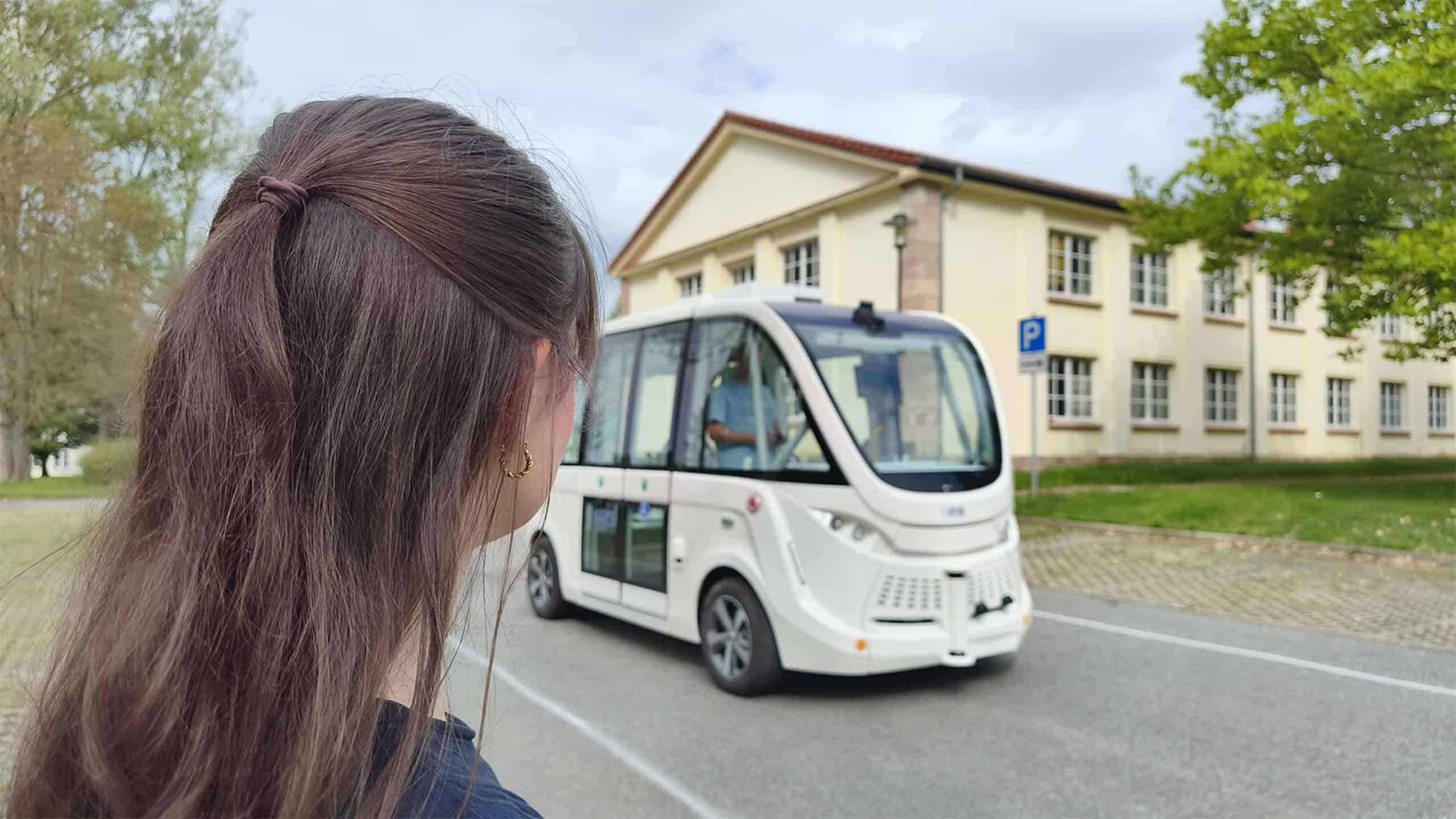
How do pedestrians react to a driverless vehicle? Researchers from Chemnitz and Berlin tested encounters with an automated shuttle. © Dr. Josephine Halama
A vehicle rolls up. You stand at the side of the road, trying to catch the eye of the person behind the wheel. They give a brief nod. So you set off. But what if there’s no one behind the wheel at all? What if eye contact isn’t possible, and no one nods at you? Self-driving vehicles are expected to travel through our cities in the future. This summer, researchers from Chemnitz University of Technology and the Technical University of Berlin tested how such encounters work.
In July and August 2026, an automated shuttle drove across the Chemnitz University of Technology campus on Erfenschlager Straße for this purpose. The study involved the Department of Psychology led by Prof. Stefan Brandenburg and the Department of Ergonomics led by Prof. Angelika Bullinger-Hoffmann. Both are part of the Chemnitz Center for Mobility. The partner institution was the Department of Automotive Engineering at TU Berlin, led by Prof. Steffen Müller.
Who was driving played no role in the evaluation
In the first study, the researchers tested three scenarios. Sometimes the shuttle drove on its own; other times, it was controlled by a person on board. In the third scenario, a person steered the vehicle remotely, similar to a remote control. Experts refer to this as teleoperation. The shuttle also approached the test subjects at varying speeds. Afterward, they evaluated the encounter.
Overall, the test subjects perceived the encounters as safe, relaxed, and self-determined. They also rated the process as efficient. When the shuttle traveled faster, they felt slightly less safe and relaxed. At the same time, they rated the encounter as more efficient. Whether the shuttle was driven autonomously, by a person on board, or remotely made no difference to their perception.
It all comes down to braking
The second study focused on an everyday question. How should a self-driving vehicle brake when yielding to a pedestrian? The researchers varied the type of braking and the distance over which the shuttle came to a stop.
Both factors made a difference. How the shuttle braked and where it came to a stop influenced the test subjects’ perceptions. The researchers have not yet disclosed which braking method and stopping distance were best received. The results are still preliminary. The data is currently being further analyzed and will subsequently be published in a scientific journal.