Taking AI to new depths: How Saxony is exploring AI’s opportunities and limits
AI is advancing at a rapid pace. At the same time, the debate over how safe and reliable these systems are is intensifying. Researchers in Saxony are searching for answers.
Read Aloud
0:00
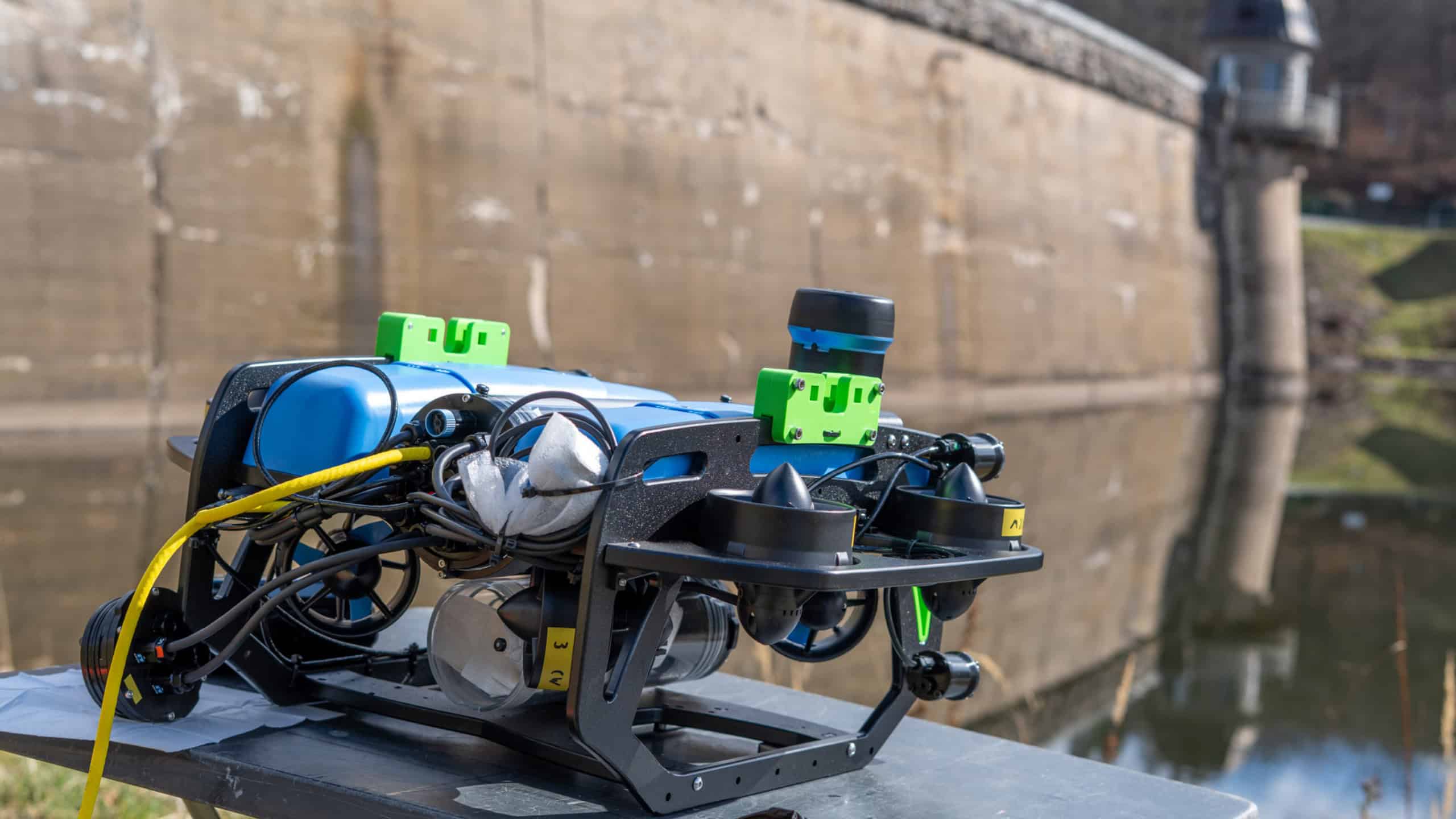
In the future, a diving robot will help inspect dams underwater for damage. Researchers at the TU Bergakademie Freiberg are combining robotics with artificial intelligence to achieve this. © Andreas Hiekel/SDC TUBAF
The task is enormous. Thousands of square meters of concrete lie underwater. Dams secure the water reserves needed for the drinking water supply. They help during floods and in times of drought. Their condition must therefore be checked regularly. To do this, specially trained experts dive down and inspect the walls for cracks and other damage. This is time-consuming. “The work is strenuous and cannot be carried out indefinitely,” explains Thomas Grab from the Scientific Diving Center at the TU Bergakademie Freiberg (TUBAF). But simply draining a dam for an inspection doesn’t work.
That’s why researchers led by Grab at TUBAF are developing a new approach. In the future, diving robots are set to take over parts of the work. In the SUBMARINE project, the robot travels along the dam and captures images of its surface. Even during the dive, a specially trained AI analyzes the images and searches for cracks and damage. The images are later used to create a 3D model in which the identified problem areas are marked.
At this point we can't show you anything yet
In order to interact with or display content from third-party providers such as Facebook, YouTube and others, we still need your consent.
This is not intended to replace human inspections of dams or bridge piers. But the model shows where divers need to look more closely. Instead of searching the entire wall, they focus on suspicious areas. This saves time and money. And it could have an even greater impact in the future. “In the time it currently takes to inspect one structure, we could inspect three to four in the future,” says Richard Gruhn, a research associate on the project.
Rapid development
Even AI won’t detect every instance of damage. “We’ll never reach a point where we cover every possibility and identify every problem,” says Thomas Grab. That’s just as impossible today as it will be later with AI. But the technology offers a tool that can improve inspections and make them more efficient.
Grab, however, is also concerned about something else. At the university, he’s witnessing just how quickly AI is now finding its way into every aspect of life. It’s fundamentally changing research and people’s everyday lives. “It’s happening so fast that it’s hard to keep up,” he says. At the same time, he observes how naturally people rely on the technology. “This blind trust – that is a danger.”
He is not alone in his concern. There is currently a lot of debate about whether the development of powerful AI systems is progressing too quickly. Dario Amodei, CEO of the U.S. company Anthropic – which is developing Claude, one of the best-known AI language models – called in mid-September for a slowdown in the development of particularly powerful models. His goal is to buy more time for safety measures and independent oversight.
His call is controversial. While some in the AI industry support greater caution, critics warn against slowing down development.
Today’s challenges
Michael Färber has been closely following the latest news from the AI industry. It did not come as a surprise to him. The professor at TU Dresden conducts research at ScaDS.AI, a research center for artificial intelligence in Dresden and Leipzig. Among other things, he works on making AI systems more reliable. When reports surface about systems that threaten humanity, he draws attention to more immediate problems. “We should focus on the current challenges,” says Färber.
These include the well-known weaknesses of language models. They can give incorrect answers, invent sources, and still sound convincing. They find it particularly difficult to recognize something that is self-evident to humans – knowing when they don’t know something. “That’s surprisingly hard to integrate into the model,” explains the scientist.
That is exactly what he is working on. Färber is investigating how statements from a language model can be linked to verifiable sources. Ideally, information should be linked to the documents from which it originates as early as the training phase. This reference should also remain intact when the finished model later generates responses. How this can be achieved reliably is the focus of his research.
However, problems don’t just arise when an AI gives incorrect answers. AI agents are increasingly taking on tasks themselves. For example, they access programs and documents within companies. In such cases, an error can have serious consequences. Färber cites the example of an agent that deletes or misfiles documents.
That’s why, for him, security starts with simple questions. What rights does an AI system have? What data is it allowed to access? What is it permitted to change on its own? Added to this are protective systems that check the intent behind a request and whether it may be answered. Such risks are already a reality today. “You don’t need sophisticated AI for that right now.”
When the real is under suspicion
As AI advances, deepfakes are becoming increasingly difficult to detect. Artificially generated images and videos are now so good that the problem is no longer just the forgery itself. Even real recordings are coming under suspicion.
Alexander Godulla is tracking this development. When he began his research on deepfakes in the early 2020s, many fakes were still easy to expose. The professor of empirical communication and media research at the University of Leipzig recalls early applications in which people, for example, swapped their faces with those of their dogs. “It just looked terrible,” he says. Then things moved quickly. With images from 2022 and 2023, the leap in quality was so great that it seemed more like a decade’s worth of progress.
Two surveys conducted by Godulla and his colleague Christian P. Hoffmann, a professor of communication management at the University of Leipzig, show just how quickly the technology is becoming part of everyday life. In 2022, a good three-quarters of respondents stated that they had never consciously encountered a deepfake. By 2025, that figure had dropped to only about 27 percent. After data cleaning, 1,297 internet users in Germany participated in the most recent survey. The sample was representative of the general population in terms of age, gender, and federal state. Only about a quarter of respondents believe they can recognize a deepfake with the naked eye.
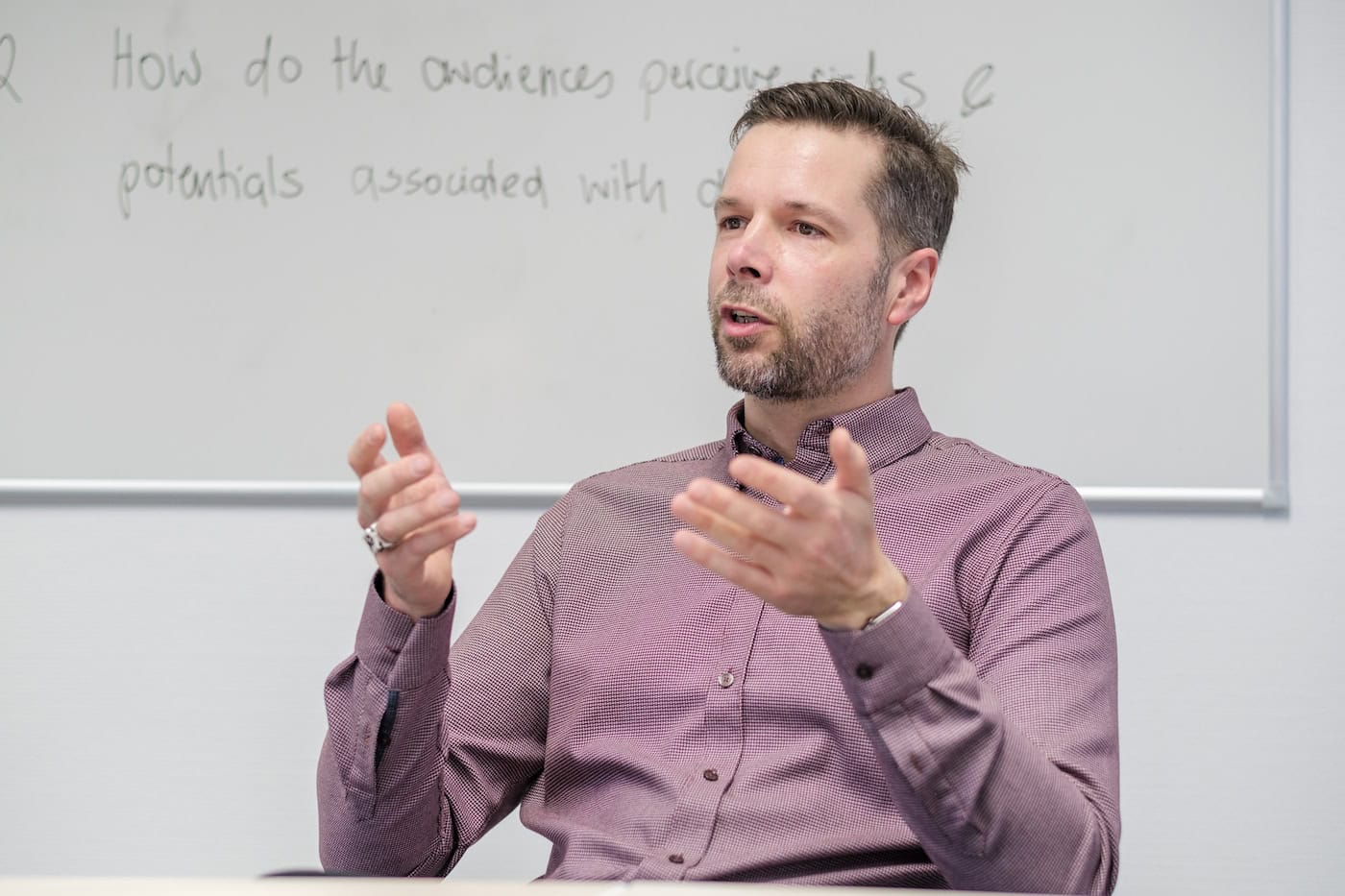
Godulla is also feeling the effects of people’s skepticism. Some time ago, a genuine interview with him appeared on YouTube. Someone commented below it, saying it could, after all, be a deepfake. “Societal doubt is deepening,” he says. His research shows that the more people know about deepfakes, the more their trust in the media can diminish. “At some point, you just start suspecting deepfakes everywhere, even when there aren’t any.”
Eventually, the human eye is no longer reliable. A well-made deepfake is indistinguishable from the original, says Godulla. That’s when the origin of a recording becomes crucial. For professional images, technical certificates can, for example, verify which camera was used to capture them. And when it comes to news, it becomes increasingly important that an image is backed by an editorial team that has verified its origin.
But even the best verification is of little use if people primarily believe and share what fits their own worldview. The researcher therefore advises greater caution. “We all need to be a little more humble in our judgments, recognize our limitations, and remind ourselves: Just because we want to believe something doesn’t make it true.”