

KI
Revised using AI
Medicine & Health
Atrial fibrillation: Treatment works – but differently than expected
A surgical procedure is intended to stop the cardiac arrhythmia and thereby improve the lives of those affected. A study led by researchers in Leipzig shows that the relationship isn’t quite that simple.
Read Aloud
0:00
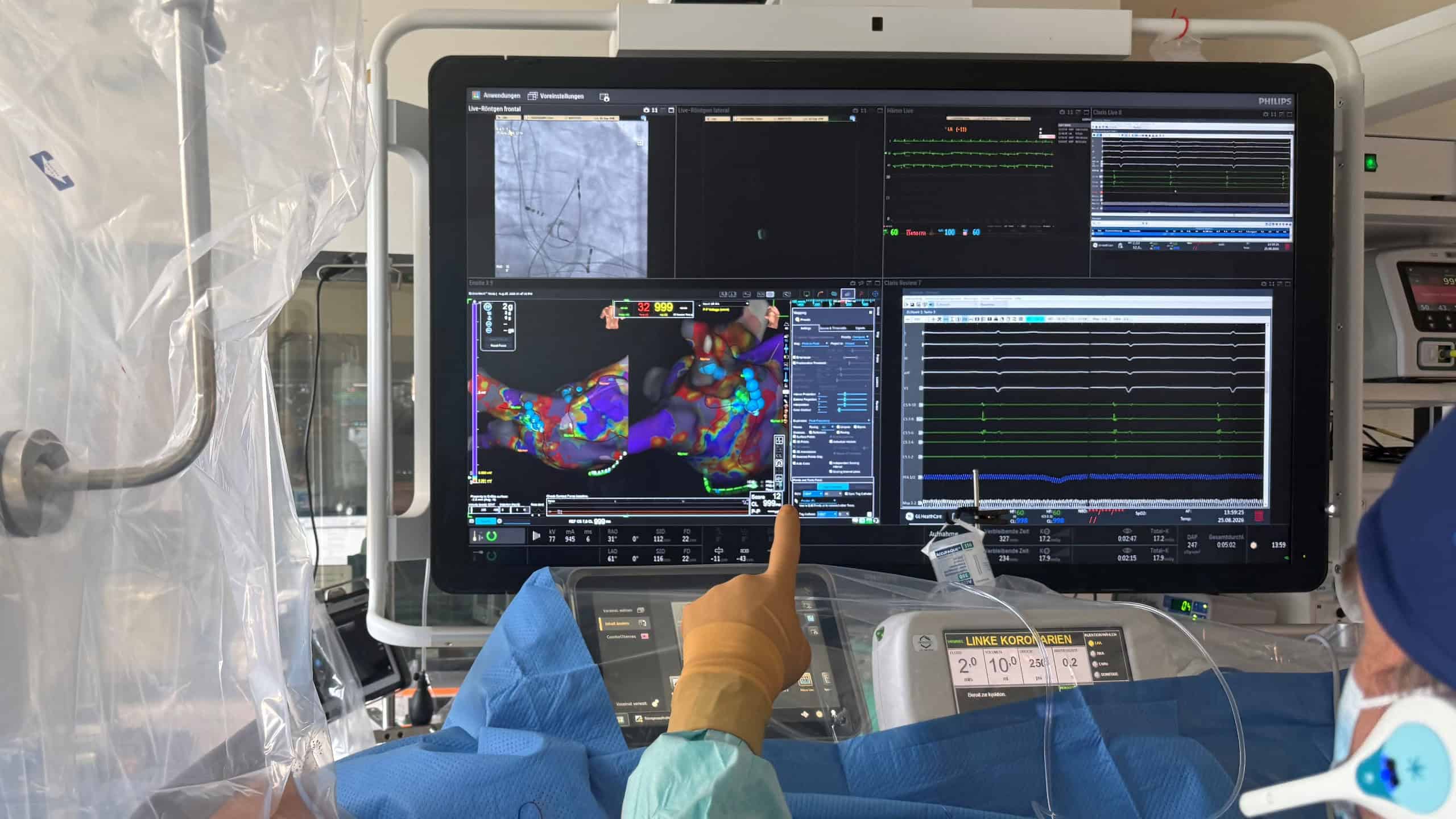
During catheter ablation, small areas of heart tissue are ablated to interrupt the abnormal electrical signals that trigger arrhythmias. © Rolf Wachter/University of Leipzig
Atrial fibrillation is the most common heart rhythm disorder worldwide. Symptoms include an irregular and often rapid heartbeat, skipped heartbeats, and shortness of breath during physical activity. The condition increases the risk of stroke and death. Doctors often treat atrial fibrillation with catheter ablation. During this procedure, they guide a catheter through a vein in the groin to the left atrium. There, they ablate small areas of heart tissue to interrupt the abnormal electrical signals that trigger the irregular heartbeat.
Worldwide, doctors perform more than 500,000 such procedures each year. A research team from Leipzig University Medical Center, the German Heart Center at Charité (DHZC) in Berlin, and the Leipzig Heart Center investigated the extent to which catheter ablation improves patients’ quality of life. The result is surprising.
Actual treatment vs. sham procedure
The team conducted a study involving 262 patients at nine hospitals in Germany and Poland. The researchers randomly assigned the patients to two groups. One group received actual catheter ablation, while the other underwent only vascular access without the actual procedure. Neither the patients nor the medical team knew who was receiving which treatment. Before the procedure and again after six months, all patients completed a quality-of-life questionnaire.
After six months, it became apparent that quality of life had not improved any more significantly after actual ablation than after a sham procedure. Approximately 80 percent of patients in both groups reported an improvement in their quality of life. “Our data show that the majority of the improvement reported by patients is apparently not due to the catheter ablation itself, but rather to a placebo effect or concomitant adjustments to medication,” says study leader Prof. Dr. Rolf Wachter of the University of Leipzig.
Ablation prevents atrial fibrillation more often
Catheter ablation nevertheless had a clear effect. After six months, 73 percent of the treated patients were free of atrial fibrillation. In the group that underwent the sham procedure, the figure was 52 percent. However, this difference was not evident in terms of quality of life. “The results do not alter the fundamental effectiveness of catheter ablation in preventing the recurrence of atrial fibrillation,” says Patrick Haag, medical coordinator of the study at the Leipzig Heart Center.
The treatment thus helps prevent atrial fibrillation. The researchers now want to investigate more closely why quality of life does not improve more significantly after the procedure. They are also interested in whether certain patient groups benefit more than others. The 12-month follow-up is still ongoing.
Original publication:
Wachter R, Haag P, Uhe T et al. Catheter ablation for symptomatic atrial fibrillation (PVI-SHAM-AF): a randomized, double-blind, sham-controlled, multicenter trial,
The Lancet, 2026.